Astronomers detect cosmic flash from early universe star blast / Photo: © ESA/ATG Europe/AFP/File

 Inside the Venezuelan prison meant to 'drive you insane'

 UK king braces as memoir by Diana's brother goes on sale

 No green light to lift EU sanctions on Russian oligarchs, talks to resume

 UK agrees support for Saudi in struggle with Houthis: reports

 EU foreign policy chief calls for continued sanctions on Russia

 Flights scrapped, evacuations urged as Typhoon Dujuan wallops Japan

 Fonseca to take break from tennis

 A Cuban zoo, and its animals, in epic battle for survival

 Infantino proposes consulting federations to reform FIFA

 El Nino weather pattern enters record territory: scientist

 OpenAI calls for US to lead global effort on AI standards

 South African ostriches plucked alive for luxury fashion: report

 US networks halt Trump coverage in revolt over White House ban

 Paramount settles with US states to clear Warner Bros. mega-merger

 Climate crisis a job for world leaders, not just activists: UK FM

 US networks halt Trump coverage over White House ban

 French singer accuses Miley Cyrus of plagiarism

 EU fines Google 403 mn euros for location data breach

 'Best is yet to come,' says De la Fuente after Spain extension

 Why diesel prices are rising more than crude oil

 COP31 host says AI's climate footprint to be a summit priority

 Renewables hit record in 2025, but world must move faster: report

 US media outlets to sue Trump administration after White House ban

 Global stocks rally on lower oil prices, US-China hopes

 EU proposes energy rating for data centres

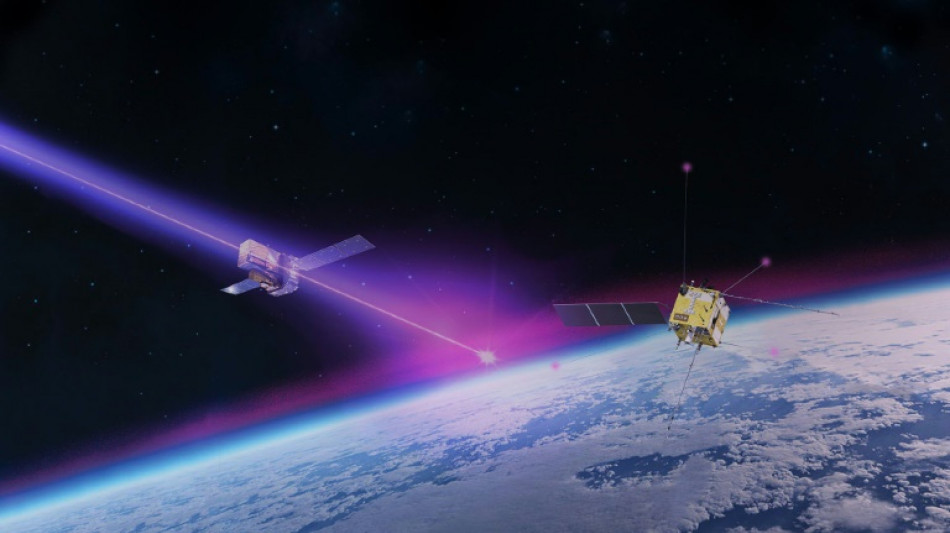
An immensely powerful flash detected earlier this year was created by a massive star exploding when the universe was just five percent of its current age, astronomers said Tuesday.
The flash was spotted on March 14 by a French-Chinese space telescope called SVOM, which launched last year on a mission to track gamma-ray bursts, the brightest and most powerful explosions in the cosmos.
When the young scientists working on the mission for France's Atomic Energy Commission (CEA) received a mobile phone alert that a major burst had arrived at Earth, they urged other telescopes to turn towards the source.
It came from a star around a hundred times bigger than our Sun that exploded 700 million years after the Big Bang, according to two studies published in the Astronomy & Astrophysics journal.
"This is extremely rare -- it's the fifth most distant gamma-ray burst ever detected," said Bertrand Cordier, the CEA's scientific lead for SVOM and a co-author of both studies.
"The photons that reached our instruments travelled for 13 billion years" to reach Earth, he told AFP.
The detection of the burst, which lasted tens of seconds, is also "the most precise in terms of the light we collected and the measurements we made," he added.
- Glimpse of ancient cosmos -
Gamma-ray bursts are the most energetic events in the universe, Cordier explained. They are thought to be caused by cataclysmic cosmic events such as massive stars going supernova or when binary neutron stars merge.
These flashes can release as much energy in a few seconds as our Sun will emit during its 10-billion-year life.
They shoot out matter at "speeds close to the speed of light", creating conditions impossible to reproduce on Earth, Cordier said.
These bright flashes also act as "probes" of the cosmos, illuminating all the matter they pass through before finally reaching us, he added.
This allows scientists a rare glimpse into the distant past of the universe, which is 13.8 billion years old.
The gamma-ray burst in March, called GRB250314A, was created by an explosion during the first generation of stars formed after the Big Bang.
These stars produced the first heavy elements -- such as iron, carbon and oxygen -- which played a fundamental role in the evolution of the universe.
Cordier hopes SVOM will be able to detect one or two similar events every year.
"The challenge is to get everything together in the chain" of observations which involves other telescopes, he said.
For example, after the burst was first detected in March, it took 17 hours before the Very Large Telescope in Chile turned its powerful lens towards the flash.
"During that time, the intensity had decreased," Cordier said.
"If we get there earlier, then we'll have better data."
H.Seidel--BTB