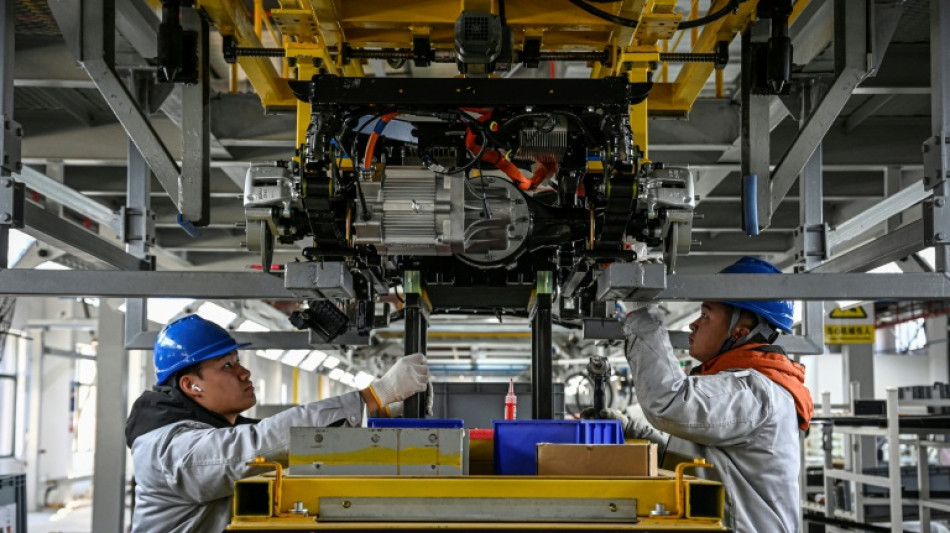
China's smaller manufacturers look to catch the automation wave / Photo: © AFP

 Inside the Venezuelan prison meant to 'drive you insane'
 UK king braces as memoir by Diana's brother goes on sale

 No green light to lift EU sanctions on Russian oligarchs, talks to resume

 UK agrees support for Saudi in struggle with Houthis: reports

 EU foreign policy chief calls for continued sanctions on Russia

 Flights scrapped, evacuations urged as Typhoon Dujuan wallops Japan

 Fonseca to take break from tennis

 A Cuban zoo, and its animals, in epic battle for survival

 Infantino proposes consulting federations to reform FIFA

 El Nino weather pattern enters record territory: scientist

 OpenAI calls for US to lead global effort on AI standards

 South African ostriches plucked alive for luxury fashion: report

 US networks halt Trump coverage in revolt over White House ban

 Paramount settles with US states to clear Warner Bros. mega-merger
 Climate crisis a job for world leaders, not just activists: UK FM

 US networks halt Trump coverage over White House ban

 French singer accuses Miley Cyrus of plagiarism

 EU fines Google 403 mn euros for location data breach

 'Best is yet to come,' says De la Fuente after Spain extension

 Why diesel prices are rising more than crude oil

 COP31 host says AI's climate footprint to be a summit priority
 Renewables hit record in 2025, but world must move faster: report

 US media outlets to sue Trump administration after White House ban

 Global stocks rally on lower oil prices, US-China hopes

 EU proposes energy rating for data centres

In a light-filled workshop in eastern China, a robotic arm moved a partially assembled autonomous vehicle as workers calibrated its cameras, typical of the incremental automation being adopted even across smaller factories in the world's manufacturing powerhouse.
China is already the world's largest market for industrial robots, and the government is pouring billions of dollars into robotics and artificial intelligence to boost its presence in the sector.
The first essentially humanlessfactoriesare already in operation, even as widespread automation raises questions about job losses as well as the cost and difficulty of transition for smaller and medium-sized companies.
The answer for many is a hybrid approach, experts and factory owners told AFP.
At the autonomous vehicle workshop, manager Liu Jingyao told AFP that humans are still a crucial part of even technologically advanced manufacturing.
"Many decisions require human judgement," said Liu, whose company Neolix produces small van-like vehicles that transport parcels across Chinese cities.
"These decisions involve certain skill-based elements that still need to be handled by people."
At the Neolix factory, 300 kilometres (186 miles) north of Shanghai, newly built driverless vehicles zoomed around a testing track simulating obstacles including puddles and bridges.
In a closed-off room, workers assembled vehicles' "brains", testing their cameras and computer chips.
"Automation... primarily serve(s) to assist humans, reducing labour intensity rather than replacing them," Liu said.
But Ni Jun, a mechanical engineering expert at Shanghai's Jiaotong University, said China's strategy of focusing on industrial applications for AI means full automation is already feasible in many sectors.
Among others, tech giant Xiaomi operates a "dark factory" -- where the absence of people means no need for lights -- with robotic arms and sensors able to make smartphones without humans.
- Digital divide -
Ni described a "digital divide" between larger companies with the funds to invest heavily in modernisation, and smaller businesses struggling to keep up.
For Zhu Yefeng's Far East Precision Printing Company, part of China's vast network of small independent factories employing up to a few dozen people each, full automation is a distant dream.
At the company just outside Shanghai, workers in small rooms fed sheets of instruction manuals into folding machines and operated equipment that printed labels for electronic devices.
The company used pen and paper to track its workflow until two years ago, with managers having to run around the factory to communicate order information.
"Things were, to put it bluntly, a complete mess," Zhu told AFP.
The company has since adopted software that allows employees to scan QR codes that send updates to a factory-wide tracker.
On a screen in his office, Zhu can see detailed charts breaking down each order's completion level and individual employees' productivity statistics.
"This is a start," Zhu told AFP. "We will move toward more advanced technology like automation, in order to receive even bigger orders from clients."
Financial constraints are a major barrier though.
"As a small company, we can't afford certain expenses," said Zhu.
His team is trying to develop its own robotic quality testing machine, but for now humans continue to check final products.
- Employment pressures -
The potential unemployment caused by widespread automation will be a challenge, said Jacob Gunter from the Berlin-based Mercator Institute for China Studies.
"Companies will be quite happy to decrease their headcount... but the government will not like that and will be under a lot of pressure to navigate this," Gunter told AFP.
Beijing's push to develop industrial robots will "intersect with the need for maintaining high employment at a time when employment pressure is considerable", he added.
Going forward, manufacturers must strike a balance "between the technical feasibility, social responsibility, and business necessity", Jiaotong University's Ni told AFP.
Zhou Yuxiang, the CEO of Black Lake Technologies -- the start-up that provided the software for Zhu's factory -- told AFP he thought factories would "always be hybrid".
"If you ask every owner of a factory, is a dark factory the goal? No, that's just a superficial description," Zhou said.
"The goal for factories is to optimise production, deliver things that their end customers want, and also make money."
E.Schubert--BTB