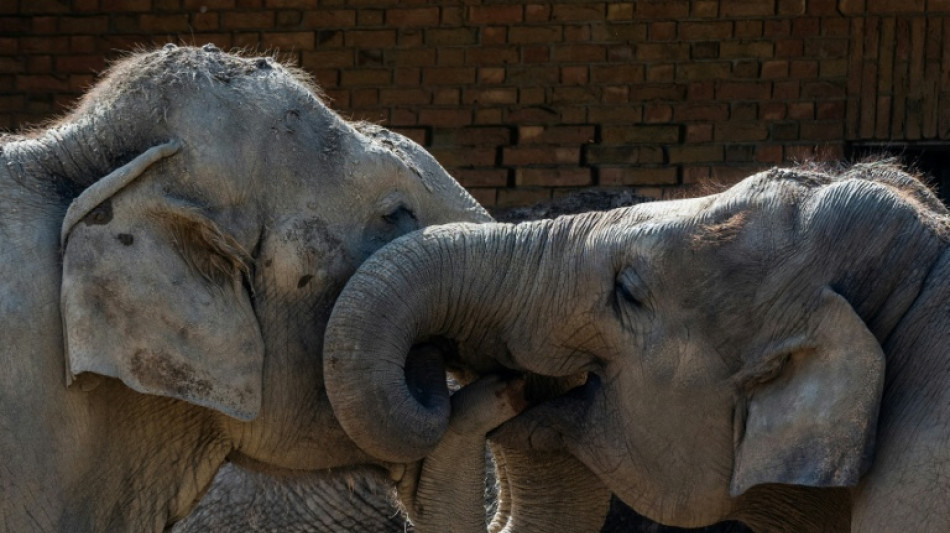
The secret to an elephant's grace? Whiskers / Photo: © AFP

 Liverpool boss Iraola urges Isak to raise his level

 Evenepoel wins record 4th straight world time-trial title

 France's Macron, Canada's Carney announce closer ties

 Carrick defends troubled Man Utd after Fulham escape

 Horror movie 'Resident Evil' tops N. American box office

 Germany's Merz vows to stay course despite new vote losses

 Man City outgun Sunderland despite Brobbey hat-trick, Man Utd rescue Fulham draw

 Mourinho blames ref committee for Real Madrid derby defeat

 Maresca craves a 1-0 win after eight-goal Man City thriller

 Atletico Madrid beat Real Madrid in tense derby clash

 Reusser retains world time-trial title

 Man City outgun Sunderland despite Brobbey hat-trick, Liverpool win at Bournemouth

 Top US, Chinese economic officials meet ahead of Trump-Xi summit

 Erdogan's LGBTQ crackdown 'first step of election campaign': activist

 Mass drone barrage on Moscow kills two

 82-year-old dies after beach fight in Greece over sun lounger

 US warns of rapid escalation in Mideast war

 Iran 'put hearts on the court' to win Asian Games basketball bronze

 School girl Yu helps China dominate in Asian Games swimming openers

 Myanmar win first Asian Games teqball gold as Spain great Puyol watches

 China's 13-year-old Yu scorches to first major gold at Asian Games

 Russians vote on last day of parliamentary elections

 Hong Kong pays final respects to former city leader Tung

 Typhoon put people off Asian Games opening ceremony, official says

 China's 13-year-old Yu cruises as Asian Games swimming begins

An elephant's trunk can surpass a human's height and lift trees -- a marvel of strength that's conversely so gentle it can grasp a tortilla chip without breaking it.
So how do the thick-skinned animals with poor eyesight pull off such delicate tasks? In a word, whiskers.
New research published Thursday in the journal Science details how the whiskers that cover an elephant's trunk have unique properties that lend the largest land mammals remarkable dexterity.
Elephants are born with about 1,000 of these bristles, lead author Andrew Schulz told AFP, many of them anchored in the trunk's wrinkles to act like feelers and help the animals assess their surroundings.
A team of engineers, materials scientists and neuroscientists analyzed the geometry, porosity and material properties of these whiskers, and expected them to mimic the whiskers found on mice or rats -- circular at a cross-section, solid and uniformly stiff.
In fact, elephant whiskers are almost blade-like, with a porous architecture similar to sheep horns, which helps with shock absorption while eating.
And a gradiated shape and structure from base to tip allows for an amplified sense of touch, Schulz said.
"The craziest finding that we had, I think, was that these whiskers have this transition from a really, really rigid base to a very, very soft tip," said the researcher at the Max Planck Institute for Intelligent Systems in Stuttgart, Germany.
Part of elephants' whisker evolution is to prevent breakage, said Schulz. Unlike most mammals with whiskers, those of elephants don't grow back.
- Elephant-inspired advances -
Many animals have sensory hairs that can act as a radar, but few quite so precise as the elephant's.
Schulz said a rat's whiskers, for example, also picks up vibrations -- but it's akin to smashing down a handful of keys on a piano.
To an elephant's whiskers, it's more like hitting specific notes.
Researchers voiced excitement that cat whiskers have a similar kind of material intelligence and stiffness gradient.
The elephant's gradiated structure can help with things like object differentiation while foraging and eating -- which they spend the vast majority of their time doing.
Elephants are also well-documented using their trunks for social touch -- "they're using the outside of their trunk," Schulz said, "so they're using those portions that are covered in the whiskers."
Caitlin O'Connell-Rodwell -- a behavioral ecologist and elephant expert who has focused on how the giant mammals communicate and detect signals through their feet -- called the findings "fascinating."
"This is really exciting for me to see just more affirmation of how sensitive their trunks really are," she told AFP.
"There's some really interesting, intriguing thoughts for the next steps, for what one could ask in terms of the behavioral application of this," O'Connell-Rodwell said.
"Not only would this allow them to say, reach up into a tree and feel around for fruit or a seed pod with better agility, but it also has implications for communication."
There's also a wealth of technological possibilities elephant whiskers could inspire, not least when it comes to robotics, Schulz said.
And "part of the novelty of this work is functional gradients exist everywhere in biology," the researcher said.
The stiff base-to-soft tip structure also appears in rotator cuffs or ACL ligaments, he said for example -- and better understanding those structures and how they might impact sensing could perhaps allow for improved repair techniques.
T.Bondarenko--BTB