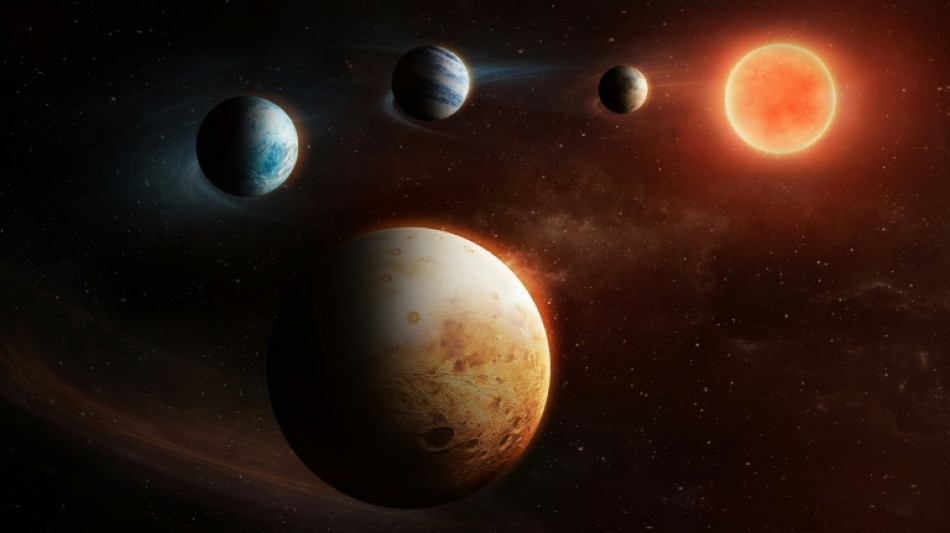
Strange 'inside-out' planetary system baffles astronomers / Photo: © ESA/AFP

 Liverpool boss Iraola urges Isak to raise his level

 Evenepoel wins record 4th straight world time-trial title

 France's Macron, Canada's Carney announce closer ties

 Carrick defends troubled Man Utd after Fulham escape

 Horror movie 'Resident Evil' tops N. American box office

 Germany's Merz vows to stay course despite new vote losses

 Man City outgun Sunderland despite Brobbey hat-trick, Man Utd rescue Fulham draw

 Mourinho blames ref committee for Real Madrid derby defeat

 Maresca craves a 1-0 win after eight-goal Man City thriller

 Atletico Madrid beat Real Madrid in tense derby clash

 Reusser retains world time-trial title

 Man City outgun Sunderland despite Brobbey hat-trick, Liverpool win at Bournemouth

 Top US, Chinese economic officials meet ahead of Trump-Xi summit

 Erdogan's LGBTQ crackdown 'first step of election campaign': activist
 Mass drone barrage on Moscow kills two

 82-year-old dies after beach fight in Greece over sun lounger

 US warns of rapid escalation in Mideast war

 Iran 'put hearts on the court' to win Asian Games basketball bronze

 School girl Yu helps China dominate in Asian Games swimming openers

 Myanmar win first Asian Games teqball gold as Spain great Puyol watches

 China's 13-year-old Yu scorches to first major gold at Asian Games

 Russians vote on last day of parliamentary elections

 Hong Kong pays final respects to former city leader Tung

 Typhoon put people off Asian Games opening ceremony, official says

 China's 13-year-old Yu cruises as Asian Games swimming begins

Surprised astronomers said Thursday they have discovered a star with planets in a bizarre order that defies scientific expectations -- and suggests these faraway worlds formed in a manner never seen before.
In our Solar System, the four planets closest to the Sun are small and rocky, while the four farther out are gas giants.
Scientists had thought this planetary order -- rocky first, then gaseous -- was consistent across the universe.
However, a star called LHS 1903 discovered in the Milky Way's thick disc suggests otherwise.
An international team of astronomers analysing data from several different telescopes had already spotted three planets orbiting the red dwarf star, which is cooler and less bright than our Sun.
The closest planet to the star was rocky, followed by two gas giants. That is the order scientists expect.
But digging into observations made by Europe's exoplanet-probing Cheops space telescope revealed a fourth planet farther out in the system -- and it is rocky.
"That makes this an inside-out system, with a planet order of rocky-gaseous-gaseous-and then rocky again," explained Thomas Wilson, the lead author of a new study describing the discovery in the journal Science.
"Rocky planets don't usually form so far away from their home star," the planetary astrophysicist from University of Warwick in the UK said in a statement.
- One planet after another -
Inner planets are expected to be small and rocky because intense radiation from the nearby star blasts most of the gas away from their rocky core.
But farther out in the cold reaches of the system, a thick atmosphere can form around cores, creating gas giants.
Puzzled by the weird LHS 1903 planetary system, the team of astronomers tried to figure out what could have happened.
After ruling out several possibilities, they came up with a scenario: what if the planets formed one at a time?
According to the most widely accepted theory, planets form simultaneously in a massive ring of gas and dust called a protoplanetary disc. This involves tiny dust grains clumping together then snowballing into cores that eventually evolve into mighty planets.
However, by the time the fourth planet orbiting LHS 1903 formed, "the system may have already run out of gas," Wilson said.
"Yet here is a small, rocky world, defying expectations," he added.
"It seems that we have found first evidence for a planet which formed in what we call a gas-depleted environment."
Since the 1990s, astronomers have discovered more than 6,000 planets outside our Solar System -- called exoplanets -- mostly by spotting slight changes in brightness as they cross in front of their star.
"Historically, our planet formation theories are based on what we see and know about our Solar System," said Isabel Rebollido, a planetary disc researcher at the European Space Agency.
"As we are seeing more and more different exoplanet systems, we are starting to revisit these theories."
D.Schneider--BTB