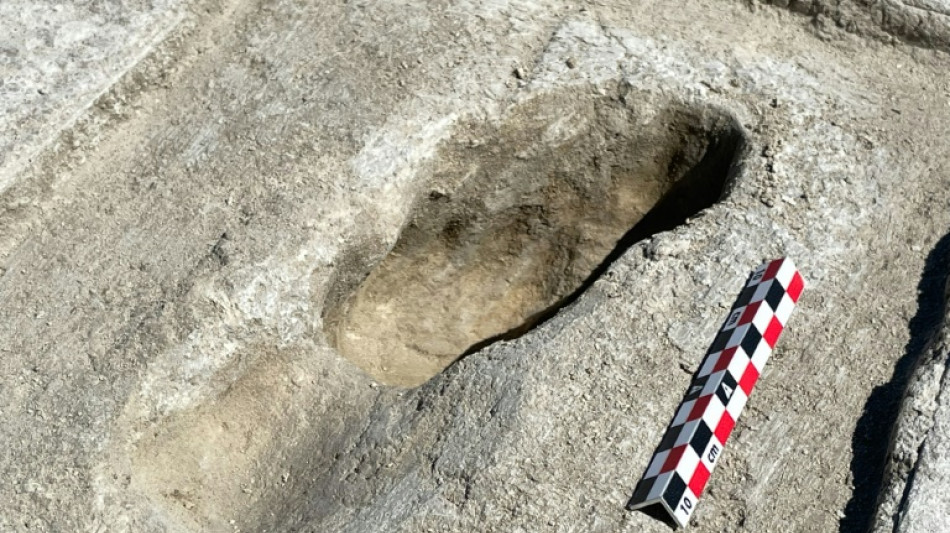
Ice-age footprints shed light on North America's early humans / Photo: © HANDOUT/AFP

 Multi-Asset Trading Venue Monochrome Exchange Announces IEO of Its Native Token, $MCR

 South Korea break Japan hearts to win Asian Games basketball gold

 Acosta takes first victory at Austrian MotoGP

 PSG president Nasser al-Khelaifi under investigation in France for conflict of interest

 China swim sensation, 13, sets Games record after Japan win early

 Drones hit Moscow as Russians go to the polls

 New England boss Fleming says 'wrong' to ask Stokes to end retirement

 Germans vote in elections threatening fresh blow to Merz

 US fears rapid escalation in Mideast after Houthis attack Riyadh

 Japan triathlete Hojo wins first gold of Asian Games

 IOC president impressed by 'beautiful' Asian Games wooden huts

 First Asian Games gold goes to Japan as China's 13-year-old Yu lights up pool

 Data centre command hub keeps AI up and running
 Pope Leo in France: the issues on the table

 Packing for a pope: behind the scenes on foreign trips

 Republicans find transgender issues a powerful political weapon in midterm campaigning

 German state elections threaten new shock waves for Merz

 Chile's Bachelet quits race to be next UN chief

 Raphinha treble fires perfect Barca to win at Sevilla

 Thiam makes winning heptathlon return at Decastar meet

 Czechs beat USA to qualify for Davis Cup finals

 Dortmund sink Stuttgart to climb to Bundesliga summit

 Trump says will not tolerate attempts to slow AI growth

 'It has to stop': runners protest women's murders in S.Africa district

 Fire erupts near Riyadh airport as Houthis claim strikes

Footprints laid down by Ice-Age hunter-gatherers and recently discovered in a US desert are shedding new light on North America's earliest human inhabitants.
Dozens of fossilized prints found in dried-up riverbeds in the western state of Utah reveal more details about how the continent's original occupants lived more than 12,000 years ago -- just as the frozen planet was starting to thaw.
The fossils could have remained unnoticed if not for a chance glance out of a moving car as researchers Daron Duke and Thomas Urban drove through Hill Air Force Base chatting about footprints.
"We were talking about 'what would they look like?'," Duke told AFP. "And he said: Kind of like that out the window.'"
What the two men had found turned out to be 88 distinct prints left by a mixture of adults and children.
"They vary between just looking like discolored patches on the ground and... little pop ups, little pieces of dirt around them or on them. But they look like footprints," Duke said.
What came next was a painstaking few days of very careful digging -- sometimes lying on his belly -- to ensure that what they were looking at was as old as it appeared.
"What I found was bare feet of people... that had stepped in what looks to be shallow water where there was a mud sub layer," Duke explained.
"The minute they pulled their foot out, the sand infilled that and has preserved it perfectly."
Duke, of the Nevada-based Far Western Anthropological Research Group, had been in the area looking for evidence of prehistoric campfires built by the Shoshone, a people whose descendents still live in the western United States.
He had brought Urban over from Cornell University because of his expertise in uncovering evidence of ancient humans -- including the discovery of human tracks in New Mexico's White Sands National Park that are thought to be up to 23,000 years old.
- 'Awestruck' -
The new fossils add to a wealth of other finds from the area, including stone tools, evidence of tobacco use, bird bones and campfire remains, that are starting to provide a more complete record of the Shoshone and their continuous presence in the region beginning 13,000 years ago.
"These are the resident indigenous people of North America, this is where they lived, and this is where they still live today," Urban said.
For him personally, finding the footprints has been a professional high point.
"Once I... realized I was digging a human footprint, I was seeing toes, I was seeing the thing in immaculate condition... I was just kind of awestruck by it," he said.
"Nothing beats the sense of discovery and awe that maybe as an archaeologist, you are actually chasing your whole career."
And sharing the discovery with the distant descendents of the people who made the prints was immensely rewarding, Urban said.
"You realize the same thing is happening -- what the connection is to such a distant past and to something so human, I think it gets to everybody in one way or another eventually."
E.Schubert--BTB