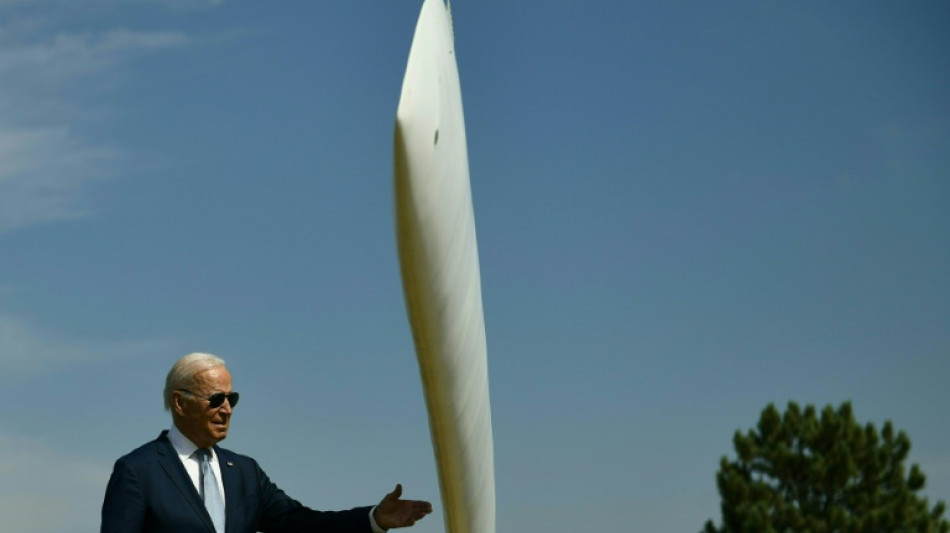
What's in Biden's big climate and health bill? / Photo: © AFP/File

 Multi-Asset Trading Venue Monochrome Exchange Announces IEO of Its Native Token, $MCR

 South Korea break Japan hearts to win Asian Games basketball gold

 Acosta takes first victory at Austrian MotoGP

 PSG president Nasser al-Khelaifi under investigation in France for conflict of interest

 China swim sensation, 13, sets Games record after Japan win early

 Drones hit Moscow as Russians go to the polls

 New England boss Fleming says 'wrong' to ask Stokes to end retirement

 Germans vote in elections threatening fresh blow to Merz

 US fears rapid escalation in Mideast after Houthis attack Riyadh

 Japan triathlete Hojo wins first gold of Asian Games

 IOC president impressed by 'beautiful' Asian Games wooden huts

 First Asian Games gold goes to Japan as China's 13-year-old Yu lights up pool

 Data centre command hub keeps AI up and running

 Pope Leo in France: the issues on the table

 Packing for a pope: behind the scenes on foreign trips

 Republicans find transgender issues a powerful political weapon in midterm campaigning

 German state elections threaten new shock waves for Merz

 Chile's Bachelet quits race to be next UN chief

 Raphinha treble fires perfect Barca to win at Sevilla

 Thiam makes winning heptathlon return at Decastar meet

 Czechs beat USA to qualify for Davis Cup finals

 Dortmund sink Stuttgart to climb to Bundesliga summit

 Trump says will not tolerate attempts to slow AI growth

 'It has to stop': runners protest women's murders in S.Africa district

 Fire erupts near Riyadh airport as Houthis claim strikes

Hundreds of billions of dollars for clean energy projects, cheaper prescription drugs and new corporate taxes are a few of the key items in US President Joe Biden's massive investment plan, which the House of Representatives is expected to pass Friday, after Senate approval.
Here's a closer look at the signature elements of the plan, which could offer the Democratic leader a big political win heading into November's crucial midterm elections.
- $370 billion for clean energy, climate -
If the legislation is passed, it will mark the biggest investment in US history in the fight against climate change.
Rather than attempting to punish the biggest polluters in corporate America, the bill put forward by Biden's party instead proposes a series of financial incentives aimed at steering the world's biggest economy away from fossil fuels.
Tax credits would be given to producers and consumers of wind, solar and nuclear power.
If passed, the legislation would allot up to $7,500 in tax credits to every American who buys an electric vehicle. Anyone installing solar panels on their roof would see 30 percent of the cost subsidized.
Around $60 billion would be allocated for clean energy manufacturing, from wind turbines to the processing of minerals needed for electric car batteries.
The same amount would go towards programs to help drive investment in underprivileged communities, notably through grants for home renovation to improve energy efficiency and access to less polluting modes of transportation.
Huge investments would go into making forests less susceptible to wildfires and protect coastal areas from erosion caused by devastating hurricanes.
The bill aims to help the United States reduce its carbon emissions by 40 percent by 2030, as compared with 2005 levels.
- $64 billion for health care -
The second major aspect of the legislation is to help reduce the huge disparities in access to health care across the United States, notably by reining in skyrocketing prescription drug prices.
If the draft eventually becomes law, Medicare -- the nation's health insurance plan for those aged 65 and older, or with modest incomes -- could be permitted to negotiate prices of certain medications directly with Big Pharma for the first time, likely yielding far better deals.
The plan would require pharmaceutical companies to offer rebates on certain drugs if the prices rise faster than soaring US inflation.
It also would extend benefits under Barack Obama's signature Affordable Care Act -- known colloquially as Obamacare -- until 2025.
- Minimum corporate tax of 15% -
Alongside these huge investments, the so-called "Inflation Reduction Act" would seek to pare down the federal deficit through the adoption of a minimum corporate tax of 15 percent for all companies with profits exceeding one billion dollars.
The new tax seeks to prevent certain huge firms from using tax havens to pay far less than what they theoretically owe.
According to estimates, the measure could generate more than $258 billion in tax revenue for US government coffers over the next 10 years.
S.Keller--BTB