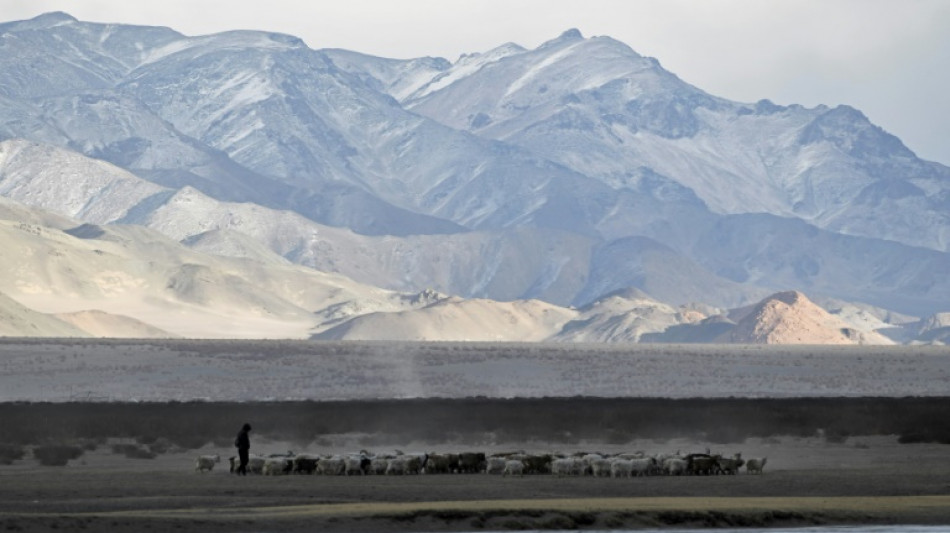
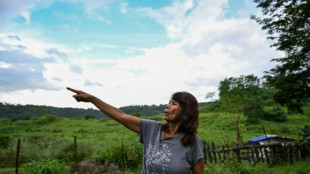
Tibetan Plateau water stores under threat: study / Photo: © AFP/File

 Multi-Asset Trading Venue Monochrome Exchange Announces IEO of Its Native Token, $MCR
 South Korea break Japan hearts to win Asian Games basketball gold
 Acosta takes first victory at Austrian MotoGP

 PSG president Nasser al-Khelaifi under investigation in France for conflict of interest

 China swim sensation, 13, sets Games record after Japan win early

 Drones hit Moscow as Russians go to the polls

 New England boss Fleming says 'wrong' to ask Stokes to end retirement

 Germans vote in elections threatening fresh blow to Merz
 US fears rapid escalation in Mideast after Houthis attack Riyadh

 Japan triathlete Hojo wins first gold of Asian Games
 IOC president impressed by 'beautiful' Asian Games wooden huts

 First Asian Games gold goes to Japan as China's 13-year-old Yu lights up pool

 Data centre command hub keeps AI up and running
 Pope Leo in France: the issues on the table

 Packing for a pope: behind the scenes on foreign trips

 Republicans find transgender issues a powerful political weapon in midterm campaigning

 German state elections threaten new shock waves for Merz

 Chile's Bachelet quits race to be next UN chief

 Raphinha treble fires perfect Barca to win at Sevilla

 Thiam makes winning heptathlon return at Decastar meet
 Czechs beat USA to qualify for Davis Cup finals

 Dortmund sink Stuttgart to climb to Bundesliga summit

 Trump says will not tolerate attempts to slow AI growth

 'It has to stop': runners protest women's murders in S.Africa district

 Fire erupts near Riyadh airport as Houthis claim strikes

The Tibetan Plateau will experience significant water loss this century due to global warming, according to research published Monday that warns of severe supply stress in a climate change "hotspot".
The reservoirs of the Tibetan Plateau, which covers much of southern China and northern India, are fed by monsoons and currently supply most of the water demand for nearly two billion people.
But the plateau's complex terrain has made it difficult for scientists to predict how warming temperatures and altered weather patterns linked to climate change will affect the region's water stores.
Researchers based in China and the United States used satellite-based measurements to determine the net change in water and ice mass over the past two decades.
They added in direct measurements of glaciers, lakes and sub-surface water levels to estimate changes in the water mass, then used a machine learning technique to predict storage changes under scenarios such as higher air temperature and reduced cloud cover.
They found that due to an increasingly warm and wet climate, the Tibetan Plateau has lost just over 10 billion tonnes of water a year since 2002.
Writing in the journal Nature Climate Change, the team projected changes in water storage across the plateau under a middle-of-the-road emissions scenario, where levels of carbon pollution stay roughly at current levels before falling gradually after 2050.
They found two river basins were particularly vulnerable to water loss.
For the Amu Darya, central Asia's largest river, water loss could be equivalent to 119 percent of the current demand.
Communities reliant on the Indus basement for water supply could see a loss equivalent to 79 percent of current demand, the study showed.
The authors recommended that governments begin to explore alternative water supply options, including more groundwater extraction, to make up for the anticipated shortfall.
Michael Mann, director of the Penn Center for Science, Sustainability and the Media, said "substantial reductions in carbon emissions over the next decade" would limit global warming and the "predicted collapse of the Tibetan Plateau water towers".
"But even in a best-case scenario, further losses are likely unavoidable, which will require substantial adaptation to decreasing water resources in this vulnerable, highly populated region of the world. Just what that would look like is hard to say -- we're in unchartered waters," Mann, a study co-author, told AFP.
"Suffice it to say, some amount of suffering is locked in."
F.Pavlenko--BTB