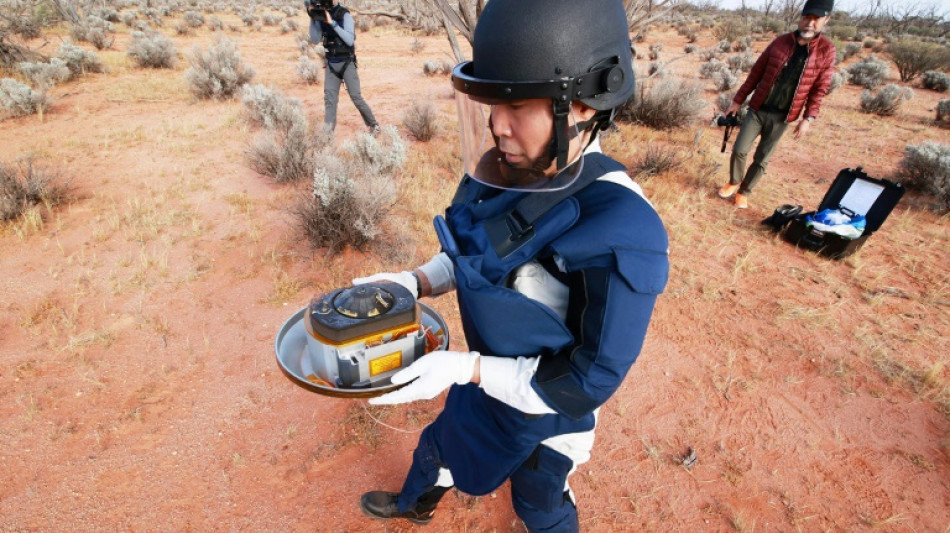
Space mission shows Earth's water may be from asteroids: study / Photo: © JAXA/AFP/File

 Multi-Asset Trading Venue Monochrome Exchange Announces IEO of Its Native Token, $MCR

 South Korea break Japan hearts to win Asian Games basketball gold

 Acosta takes first victory at Austrian MotoGP

 PSG president Nasser al-Khelaifi under investigation in France for conflict of interest

 China swim sensation, 13, sets Games record after Japan win early

 Drones hit Moscow as Russians go to the polls

 New England boss Fleming says 'wrong' to ask Stokes to end retirement

 Germans vote in elections threatening fresh blow to Merz

 US fears rapid escalation in Mideast after Houthis attack Riyadh

 Japan triathlete Hojo wins first gold of Asian Games
 IOC president impressed by 'beautiful' Asian Games wooden huts

 First Asian Games gold goes to Japan as China's 13-year-old Yu lights up pool

 Data centre command hub keeps AI up and running

 Pope Leo in France: the issues on the table

 Packing for a pope: behind the scenes on foreign trips

 Republicans find transgender issues a powerful political weapon in midterm campaigning

 German state elections threaten new shock waves for Merz

 Chile's Bachelet quits race to be next UN chief

 Raphinha treble fires perfect Barca to win at Sevilla

 Thiam makes winning heptathlon return at Decastar meet

 Czechs beat USA to qualify for Davis Cup finals

 Dortmund sink Stuttgart to climb to Bundesliga summit

 Trump says will not tolerate attempts to slow AI growth

 'It has to stop': runners protest women's murders in S.Africa district

 Fire erupts near Riyadh airport as Houthis claim strikes

Water may have been brought to Earth by asteroids from the outer edges of the solar system, scientists said after analysing rare samples collected on a six-year Japanese space mission.
In a quest to shed light on the origins of life and the formation of the universe, researchers are scrutinising material brought back to earth in 2020 from the asteroid Ryugu.
The 5.4 grams (0.2 ounces) of rocks and dust were gathered by a Japanese space probe, called Hayabusa-2, that landed on the celestial body and fired an "impactor" into its surface.
Studies on the material are beginning to be published, and in June, one group of researchers said they had found organic material which showed that some of the building blocks of life on Earth, amino acids, may have been formed in space.
In a new paper published in the journal Nature Astronomy, scientists said the Ryugu samples could give clues to the mystery of how oceans appeared on Earth billions of years ago.
"Volatile and organic-rich C-type asteroids may have been one of the main sources of Earth's water," said the study by scientists from Japan and other countries, published Monday.
"The delivery of volatiles (that is, organics and water) to the Earth is still a subject of notable debate," it said.
But the organic materials found "in Ryugu particles, identified in this study, probably represent one important source of volatiles".
The scientists hypothesised that such material probably has an "outer Solar System origin", but said it was "unlikely to be the only source of volatiles delivered to the early Earth".
Hayabusa-2 was launched in 2014 on its mission to Ryugu, around 300 million kilometres away, and returned to Earth's orbit two years ago to drop off a capsule containing the sample.
In the Nature Astronomy study, the researchers again hailed the findings made possible by the mission.
"Ryugu particles are undoubtedly among the most uncontaminated Solar System materials available for laboratory study and ongoing investigations of these precious samples will certainly expand our understanding of early Solar System processes," the study said.
M.Furrer--BTB