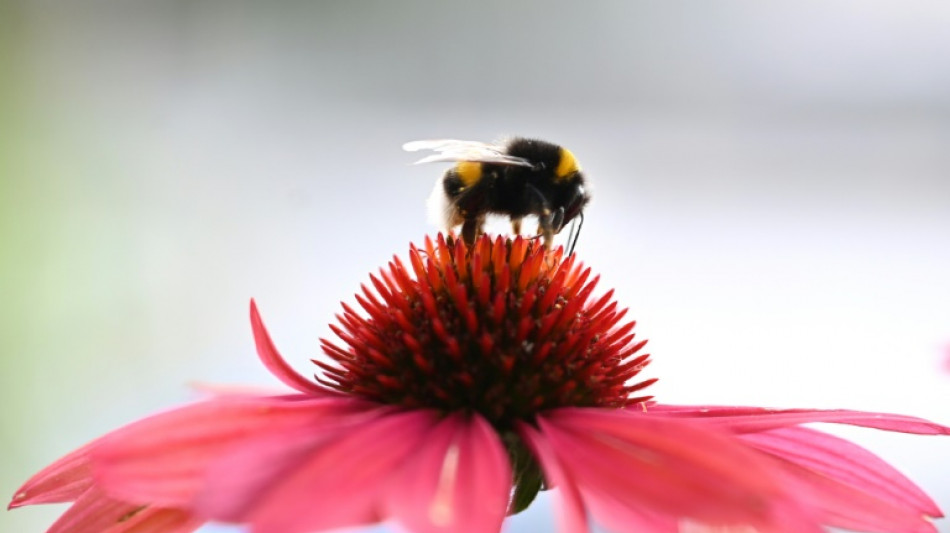
Climate change causes wonky bumblebee wings: scientists / Photo: © APA/AFP/File

 Macron welcomes Canada's Carney to French Atlantic territory

 Fiorentina frustrate Napoli with Serie A draw, Como upset

 Five-star Man City top Premier League after Sunderland thriller

 Ukrainian drones hit Moscow on last day of Russian elections

 Multi-Asset Trading Venue Monochrome Exchange Announces IEO of Its Native Token, $MCR

 South Korea break Japan hearts to win Asian Games basketball gold

 Acosta takes first victory at Austrian MotoGP

 PSG president Nasser al-Khelaifi under investigation in France for conflict of interest

 China swim sensation, 13, sets Games record after Japan win early

 Drones hit Moscow as Russians go to the polls

 New England boss Fleming says 'wrong' to ask Stokes to end retirement

 Germans vote in elections threatening fresh blow to Merz

 US fears rapid escalation in Mideast after Houthis attack Riyadh

 Japan triathlete Hojo wins first gold of Asian Games

 IOC president impressed by 'beautiful' Asian Games wooden huts

 First Asian Games gold goes to Japan as China's 13-year-old Yu lights up pool

 Data centre command hub keeps AI up and running

 Pope Leo in France: the issues on the table

 Packing for a pope: behind the scenes on foreign trips

 Republicans find transgender issues a powerful political weapon in midterm campaigning

 German state elections threaten new shock waves for Merz

 Chile's Bachelet quits race to be next UN chief

 Raphinha treble fires perfect Barca to win at Sevilla

 Thiam makes winning heptathlon return at Decastar meet

 Czechs beat USA to qualify for Davis Cup finals

Warmer and wetter weather linked to climate change appears to stress out bumblebees and make their wings more asymmetrical, which could ultimately affect their future development, according to UK scientists in a new research paper.
"With hotter and wetter conditions predicted to place bumblebees under higher stress, the fact these conditions will become more frequent under climate change means bumblebees may be in for a rough time over the 21st century," scientists at Imperial College, London, wrote in the Animal Ecology journal on Wednesday.
The large furry bees, known for their distinctive buzz, only feed on flowers, making them vulnerable to changes to the countryside due to intensive farming.
Their population has declined in Britain over the past century, with two species becoming extinct, according to the Bumblebee Conservation Trust.
The Imperial College scientists looked at more than 6,000 bumblebee specimens in natural history museums, collected across Britain during the 20th century.
The scientists examined the right-left symmetry between the bees' four wings, because asymmetry is an indication that the insect experienced stress during development.
They found that bees from the second half of the 20th century consistently had a higher average rate of asymmetry.
Asymmetry was also "consistently higher in warmer and wetter years," according to the paper's senior co-author Richard Gill.
"Overall, these results could suggest bumblebees experienced increasing stress as the century progressed and that aspects of climate change could have contributed to this trend," the paper said.
The weather conditions linked to wonky wings "will likely increase in frequency with climate change", it continued.
In April, scientists in the United States who studied more than 20,000 bees in the Rocky Mountains found that bumblebees had lower heat tolerance than smaller bees and were "more threatened under climate warming than other bees".
Insects are facing a huge impact from both warming climate and intensive agriculture.
Another study released in April in the journal Nature found that these factors cause insect populations to plummet by nearly half compared to areas less affected by temperature rises and industrial farming.
M.Ouellet--BTB