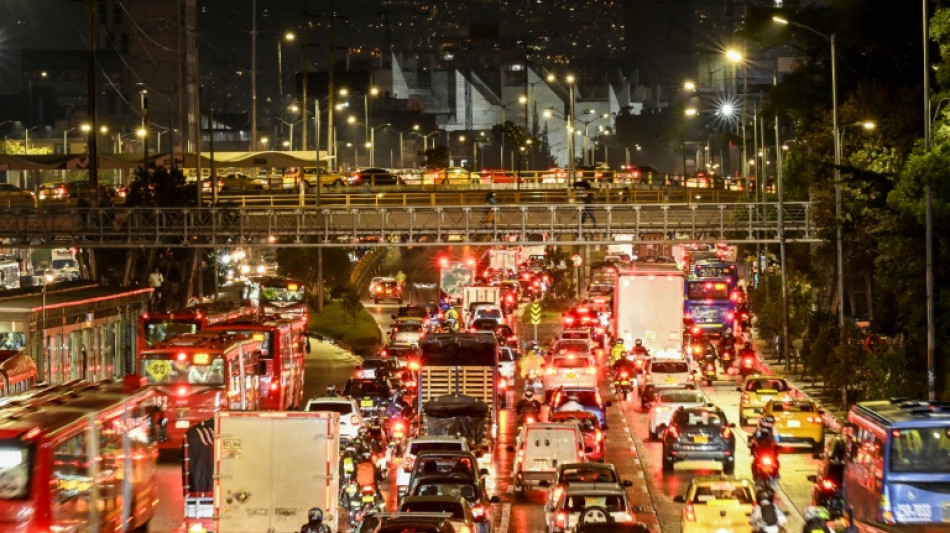
Climate crisis: Transition of global economy way off track / Photo: © AFP/File

 Braves clinch division title as Red Sox reach MLB playoffs
 Bordeaux-Begles hammer Stade Francais despite Jalibert injury

 Milan and Juventus end blips with home wins

 Bridgeman wins PGA Biltmore title with sizzling 61

 Williams injured as Bears shut down by Vikings

 US warns of rapid escalation in Middle East war

 Germany's far-right AfD celebrates another state election win
 Russia vows revenge for election-day attacks as poll shows ruling party win

 Spaun late shows snatches PGA Championship win

 Conceicao strikes as Juventus beat Atalanta

 Britain, Zverev-inspired Germany, Spain complete Davis Cup finals

 Man Utd salvage Fulham draw as pressure mounts on Carrick

 Spanish civil war drama 'The Black Ball' wins at Toronto festival

 Germany's Merz shaken by far-right and far-left gains in state votes

 Macron welcomes Canada's Carney to French Atlantic territory

 Fiorentina frustrate Napoli with Serie A draw, Como upset

 Five-star Man City top Premier League after Sunderland thriller

 Ukrainian drones hit Moscow on last day of Russian elections

 Multi-Asset Trading Venue Monochrome Exchange Announces IEO of Its Native Token, $MCR

 South Korea break Japan hearts to win Asian Games basketball gold

 Acosta takes first victory at Austrian MotoGP

 PSG president Nasser al-Khelaifi under investigation in France for conflict of interest

 China swim sensation, 13, sets Games record after Japan win early

 Drones hit Moscow as Russians go to the polls

 New England boss Fleming says 'wrong' to ask Stokes to end retirement

Across virtually every sector, the greening of the global economy is unfolding far too slowly to stave off climate catastrophe, according to a sobering report Wednesday from a consortium of research organisations.
From power, industry and transport to food production, deforestation and finance, progress across 40 key indicators must accelerate dramatically -- in many cases ten-fold or more -- to stay in line with the Paris treaty goal of capping global warming at 1.5 degrees Celsius.
Earth's surface has already warmed 1.2C, enough to unleash a deadly and costly crescendo of climate-enhanced storms, floods, droughts and heatwaves.
In at least five areas those trend lines are still moving in the wrong direction entirely, according to the 200-page analysis, which comes 12 days ahead of crunch UN climate talks in Sharm El-Sheik, Egypt.
These include the share of natural gas in electricity generation, the share of kilometres travelled by passenger cars, and carbon pollution from agriculture.
"We are not winning in any sector," said Ani Dasgupta, head of the World Resources Institute, one of half-a-dozen climate policy think tanks that contributed to the report.
The findings, he said, are "an urgent wakeup call for decision-makers to commit to real transformation across every aspect of our economy".
- Clean energy -
Comparing current efforts to those required by 2030 and mid-century to limit warming to 1.5C, researchers quantified the global gap in climate action.
"The hard truth is that none of the 40 indicators we assessed are on track to achieve their 2030 targets," said lead author Sophia Boehm, a researcher at Systems Change Lab.
To prevent dangerous overheating, global carbon pollution must decline 40 percent by the end of this decade. By 2050, the world must be carbon neutral, compensating any remaining emissions with CO2 removal.
Most worrying, the authors said in a briefing, are shortfalls in the power sector and the lack of progress in halting deforestation.
The phase-out of coal used to generate electricity without filtering CO2 emissions must happen six times faster, equivalent to retiring nearly 1,000 coal-fired power plants annually over the next seven years, they found.
The power sector is the biggest source of global CO2 emissions, and coal -- accounting for nearly 40 percent of electricity worldwide -- is by far the most carbon intensive of fossil fuels.
"If our solution to many things is electrification, then we need to make sure that electricity is clean and free of fossil fuels," said co-author Louise Jeffery, an analyst at New Climate Institute.
Huge increases in solar and wind power have not been enough to keep up with expanding demand for energy.
- 'Irreversible' forest loss -
Progress on deforestation must accelerate two- to three-fold to keep the 1.5C goal within striking distance, according to the report.
"The loss of primary forest is irreversible, both in terms of carbon storage and as a haven for biodiversity," said co-author Kelly Levin, chief of science, data and systems change at the Bezos Earth Fund.
"If meeting the 1.5C target is challenging now, it is completely impossible when you chip away at our carbon sinks," she added, referring to the role of forests and soil in absorbing some 30 percent of humanity's carbon pollution.
Other key findings from the report on the pace of change needed this decade:
- Public transport systems such as metros, light-rail and public bus networks must expand six times faster;
- The amount of carbon emitted in cement production must decline 10 times faster;
- Per-capital meat consumption -- still on the increase -- must drop, and the shift to sustainable diets must happen five times faster.
The report also looked at climate finance.
"Governments and private institutions are failing to deliver on the Paris Agreement's goals of aligning financial flows with the 1.5C limit," said Claire Fyson, an analyst at Climate Analytics.
The analysis showed that global climate finance -- sure to be a key sticking point at UN talks in Egypt -- must grow more than 10 times faster than recent trends, from $640 billion in 2022 to $5.2 in 2030.
At the same time, governments are still pouring money into fossil fuels, spending nearly $700 billion of public financing on coal, oil and gas in 2020.
Major economies nearly doubled the amount they spend on fossil fuel production and consumption subsidies between 2020 and 2021.
F.Pavlenko--BTB