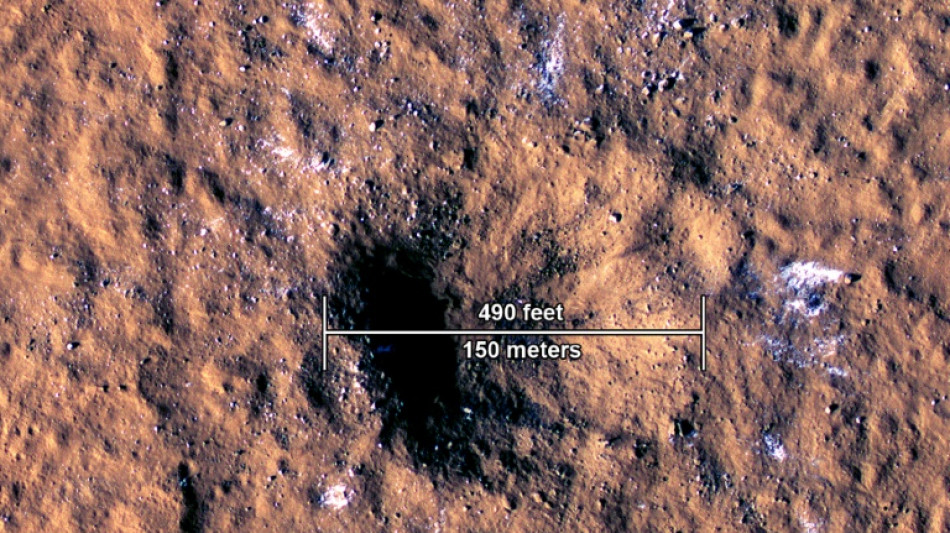
Meteorite that smashed into Mars shook planet, NASA says / Photo: © NASA/JPL-Caltech/University of Arizona/AFP

 Braves clinch division title as Red Sox reach MLB playoffs

 Bordeaux-Begles hammer Stade Francais despite Jalibert injury

 Milan and Juventus end blips with home wins

 Bridgeman wins PGA Biltmore title with sizzling 61

 Williams injured as Bears shut down by Vikings

 US warns of rapid escalation in Middle East war

 Germany's far-right AfD celebrates another state election win

 Russia vows revenge for election-day attacks as poll shows ruling party win

 Spaun late shows snatches PGA Championship win

 Conceicao strikes as Juventus beat Atalanta

 Britain, Zverev-inspired Germany, Spain complete Davis Cup finals

 Man Utd salvage Fulham draw as pressure mounts on Carrick

 Spanish civil war drama 'The Black Ball' wins at Toronto festival

 Germany's Merz shaken by far-right and far-left gains in state votes

 Macron welcomes Canada's Carney to French Atlantic territory

 Fiorentina frustrate Napoli with Serie A draw, Como upset

 Five-star Man City top Premier League after Sunderland thriller

 Ukrainian drones hit Moscow on last day of Russian elections

 Multi-Asset Trading Venue Monochrome Exchange Announces IEO of Its Native Token, $MCR

 South Korea break Japan hearts to win Asian Games basketball gold

 Acosta takes first victory at Austrian MotoGP

 PSG president Nasser al-Khelaifi under investigation in France for conflict of interest

 China swim sensation, 13, sets Games record after Japan win early

 Drones hit Moscow as Russians go to the polls

 New England boss Fleming says 'wrong' to ask Stokes to end retirement

Scientists who study Mars on Thursday revealed the remarkable Christmas gift they received from the planet last year.
On December 24, 2021, a meteorite hit Mars' surface, triggering magnitude 4 tremors, which were detected by NASA's InSight spacecraft -- which landed on the planet four years ago -- some 2,200 miles (3,500 kilometers) away.
The true origin of this so-called marsquake was only confirmed when the Mars Reconnaissance Orbiter (MRO) was able to take a picture of the newly formed crater created by the hit when it flew over the impact site less than 24 hours later.
The image is impressive, showing blocks of ice that were spewed up onto the planet's surface around the 492-foot (150-meter) wide and 70-foot (21-meter) deep hole.
The crater is the largest ever observed since the MRO began its Mars orbit 16 years ago.
And though meteorite impacts on Mars are not rare, "we never thought we'd see anything that big," Ingrid Daubar, who works on the InSight and MRO missions, told reporters at a press conference Thursday.
Researchers estimate that the meteorite itself would have measured between 16 to 39 feet across. An object of that size would have disintegrated in Earth's atmosphere before falling to the ground here.
"It is simply the biggest meteorite impact on the ground that we have heard since science has been done with seismographs or seismometers," said planetology professor Philippe Lognonne, who participated in two studies related to the observation published in the journal Science Thursday.
NASA released an audio recording of the collision, which was made by speeding up the vibrations collected by the seismometer.
- 'Useful' ice presence -
The valuable information gathered in studying the crash will contribute to deeper knowledge of Mars' interior and the history of how the planet was created, scientists said.
The presence of ice, in particular, is "surprising," said Daubar, who also co-authored the two studies.
"This is the warmest spot on Mars, the closest to the equator, we've ever seen water ice," she said.
In addition to the information this discovery offers about the Martian climate, the presence of water at this latitude -- and not just near the poles -- could prove "really useful" for future human visitors to Mars, director of NASA's Planetary Science Division Lori Glaze said.
"We'd want to land the astronauts as near to the equator as possible," she said, to take advantage of warmer temperatures.
"That ice could be converted into water, oxygen or hydrogen," Glaze said.
The impact was powerful enough to generate seismic waves both down to the planet's core and across its crust horizontally, making it possible to study Mars' internal structure -- revealing that the crust on which InSight sits is less dense than the crust the waves traveled over from the crater site.
The end of InSight's mission -- which recorded more than 1,300 marsquakes in total -- could come in the next couple of months, according to Bruce Banerdt of NASA's Jet Propulsion Lab, due to the expected accumulation of dust on the lander's solar power panel.
It's "sad," he said, while celebrating that the probe worked "marvelously" for four years.
H.Seidel--BTB