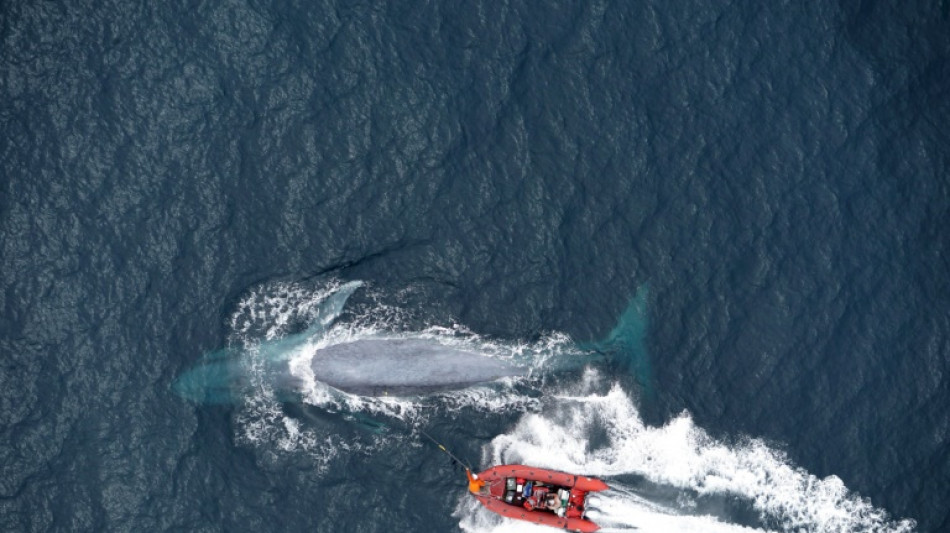
Blue whales eat 10 million pieces of microplastic a day: study / Photo: © Goldbogen Laboratory/AFP/File

 Braves clinch division title as Red Sox reach MLB playoffs

 Bordeaux-Begles hammer Stade Francais despite Jalibert injury

 Milan and Juventus end blips with home wins

 Bridgeman wins PGA Biltmore title with sizzling 61

 Williams injured as Bears shut down by Vikings

 US warns of rapid escalation in Middle East war

 Germany's far-right AfD celebrates another state election win

 Russia vows revenge for election-day attacks as poll shows ruling party win

 Spaun late shows snatches PGA Championship win

 Conceicao strikes as Juventus beat Atalanta

 Britain, Zverev-inspired Germany, Spain complete Davis Cup finals

 Man Utd salvage Fulham draw as pressure mounts on Carrick

 Spanish civil war drama 'The Black Ball' wins at Toronto festival

 Germany's Merz shaken by far-right and far-left gains in state votes

 Macron welcomes Canada's Carney to French Atlantic territory

 Fiorentina frustrate Napoli with Serie A draw, Como upset

 Five-star Man City top Premier League after Sunderland thriller

 Ukrainian drones hit Moscow on last day of Russian elections

 Multi-Asset Trading Venue Monochrome Exchange Announces IEO of Its Native Token, $MCR

 South Korea break Japan hearts to win Asian Games basketball gold

 Acosta takes first victory at Austrian MotoGP

 PSG president Nasser al-Khelaifi under investigation in France for conflict of interest

 China swim sensation, 13, sets Games record after Japan win early

 Drones hit Moscow as Russians go to the polls

 New England boss Fleming says 'wrong' to ask Stokes to end retirement

Blue whales consume up to 10 million pieces of microplastic every day, research estimated Tuesday, suggesting that the omnipresent pollution poses a bigger danger to the world's largest animal than previously thought.
The tiny fragments of plastic have been found everywhere from the deepest oceans to the highest mountains, and even inside human organs and blood.
Now a modelling study published in the journal Nature Communications has estimated how much is being ingested by whales.
A US-led research team put tags on 191 blue, fin and humpback whales that live off the coast of California to observe their movements.
"It's basically like an Apple Watch, just on the back of a whale," said Shirel Kahane-Rapport, a researcher at California State University, Fullerton and the study's first author.
The whales mostly fed at depths of between 50 to 250 metres (165-820 feet), which is home to the "greatest concentration of microplastics in the water column," Kahane-Rapport told AFP.
The researchers then estimated the size and number of mouthfuls the whales had daily and what was filtered out, modelling three different scenarios.
Under the most likely scenario, the blue whales ate up to 10 million microplastic pieces a day.
Over the 90-120 day annual feeding season, that represents more than a billion pieces a year.
The largest animal ever to live on Earth is also likely the biggest microplastic consumer, eating up to 43.6 kilogrammes a day, the study said.
"Imagine carrying around an extra 45 kilogrammes -- yes, you're a very big whale, but that will take up space," Kahane-Rapport said.
Humpback whales were estimated to eat around four million pieces a day.
While it is easy to imagine whales sucking in vast amounts of microplastics as they gulp their way through the ocean, the researchers found that was not the case.
Instead, 99 percent of the microplastics entered the whales because they were already inside their prey.
"That's concerning for us," Kahane-Rapport said, because humans eat that prey.
"We also eat anchovies and sardines," she said, adding that "krill is the basis of the food web".
Previous research has shown that if krill are in a tank with microplastic, "they will eat it," Kahane-Rapport said.
Now that the researchers know how much microplastic is being consumed by whales, next they aim to determine how much harm it could be doing.
"The dose defines the poison," Kahane-Rapport said.
R.Adler--BTB