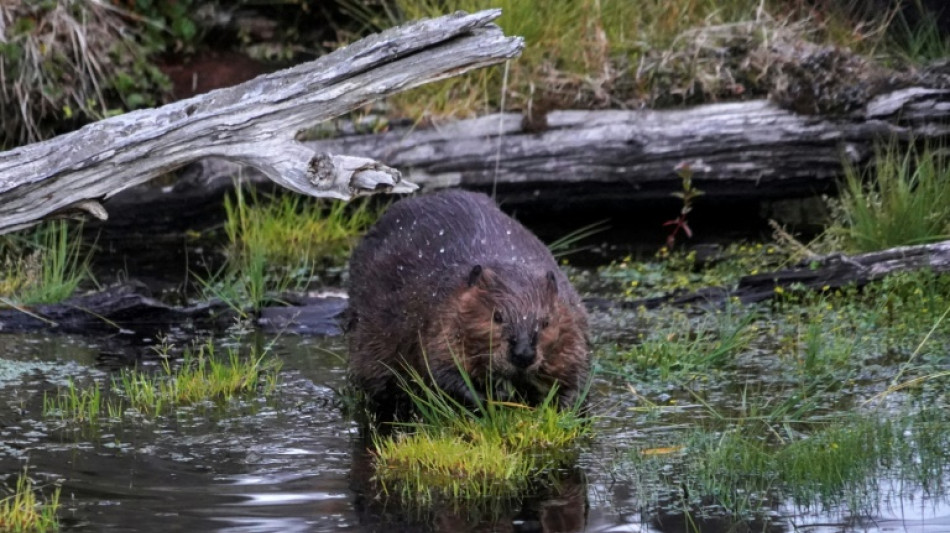
Eager beaver: dams improve quality of river water hit by climate change / Photo: © AFP

 Braves clinch division title as Red Sox reach MLB playoffs

 Bordeaux-Begles hammer Stade Francais despite Jalibert injury

 Milan and Juventus end blips with home wins

 Bridgeman wins PGA Biltmore title with sizzling 61

 Williams injured as Bears shut down by Vikings

 US warns of rapid escalation in Middle East war

 Germany's far-right AfD celebrates another state election win

 Russia vows revenge for election-day attacks as poll shows ruling party win

 Spaun late shows snatches PGA Championship win

 Conceicao strikes as Juventus beat Atalanta

 Britain, Zverev-inspired Germany, Spain complete Davis Cup finals

 Man Utd salvage Fulham draw as pressure mounts on Carrick

 Spanish civil war drama 'The Black Ball' wins at Toronto festival

 Germany's Merz shaken by far-right and far-left gains in state votes

 Macron welcomes Canada's Carney to French Atlantic territory

 Fiorentina frustrate Napoli with Serie A draw, Como upset

 Five-star Man City top Premier League after Sunderland thriller

 Ukrainian drones hit Moscow on last day of Russian elections

 Multi-Asset Trading Venue Monochrome Exchange Announces IEO of Its Native Token, $MCR

 South Korea break Japan hearts to win Asian Games basketball gold

 Acosta takes first victory at Austrian MotoGP

 PSG president Nasser al-Khelaifi under investigation in France for conflict of interest

 China swim sensation, 13, sets Games record after Japan win early

 Drones hit Moscow as Russians go to the polls

 New England boss Fleming says 'wrong' to ask Stokes to end retirement

Hotter, drier weather means beaver populations are spreading in the western United States, and their dams are helping to mitigate the negative impacts of climate change on river water quality, according to a new study on Tuesday.
The findings -- discovered almost by accident -- offered a "rare bright spot" in an otherwise bleak landscape of climate change news, the lead author told AFP.
Stanford University scientists and colleagues conducted the research over three years on the East River, a main tributary of the Colorado River in the US state of Colorado.
It has long been known that beaver dams can improve the quality of river water by filtering out contaminants.
But what came as a surprise is what the Stanford team described as a virtuous climate change-induced "feedback" loop.
It works like this: hotter, drier spells linked to a warming world often reduce water quality, mainly because less water leads to a higher concentration of contaminants such as nitrate, a form of nitrogen.
At the same time, a changing climate has increased the range of industrious buck-toothed beavers, and widened the impact of their dams, thus helping to dilute the negative impact of global warming.
"In building more dams, they mitigate that degradation in water quality that's caused by climate change," lead author Christian Dewey told AFP.
When the beavers' dams raise water levels upstream, water is diverted into surrounding soils and secondary waterways, collectively called a riparian zone.
"These zones act like filters, straining out excess nutrients and contaminants before water re-enters the main channel downstream," according to a press release about the study, published in Nature Communications.
- 'Rare bright spot' -
The same contaminants -- potentially harmful to humans, animals or plants in river water -- are thus dispersed with little or no negative impact in soils.
This is good news in the area where the research was conducted, as the Colorado River provides drinking water and supports livelihoods for some 40 million people, according to the US government.
Nitrogen in particular promotes algae overgrowth, which starves water of oxygen needed to support diverse animal life and a healthy ecosystem.
The study found that the benefits provided by the beaver dams improved water quality in both high- and low-water conditions linked to climate change -- whether hot and dry spells, or heavy rainfall and snowmelt.
In both cases, "the beaver dam pushed more water and nitrate into surrounding soil than did either seasonal extreme, leading to vastly more removal of nitrate", Dewey said.
He said he did not set out to study beaver dams initially, but one cropped up on the river he was testing for seasonal changes in hydrology.
"It was incredibly lucky," he said.
He cautioned that the feedback dynamic may be unique to the particular conditions in western United States, and thus may not be found elsewhere.
But the findings are still "a rare bright spot in climate news", and perhaps an example of nature restoring balance.
"We push too far, and then (there's) sort of a swinging back in the other direction, at least in the case of beavers."
N.Fournier--BTB