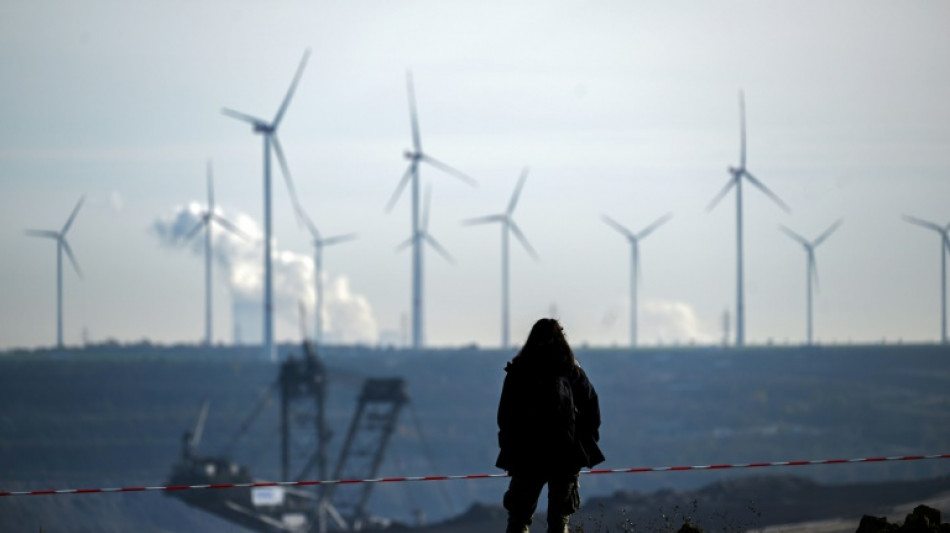
Fixing climate trumps economic woes, threat of war: YouGov survey / Photo: © AFP

 Inside the Venezuelan prison meant to 'drive you insane'
 UK king braces as memoir by Diana's brother goes on sale

 No green light to lift EU sanctions on Russian oligarchs, talks to resume

 UK agrees support for Saudi in struggle with Houthis: reports

 EU foreign policy chief calls for continued sanctions on Russia

 Flights scrapped, evacuations urged as Typhoon Dujuan wallops Japan

 Fonseca to take break from tennis

 A Cuban zoo, and its animals, in epic battle for survival

 Infantino proposes consulting federations to reform FIFA

 El Nino weather pattern enters record territory: scientist

 OpenAI calls for US to lead global effort on AI standards

 South African ostriches plucked alive for luxury fashion: report

 US networks halt Trump coverage in revolt over White House ban

 Paramount settles with US states to clear Warner Bros. mega-merger

 Climate crisis a job for world leaders, not just activists: UK FM

 US networks halt Trump coverage over White House ban
 French singer accuses Miley Cyrus of plagiarism
 EU fines Google 403 mn euros for location data breach

 'Best is yet to come,' says De la Fuente after Spain extension

 Why diesel prices are rising more than crude oil

 COP31 host says AI's climate footprint to be a summit priority

 Renewables hit record in 2025, but world must move faster: report
 US media outlets to sue Trump administration after White House ban
 Global stocks rally on lower oil prices, US-China hopes

 EU proposes energy rating for data centres

Government action to curb global warming should be a top concern despite inflation, an energy crisis and nuclear sabre-rattling by Russia, according to a YouGov survey in wealthy nations published exclusively by AFP.
Carried out before the COP27 climate summit in Sharm el-Sheikh, Egypt, the survey found that more than half of respondents in France, Britain, Italy, Spain, Germany and the United States said halting global warming should be a "key priority" regardless of the state of the economy.
Thirty percent said it should be "paused" so other problems can be addressed.
"This survey shows that there is far more common ground among the public when it comes to climate change and what to do about it, than what we often see on our TV screens and Twitter feeds," said Luke Tryl, British director for More in Common, a non-profit examining polarisation in society.
But the survey also revealed differences in outlook between the six nations, which could suggest people in rich economies hit hardest by climate impacts see the issue as more urgent, compared to wealthy countries less afflicted.
More than 60 percent of respondents in France, Spain and Italy said tackling global warming should not give way to other problems, but barely 40 percent held this view in Germany, Britain and the United States.
- 'Lack of confidence' in politicians -
Germany and Britain have seen episodes of flooding and extreme heat, but the Mediterranean Basin -- a climate change "hotspot" according to the UN's IPCC climate science advisory body -- has been hammered by heatwaves, droughts and wildfires, all of which are predicted to worsen.
Two to three times as many respondents in each country said that climate change will cause "a large amount" of harm to the world in the future, compared to whether they personally will experience harm.
That possibly reflects the extent to which people in rich countries are insulated from severe impacts.
When respondents were asked whether they had already personally experienced weather events caused by climate change, 48 to 58 percent in Spain, Italy and France said they had, compared to 44, 38 and 36 percent in Britain, the United States and Germany, respectively.
The United States was in several ways an outlier in the survey, which polled between 1,000 and 2,000 people in each country.
Despite a crescendo of extreme weather measurably linked to warming in the United States -- including intense drought in the southwest, record wildfires in the northwest, flooding and drought in the midwest, and devastating hurricanes on the eastern seaboard -- barely half of Americans think that human activity has caused Earth's climate to change.
That figure rises to an average of nearly 80 percent across the European nations, and to 84 and 88 percent, respectively, in Spain and Italy.
Views in the United States on this question were evenly divided across age, gender and self-identified race, but skewed heavily according to political affiliation.
More than 80 percent of those voting for President Joe Biden in 2020 said global warming is manmade, versus only a quarter of those who voted for Donald Trump, who this week announced he would take another run at the White House in 2024.
Across the board, people said political leaders were not doing enough to fix the climate, the survey showed.
"There is a shared lack of confidence in their national government's ability to grip this crisis," Tryl said.
- Protecting future generations -
Nearly 40 percent of respondents said government policies to reduce carbon emissions would have a "positive impact" in the long term, with only 14 percent saying such policies would improve things in the short-run.
Some 90 percent of the total respondents said they believe the climate is changing, with the remainder saying is not, or they did not know.
When asked, however, if they were confident their governments were "prepared to take the necessary action to stop climate change," two-thirds of respondents who do believe the climate is changing said "no" in European countries. In the United States it was 40 percent.
"Politicians aren't necessarily keeping up," said Amiera Sawas, director of programmes and research at Climate Outreach in Britain, who works with survey data.
By a wide margin, the number one reason given for taking action on climate change was to protect future generations, with between 40 and 50 percent giving that as a motive.
Protecting habitats and species from further damage was the second most common answer.
Following on the heels of COP27, a UN biodiversity summit tasked with laying down new targets for protecting nature will convene in Canada in early December.
H.Seidel--BTB