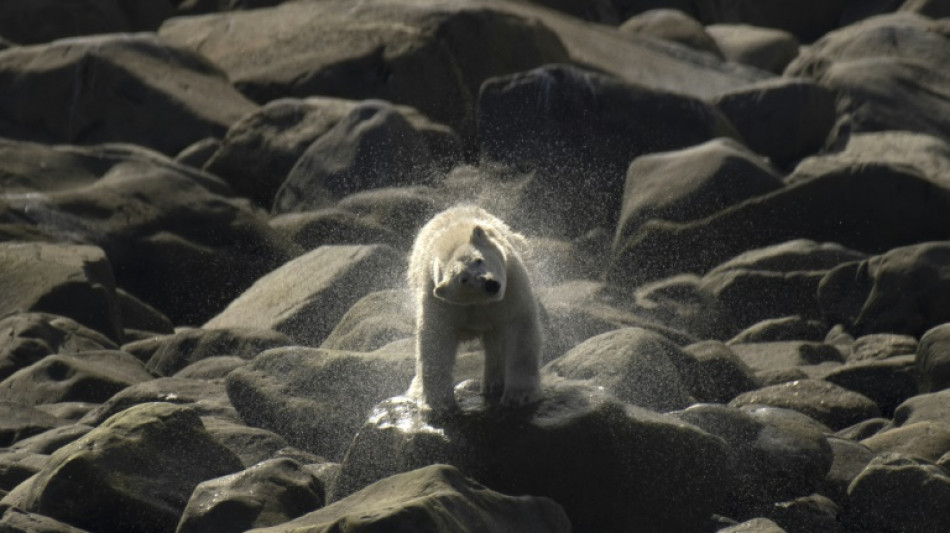
Canadian polar bears disappearing fast: study / Photo: © AFP/File

 Manchester United rallies past Roma as PSG dominates in Champions League

 Qatar sees tentative opening for renewed regional diplomacy
 Qatar Tourism joins Pacific Asia Travel Association at London travel market

 Abdul El-Sayed Wins Michigan Senate Seat in Historic Election

 Qatar media bodies discuss support for humanitarian initiatives

 No. 22 UCLA defeats No. 5 Arizona 84-75 despite Kharchenkov's 38 points

 Vessel operator seeks witnesses after Vancouver grounding

 US Air Force deploys F-16 fighters to remote Aleutian base for readiness drill

 Bezos grant helps Seattle nonprofit move thousands of families toward housing

 Shrini Srivastava joins crew of Varanasi-Delhi Vande Bharat Sleeper service

 Nearly Half of Australian Workers Overqualified, Survey Finds

Polar bears are disappearing fast from the Western part of Hudson Bay, on the southern tip of the Canadian Arctic, according to a new government survey.
The number of female bears and cubs in particular has seen a dramatic decline.
Researchers have flown over the region -- which includes the town of Churchill, a tourist destination touted as the "polar bear capital of the world" -- every five years to count the number of bears and extrapolate population trends.
During the last survey in late August and early September 2021, the results of which were released earlier this month, they spotted 194 bears and, based on that count, estimated a total population of 618 bears, down from 842 five years earlier.
"Comparison to aerial surveys estimates from 2011 and 2016 suggests that the WH (Western Hudson Bay population) may be decreasing in abundance," the study said.
It also "revealed significant declines in the abundance of adult female and subadult bears (cubs) between 2011 and 2021."
"The observed declines are consistent with long-standing predictions regarding the demographic effects of climate change on polar bears," the researchers said.
They also cited possible displacements of bears to neighboring regions and hunting for the population decline.
The bears' sea-ice habitat has been disappearing at an alarming rate, with the far north warming up to four times faster than the rest of the world.
The sea ice has become less thick and is breaking up earlier in the spring as well as freezing later in the fall.
The bears rely on the ice for foraging for seals, movement and reproduction.
Since the 1980s, the ice pack in the bay has decreased by nearly 50 percent in summer, according to the US National Snow and Ice Data Center.
A report published two years ago in the journal Nature Climate Change suggested this trend could lead to the near-extinction of these animals, noting there were 1,200 polar bears on the western shores of Hudson Bay in the 1980s.
C.Meier--BTB