How a lone 'immigrant' wolf revived a forest ecosystem / Photo: © AFP

 Alarm at German airport after drone found near Ukrainian plane, mid-air incident

 Salah arrives in Turkey for Trabzonspor talks

 Embattled FIFA chief Infantino holds emergency talks with directors

 Russian barrage on Kyiv kills 17 as Ukraine fails to down single missile

 'Lost': Migrants despair after Britain expels them back to France

 Cathay Pacific's profit soars 71% despite Iran war driving up fuel costs

 Russian barrage on Ukraine kills 15, wounds dozens more

 South Korea police raid Starbucks HQ over 'Tank Day' fiasco

 Tech back in fashion as Asian markets extend rebound

 Total eclipse gives scientists chance to probe Sun's mysteries

 What to know about the total solar eclipse on August 12

 'Like the end of the world': the eclipse chasers flocking to Spain

 Taiwan begins military drills as China pressure grows

 UK mansion where 'listeners' spied on Nazi generals becomes museum

 Sabalenka tops Uchijima in WTA Toronto opener

 Alcaraz withdraws from Cincinnati Masters with wrist injury

 SpaceX revenue jumps 92% in first earnings report, but shares slide

 US eyes Hormuz deal 'today or tomorrow' as ship sinks in Red Sea

 SpaceX revenue jumps 92% in first earnings report

 New commissioner Berg wants to take MLS to 'next level'

 Colombian ex-guerrillas fear for future under hardline president

 Tsitsipas comeback continues with Montreal first-round win

 Swiatek fends off Bejlek to reach Toronto third round

 Reusser romps to overall lead at Tour de France Femmes

 McDonald's reports slower US sales in 2nd quarter

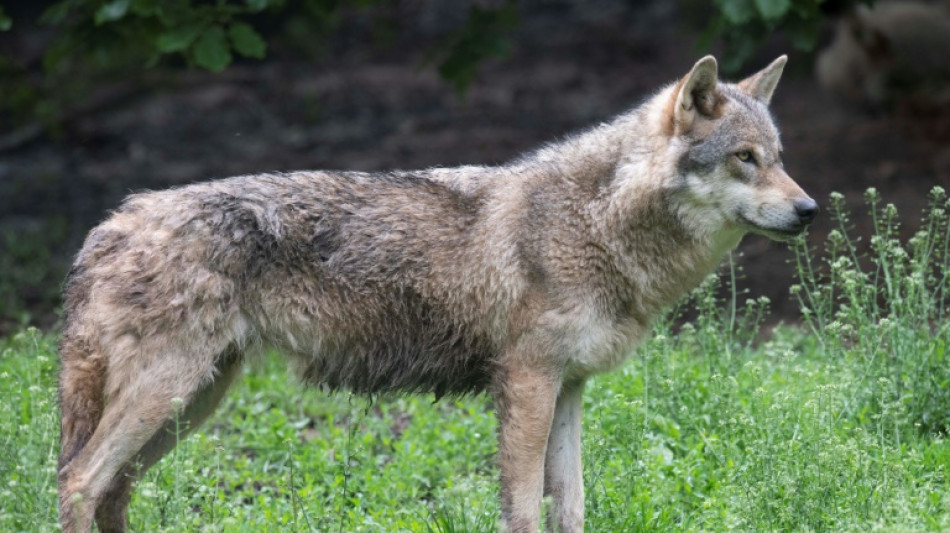
In 1997, a lone wolf crossed an ice bridge that briefly connected Canada with the remote Isle Royale, which lies off the coast of Michigan in Lake Superior and is renowned for its rich biodiversity.
His arrival revived the flagging fortunes of the wider wolf population, which had been hit by disease and inbreeding, and triggered cascading effects that improved the health of the overall forest ecosystem, a study in Science Advances showed Wednesday.
"Issues like inbreeding and low genetic diversity are an important concern for scientists," first author Sarah Hoy, an ecologist at Michigan Technical University told AFP.
"But this is the first study that shows when you have these genetic issues, they don't just impact the particular population and increase the risk that they will go extinct: they also have these really big knock on effects on all the other species."
- 'Old Gray Guy' -
The first wolves arrived on the island in the late 1940s, and their main prey are moose -- giving rise to the longest running study of a predator-prey system anywhere in the world.
But by the 1980s, the wolves were in trouble due to the arrival of canine parvovirus which drove their numbers down from a high of 50 to around 12.
Though the disease eventually disappeared, the population didn't recover right away. The reason was severe inbreeding, which caused lower reproductive success, as well as poorer health outcomes such as spinal deformities of the kind often seen in purebred dogs.
"If you're a wild wolf and you're having to take down prey like a moose that's eight times your size, that can make life in the wild really tough for you," Hoy said.
Enter the immigrant, identified as "M93" by scientists, but affectionately nicknamed "The Old Gray Guy."
M93 was unrelated to the existing population, and also had the advantage of being unusually large -- a big benefit when defending turf from rivals or taking down 800 pound ungulates.
He quickly became the breeding male in one of the island's three wolf packs and went on to sire 34 pups, greatly improving the genetic health of the population and the kill rate of its prey.
- Restoring balance -
Moose are voracious herbivores, consuming up to 30 pounds (14 kilograms) of vegetation a day. By reducing their numbers, the wolves helped bring the forest back into balance, which was most notable in the effects on balsam firs -- the species commonly used as Christmas trees.
With fewer moose, the trees began growing at rates not seen in decades, which is vital for the renewal of the forest and the myriad plant and animal species that depend on it.
The benefits brought by M93's arrival lasted around a decade, then the situation deteriorated once more -- ironically as a result of his extreme reproductive success.
By 2008, two years after his death, 60 percent of the wolf population's gene pool was inherited from M93, which led to a return of genetic deterioration.
M93 himself began breeding with his daughter after his mate died, and simultaneous inbreeding by other members triggered a rapid population decline until 2015, when there were just two wolves left: a father-daughter pair who were also half siblings.
Fortunately, a restoration program beginning in 2018 has once more brought balance to the system, and there are currently around 30 wolves and just under a thousand moose on the island.
For Hoy, a key takeaway is that the same principle of inserting just a small number of individuals could be applied to other imperiled predator populations that suffer from the harmful effects of inbreeding, such as lions or cheetahs, to similarly improve their ecosystems.
William Ripple, a professor of ecology at Oregon State University who was not part of the research, told AFP it was an "important study" that advances understanding "by showing that genetic processes may limit the ecological effects of a keystone species, the gray wolf."
C.Kovalenko--BTB