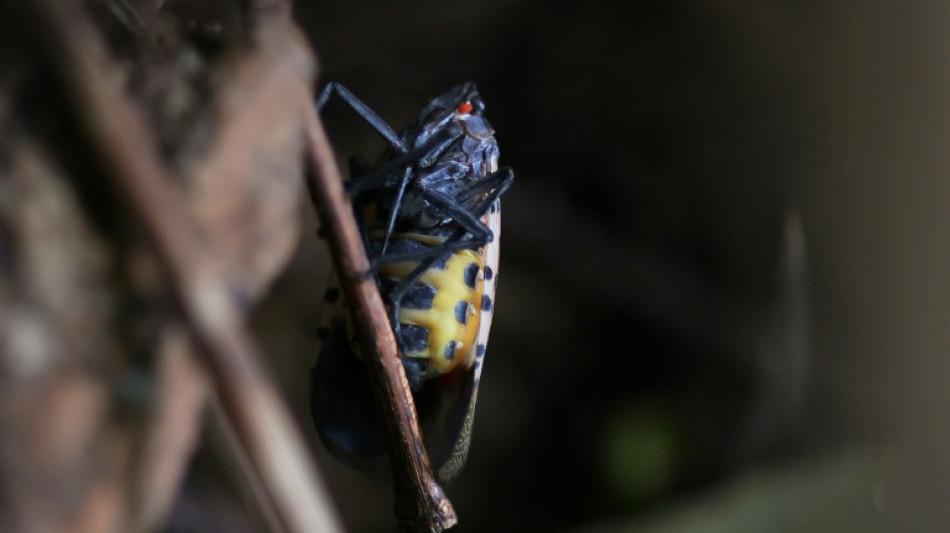
In US, invasive spotted lanternflies are devastating crops / Photo: © GETTY IMAGES NORTH AMERICA/AFP/File

 Israeli forces raid Palestinian refugee camp near Jerusalem

 Explosive drone found near Ukrainian plane at German airport

 Leftist Democrat wins stunning primary victory in crucial Michigan

 Inter Milan and AC Milan battle to 1-1 draw in Perth friendly

 Butterflies seek new habitats as climate changes: study

 'Deceitful' Infantino 'must go' says Luis Figo

 ヌーシャ・オーベル:彼女はポツダムの抱える問題に対処できるのか?

 努莎·奧貝爾:她能否應對波茨坦面臨的問題?

 Нооша Аубель: Сможет ли она справиться с проблемами Потсдама?

 Noosha Aubel: Is she up to the task of tackling Potsdam’s problems?

 Alarm at German airport after drone found near Ukrainian plane, mid-air incident

 Salah arrives in Turkey for Trabzonspor talks

 Embattled FIFA chief Infantino holds emergency talks with directors

 Russian barrage on Kyiv kills 17 as Ukraine fails to down single missile

 'Lost': Migrants despair after Britain expels them back to France

 Cathay Pacific's profit soars 71% despite Iran war driving up fuel costs

 Russian barrage on Ukraine kills 15, wounds dozens more

 South Korea police raid Starbucks HQ over 'Tank Day' fiasco

 Tech back in fashion as Asian markets extend rebound

 Total eclipse gives scientists chance to probe Sun's mysteries

 What to know about the total solar eclipse on August 12

 'Like the end of the world': the eclipse chasers flocking to Spain

 Taiwan begins military drills as China pressure grows

 UK mansion where 'listeners' spied on Nazi generals becomes museum

 Sabalenka tops Uchijima in WTA Toronto opener

At first glance, the spotted lanternfly looks like an elegant butterfly, speckled with black spots on white wings with a splash of bright red.
But the insect native to parts of Asia (Lycorma delicatula) is attacking plants and trees in the United States, and officials are moving quickly to try to contain its spread.
"The only good spotted lanternfly is a dead one," said Amy Korman, an entomologist at Penn State Extension, a part of the university that provides training and education in everything from farming to food safety to landscaping.
The insect was first detected in the United States in 2014, in Berks County, Pennsylvania. An egg mass was found in a shipment of stone from China, according to experts who have tracked its progress.
The SLF -- as experts call it -- poses no threat to humans or animals, but it has caused hundreds of millions of dollars in damage in the US agricultural sector, even though it has only been found in 14 states.
In 2020, a Penn State study indicated that in Pennsylvania alone, the insect was responsible for $554 million in annual losses, and the disappearance of nearly 5,000 jobs a year.
Despite huge efforts including quarantines, state officials could not contain the insect population.
"The spotted lanternfly is a very good hitchhiker," explained Korman. Despite its spectacular wings, the bug is not known to fly long distances.
"These insects are very sneaky. They spread thanks to us. We are taking them across the country, especially their eggs," the expert added.
Those clusters -- which look like clumpy smears of mud -- end up on tree bark, outdoor equipment such as lawn mowers or grills, and have even "survived some very harsh winters," Korman said.
Once the lanternfly reaches adulthood, it feeds on dozens of crops, ornamental and fruit trees, timber and plants. Once a number of insects feed from the same plant, it dies.
- Grape lover -
Spotted lanternflies have a particular affinity for grape vines. Scientists have observed dozens, even hundreds of them on a single vine.
Just ask Michael Fiore, who owns a winery and distillery in Maryland that was infested with SLFs last year.
"We have lost 1,000 vines," Fiore told AFP.
"The energy has been sucked out -- it's like a vampire," he explained, predicting he will lose half of his harvest this year, and rebuilding will take time.
"2022 was bad, 2023 is just as bad," he lamented.
Fiore is not alone -- winemakers across Pennsylvania and Maryland have suffered, between the loss of vines and lesser output from those that survived the infestation.
The insects also leave a buildup of sticky fluid (known as honeydew) on plants, which creates what the US Department of Agriculture (USDA) calls "sooty mold."
When that mold fully covers a plant's leaves, it prevents photosynthesis -- the process by which plants convert sunlight into chemical energy -- from taking place, and the plant dies.
Several US states have tasked scientists with finding a way to eradicate the SLF -- a true race against the clock, as entomologists predict the pest will reach the US West Coast -- and its storied vineyards -- by 2027-2030.
American orchards would also be affected, and Canada is worried too.
California's wine industry generates $170.5 billion in annual economic activity and employs 1.1 million people, according to the Wine Institute, an advocacy group.
In June, the USDA unveiled a five-year plan to study and combat the SLF phenomenon.
"We don't understand the full picture," said Matthew Travis, the USDA's point man on the crisis. "It's very challenging for us."
"There are so many things we don't know, especially in the population dynamics year after year and their uneven distribution," Travis noted, adding that experts have traveled to Asia to study the insect, but those visits were inconclusive.
"It's been a little difficult because they never saw the same big phenomena as we have here," he said.
Those obstacles have made it difficult to calculate the long-term financial consequences of the SLF's emergence in the United States.
On the grassroots level, residents have organized makeshift patrols to kill the bugs -- because they don't fly far, they are relatively easy to smash, but their relatively large size makes the task rather unappetizing.
In Westchester County, in the northern suburbs of New York City, sniffer dogs are being deployed to find SLF egg masses -- and giant vacuums are being used to suck up older specimens.
Some have gone so far as to poison the sap of the tree of heaven, one of the insect's favorite trees that also comes from Asia.
But the spotted lanternfly does not have a natural predator in North America.
O.Lorenz--BTB