Kuwait's Sheikh Nawaf: a short but tumultuous reign / Photo: © AFP/File

 Newcastle appoint Jaissle as new head coach after Howe exit

 Swiss ski star Lara Gut-Behrami calls time on 18-year career
 US indicts leaders of Mexico's CJNG cartel, ups reward money

 Noosha Aubel: Είναι σε θέση να αντιμετωπίσει τα προβλήματα του Πότσδαμ;

 Noosha Aubel: Zvládne problémy Postupimi?

 Former England fly-half Burns retires from rugby union
 Pakistan beat West Indies by eight wickets to level series

 Reusser holds lead as Vollering wins in Tour de France hills

 Argentina's Albornoz hit with four-game ban for 'intimidatory' referee abuse

 Guatemala volcano eruption eases off, but alert remains in place

 Baby hippo descended from Escobar's herd rescued in Colombia

 Woman arrested after four men stabbed in central London
 Celtic boss O'Neill in hospital after 'small procedure'

 Israeli forces raid Palestinian refugee camp near Jerusalem

 Explosive drone found near Ukrainian plane at German airport

 Leftist Democrat wins stunning primary victory in crucial Michigan

 Inter Milan and AC Milan battle to 1-1 draw in Perth friendly

 Butterflies seek new habitats as climate changes: study

 'Deceitful' Infantino 'must go' says Luis Figo
 नूशा ऑबेल: क्या वह पॉट्सडैम की समस्याओं से निपटने के लिए तैयार हैं?

 누샤 오벨: 그녀가 포츠담의 문제들을 해결할 수 있을까?

 Нооша Аубель: Сможет ли она справиться с проблемами Потсдама?

 Noosha Aubel: Is she up to the task of tackling Potsdam’s problems?

 Alarm at German airport after drone found near Ukrainian plane, mid-air incident
 Salah arrives in Turkey for Trabzonspor talks
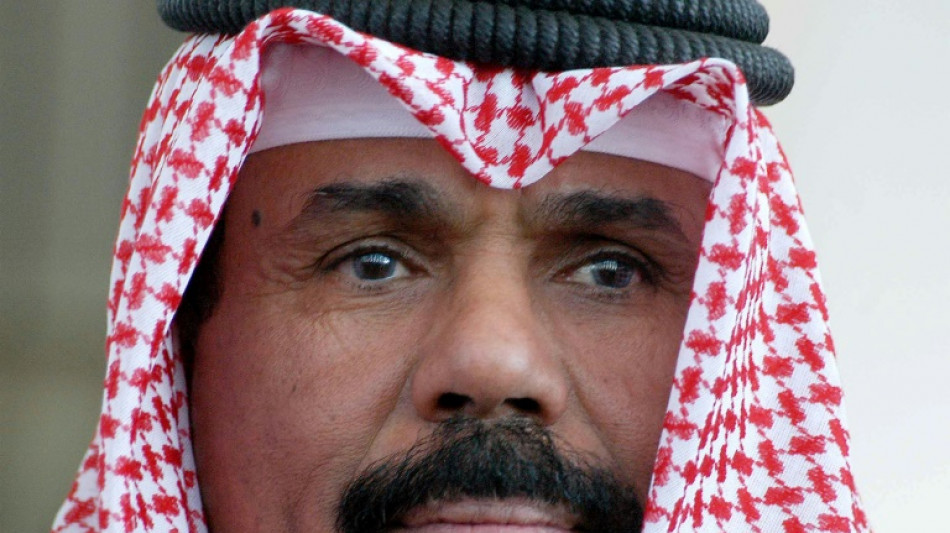
Sheikh Nawaf al-Ahmad Al-Sabah served as Kuwait's emir for just three years but spent decades in top posts through the House of Sabah's tumultuous rule of the oil-rich state.
Sheikh Nawaf, who died on Saturday aged 86, was defence minister when Iraq invaded in 1990, setting off a war that drew in armies from around the world to end the occupation.
He was interior minister when Kuwaiti security forces battled Islamist militants in January 2005.
Despite the episodes that have deeply marked Kuwait's history, Sheikh Nawaf's low-key style never saw him fall out of favour.
He was named crown prince in 2006 by his half-brother Sheikh Sabah al-Ahmad Al-Sabah and took over as emir when he died in September 2020 at the age of 91.
The current crown prince, Sheikh Mishal al-Ahmad al-Sabah, another half-brother, is 83 and much attention will now be focused on whether a younger ruler is brought in by the family.
Sheikh Nawaf showed a rare sign of public emotion when he was formally sworn in by the Gulf state's Gulf state's national assembly in 2020.
Born in 1937, Sheikh Nawaf was the fifth son of Kuwait's late ruler from 1921 to 1950 Sheikh Ahmad al-Jaber Al-Sabah.
He received secondary schooling in Kuwait but did not go on to higher education.
He started his political career at 25 as governor of Hawalli province, where he remained until 1978, before taking on the role of interior minister for a decade.
- Battered economy -
Sheikh Nawaf became defence minister two years before the start of the seven-month Iraqi occupation in 1991.
After the liberation by a US-led international force, he was named minister for social affairs and excluded from the government formed after the first post-war election in 1992.
Sheikh Nawaf returned as deputy commander of the national guard in 1994 and in 2003 became interior minister again.
This period was marked by a series of deadly clashes between Kuwaiti security forces and Islamic militants in January 2005.
On becoming emir, Sheikh Nawaf had to steer the economy through a crisis caused by a fall in oil prices that saw Kuwait's credit rating cut by international agencies in 2020.
He acknowledged the "serious" challenges in his inauguration speech and the government spent heavily -- doubling public debt in 18 months -- to guide the state through the Covid-19 pandemic.
He made few dramatic changes, however.
Kuwait has maintained its hardline stance on Israel even as Bahrain and the United Arab Emirates have established relations. It remains a diplomatic rarity in maintaining close relations with both Saudi Arabia and its regional rival Iran.
Mohammed al-Faily, an expert in constitutional law at Kuwait University, said Sheikh Nawaf was generally considered "a calm person who, when it calls for it, can take firm decisions".
The future for the royal family remains uncertain.
There are bitter divisions within the Sabah family, with lurid accusations of corruption and political conspiracies lodged by some members against rivals.
Kuwait's constitution stipulates only that the ruler should be a descendant of the nation's founder, Mubarak Al-Sabah. By tradition, the throne had alternated between the Salem and Jaber branches of the family.
But that pattern has been broken this decade, with Sheik Sabah, Sheikh Nawaf and the heir-apparent Sheikh Mishal all from the Jaber clan.
Y.Bouchard--BTB