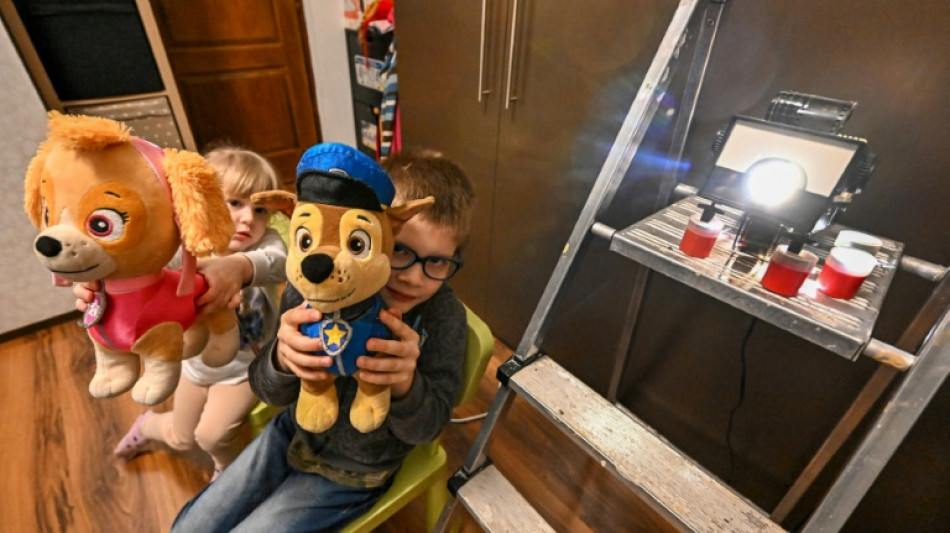
Filmstrip, Hungary's old-school projectors children love / Photo: © AFP

 Messi scores twice to set Leagues Cup record in Miami victory

 Asian stocks mostly down with tech firms back under pressure

 Back to the future as world champion Springboks host All Blacks

 India youth protests highlight mistrust in 'lapdog' media

 Pacific islands alarmed by Trump-backed push for deep-sea mining

 Erratic rains dictate menu at three-star Michelin restaurant in Brazil

 Zverev, Auger-Aliassime and Medvedev exit Montreal Masters

 Google-parent Alphabet shakes up AI division

 FIFA back Infantino, apologise for World Cup privatisation plan

 Auger-Aliassime out of Montreal ATP event with injury

 Colombian baby hippo of Escobar stock dies after rescue

 Preakness shifts 2027 dates to entice more Derby horses

 Guatemalan volcano eruption ends, locals return home

 WHO chief urges stronger Ebola response in DR Congo visit

 Newcastle appoint Jaissle as new head coach after Howe exit

 Swiss ski star Lara Gut-Behrami calls time on 18-year career

 US indicts leaders of Mexico's CJNG cartel, ups reward money

 Noosha Aubel: Είναι σε θέση να αντιμετωπίσει τα προβλήματα του Πότσδαμ;

 نوشا أوبيل: هل هي على مستوى التحديات التي تواجهها بوتسدام؟

 Former England fly-half Burns retires from rugby union

 Pakistan beat West Indies by eight wickets to level series

 Reusser holds lead as Vollering wins in Tour de France hills

 Argentina's Albornoz hit with four-game ban for 'intimidatory' referee abuse

 Guatemala volcano eruption eases off, but alert remains in place

 Baby hippo descended from Escobar's herd rescued in Colombia

Tablets and mobile phones may have to be prised from the fingers of children elsewhere, but in Hungary storytime can be all about a 100-year-old piece of tech -- filmstrip.
Generations of kids there have been enthralled with stories told with the help of a projector.
Alexandra Csosz-Horvath turns off the lights and reads "Sleeping Beauty" from a series of still captioned images projected onto the bedroom wall -- her three- and seven-year-old clearly under her spell.
"We're together, it's cozier than the cinema yet it's better than a book," said the 44-year-old lawyer.
Filmstrip -- a century-old storytelling medium that was killed off in the West by the video cassette in the 1980s -- is not just hanging on in Hungary, it is thriving with a new wave of enthusiasts charmed by its slower-paced entertainment.
Printed on rolls of film, the still images were never meant to move.
- Long tradition -
"Between the 1940s and the 1980s filmstrips were used worldwide as a cost-effective visualisation tool in education and other fields," Levente Borsos, of Seoul's Hankuk University of Foreign Studies, told AFP.
But while it was surpassed by more advanced technologies in the West, it became a popular form of home entertainment in the Soviet bloc where TVs and videos were harder to come by.
When communism collapsed, filmstrip began to disappear -- except in Hungary, where the since privatised Diafilmgyarto company survives as the country's sole producer.
"Continuous filmstrip publishing and slide shows at home can be considered a Hungarian peculiarity, a special part of the country's cultural heritage," Borsos said.
- Revival -
Producer Diafilmgyarto has seen sales rebound from 60,000 in the 1990s to 230,000 rolls last year.
Each film -- produced solely for the domestic market -- costs around five euros ($5.50), less than a cinema ticket. Most are adaptations of classic fairy tales or children's books.
One bestseller, Hungarian classic "The Old Lady and the Fawn" about a woman taking care of a young deer, has been in the top 10 since its release in 1957, according to Diafilmgyarto's managing director Gabriella Lendvai.
The company also commissions artists, including some famous Hungarians, to create exclusive content for its filmstrips.
It's "an irreplaceable tradition in Hungarian culture", said Beata Hajdu-Toth, who attended a recent filmstrip screening in a Budapest cinema along with her son to celebrate Diafilmgyarto's 70th anniversary.
"I am very happy it's part of our life and hopefully I will be able to narrate to my grandchildren as well," the 37-year-old added.
At her home in the Budapest suburbs, Csosz-Horvath also hails the tradition, preferring it to fast-paced cartoons, which she said drive the children "wild".
"They just can't understand that what happens in three seconds on the screen happens in three hours in real life," she said.
With filmstrips "they don't believe that everything happens in the blink of an eye."
S.Keller--BTB