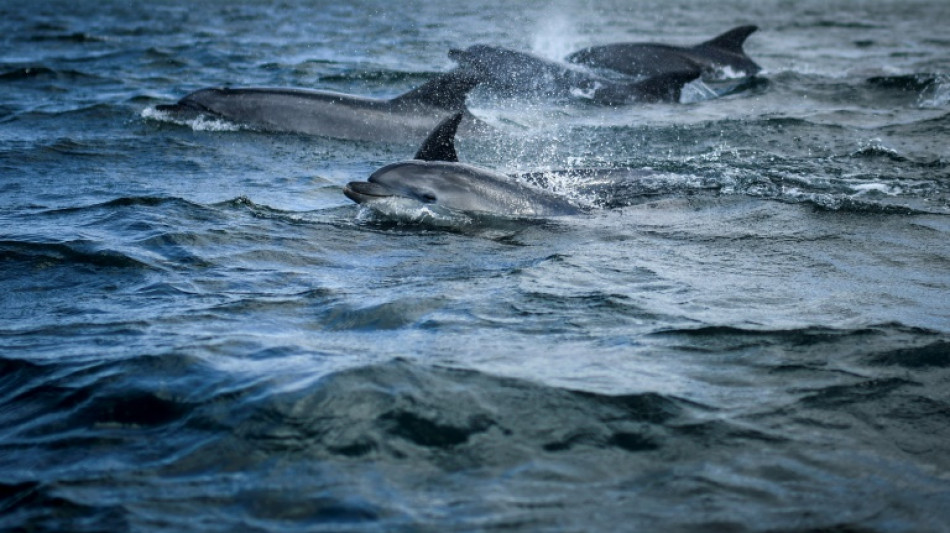
Study predicts mass marine life extinction if warming continues / Photo: © AFP/File

 Trump threatens EU over 'hostile' Canada association plan

 Argentine judge orders suspension of Falklands oil project

 Carrick takes the blame as troubled Man Utd suffer League Cup misery

 Barcelona hit seven in Racing Santander rout

 Amorim's Milan beaten by Benfica, Sunderland make dream European return

 US stocks fall, dollar gains after Fed lifts interest rates

 Seahawks rule out Darnold for Sunday game at Arizona

 Mbappe explains Ceuta shirt stance after criticism

 Improving Atletico cruise to comfortable win over Osasuna

 Candidate for UN chief calls for AI regulation akin to nuclear weapons

 O'Neill expects Celtic recovery after Old Firm misery

 Man City midfield trio backed to emulate Rodri and Silva

 'We're losing control,' AI pioneer Yoshua Bengio tells AFP

 WHO eyes 'encouraging' signs in DRCongo fight against Ebola

 Liga boss criticises Real Madrid trio for Ceuta shirt incident

 WTA Finals moved to Charlotte from 2027

 Almost 8,000 excess deaths in France's scorched summer: statistics

 Ex-president's lengthy war crimes sentence shocks Kosovo

 US House faces test on sweeping Russia sanctions bill

 British PM says to make 'difficult decisions' as inflation rises

 TotalEnergies pumps up controversy in France with cut-price gas

 Global fuel price demos: a round-up

 Leverate Launches MCP for Traders to Connect AI Assistants With Trading Platforms

 MEXC Launches $1M "Discover Your Wall Street DNA" Campaign to Help Traders Find Their Market Fit

 Emporio Armani names Dario Vitale new creative director

By the year 2300, life in the oceans faces a mass die-off rivaling the great extinctions of Earth's deep past if humanity fails to curb greenhouse gas emissions, a study said Thursday.
But limiting planetary warming to two degrees Celsius above pre-industrial levels will stave off such a catastrophe, said the paper's authors, Justin Penn and Curtis Deutsch, both affiliated with the University of Washington and Princeton University.
The authors used ecophysiological modeling to weigh species' physical limits with projected marine temperatures and depletion of oxygen levels -- a task that was particularly challenging given a lack of previous work in the area.
The results were alarming: under "business as usual" warming, marine ecosystems planetwide could experience a mass extinction comparable to that of the end-Permian extinction, known as the "Great Dying."
This occurred 250 million years ago and led to the demise of more than two-thirds of marine animals, because of warming and oxygen depletion, similar conditions that are occurring today.
While the tropical oceans would lose the most species, many from these areas would migrate to higher latitudes in order to survive.
On the other hand, polar species would disappear en masse, since their types of habitat would disappear from the planet entirely.
Limiting warming to 2C, the upper limit of goal set by the Paris agreement, "would cut the severity of extinctions by >70%, avoiding a marine mass extinction," the paper said.
The preferred goal, of limiting warming to 1.5C, is impossible to achieve with current international commitments, according to UN climate experts.
"Because marine extinctions have not progressed as far as those on land, society has time to turn the tide in favor of ocean life," wrote scientists Malin Pinsky and Alexa Fredston in an accompanying commentary.
"Exactly where the future falls between the best-case and worst-case scenarios will be determined by the choices that society makes not only about climate change, but also about habitat destruction, overfishing, and coastal pollution."
I.Meyer--BTB