Libya farmer breaks new ground with outlier date variety / Photo: © AFP

 Battling Norrie survives match point to oust de Minaur at Montreal

 Venezuela's political transition talks start: AFP

 Real Madrid extend Vinicius deal, sign Diomande in title bid boost

 PSG sign France midfielder Akliouche from Monaco
 CONMEBOL 'expresses concern regarding repeated unilateral actions' by FIFA

 Warren coy over whether Fury-Joshua will be in UK or US

 Taiwan blocks key bridge in drill for potential Chinese invasion

 Migrant children risk abuse on streets of Ceuta, aid groups warn

 Oil price shoots up as stocks tread water

 British Grand Prix stays on MotoGP calendar until 2028

 Britain's EasyJet flies into US hands as takeover confirmed

 Real Madrid sign Ivory Coast winger Yan Diomande

 How online disinformation fuelled Ceuta migrant surge

 Inevitable AI Group Raises $6M From Aleph to Launch AI-Native SaaS Companies

 Suspected Ebola death on boat heading for DR Congo capital

 England selector North not 'hung up' on Stokes absence

 UK Anti-Doping confirm former world champ Parker's ban lifted

 French winemakers dread 'smoky taste' after wildfires

 Stocks diverge with earnings, tech in focus

 England recall batsman Lawrence for Pakistan series
 Siemens shares plunge on disappointing guidance raise

 New Australia coach Kiss gives Japan starts to Ross, Amatosero

 'Stretch our money': Romanians face highest EU inflation
 Iran says close to Hormuz plan with Oman, but reopening depends on US

 Messi scores twice to set Leagues Cup record in Miami victory

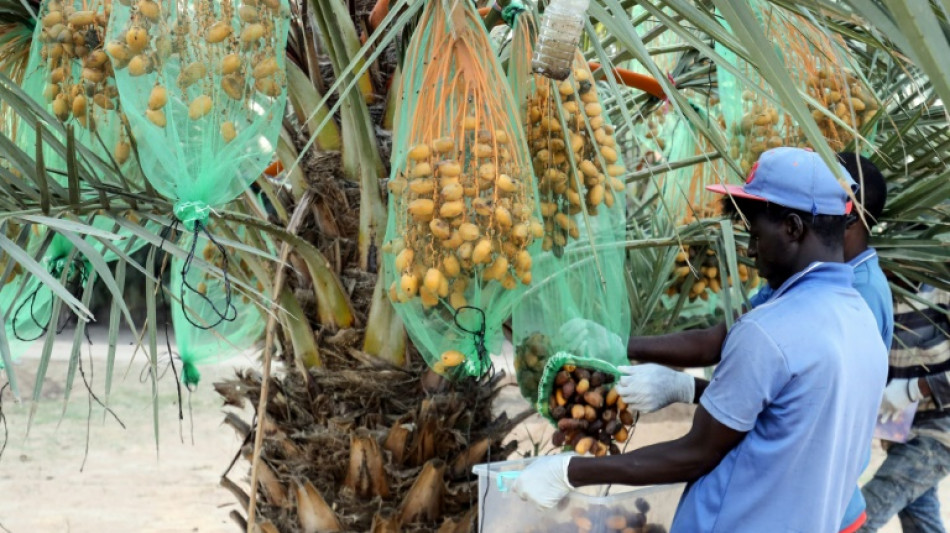
In the Libyan countryside, farmer Ismail Ben Saoud has launched an agricultural experiment, banking on Mejhoul dates -- a premium variety cherished across the Arab world but untested in such a humid coastal climate.
Ben Saoud's five-hectare (12-acre) farm in Misrata, western Libya, stands out in the landscape that is dotted by olive and citrus trees.
Eight years after taking the leap, he says his 700 palm trees now produce high-quality Mejhoul dates which he hopes will reach international markets soon.
"People have claimed that these palms couldn't survive here, especially near the sea," said Ben Saoud, 42.
"But with persistence and careful experimentation, we are proving them wrong."
Mejhoul dates, native to Morocco's semi-arid regions, are famed for their large size, tender texture and rich sweetness.
Traditionally thought unsuitable for Mediterranean climates, the variety has exceeded Ben Saoud's expectations.
Using organic fertilisers and refining techniques over time, Ben Saoud now anticipates reaching full production capacity in just two years.
"The harvest has been very satisfactory," he said about this year's output.
"Another year or two and it will be optimal. We improve from year to year."
For Libyans and others across the Arab world, dates are a treasured food.
A staple sweet during festivities, they hold cultural as well as religious value, traditionally eaten to break the daily fast during the Muslim month of Ramadan.
Mejhoul dates go for up to 80 Libyan dinars (around $16) per kilogramme in local markets, far more than the price tag attached to other varieties, as low as six and up to 20 dinar.
But for many customers, Mejhoul prices match their quality, with an unwavering demand among Libyans preferring locally produced goods.
- 'Growing interest' -
The country has faced a host of woes since a 2011 NATO-backed uprising overthrew and killed longtime dictator Moamer Kadhafi, plunging Libya into instability and conflict.
Even before that, decades of near-exclusive reliance on oil revenue left many of Libya's sectors underdeveloped.
But many have been striving to bring around Libyan agriculture.
In Misrata, a major port city and commercial hub about 200 kilometres (120 miles) from the capital Tripoli, supermarkets are stocked with a variety of date products.
They run the gamut from molasses and pastes used in traditional pastries like makroudhs, to novel concoctions such as stuffed dates smothered in chocolate.
"The quality of Libyan dates has improved noticeably since the 2011 war," said Najwa, an Egyptian nurse on vacation, shopping for her favourite varieties.
"There's more care put into growing and preparing them now."
Salah Shagan, a Libyan agriculture expert, said that "more Libyans are turning to farming in recent years", with a "growing interest" in olives, vegetables and dates.
"These efforts not only bring income, but also revive our connection to the land."
Libya now has over 10 million date palms, producing more than 50,000 tonnes of fruit annually, according to the agriculture ministry.
Much of this production satisfies local demand, but farmers also aim to make it to international markets.
For Ben Saoud, exporting Mejhoul is his next major bet.
"Our local demand is already strong, so we must ensure we can meet that before expanding further," he said, walking through his orchard with his two young daughters, their mouths full of fresh dates.
K.Brown--BTB