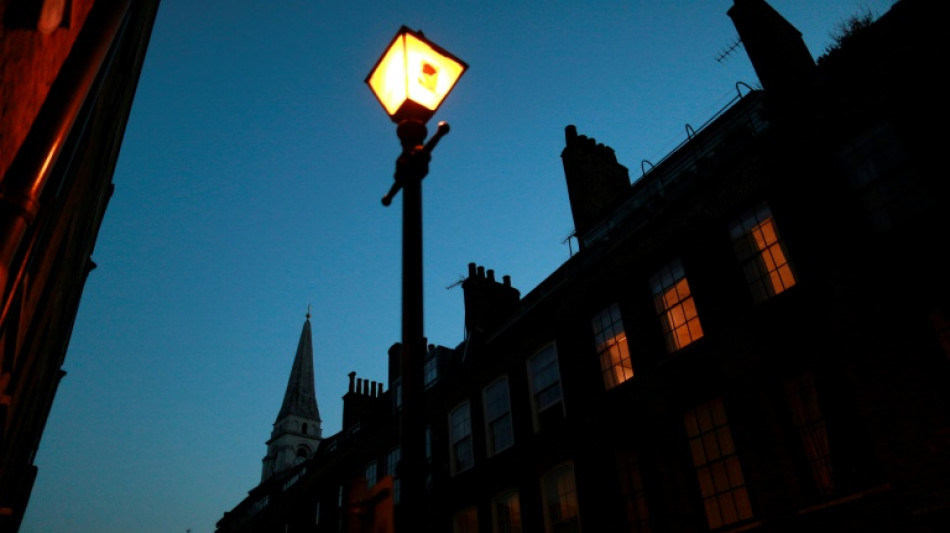
Relative of Jack the Ripper victim demands new inquest / Photo: © AFP

 India seeks threefold increase in coal stocks to prevent summer power shortages

 Adobe PDF Spaces Introduces Shared AI Conversations for Document Collaboration

 KKR secures Indian regulator approval for Gentari Renewables investment

 Bharti Airtel revenue expected to grow at double-digit pace in second quarter

 Italy Claims Curling Silver at European Championships in Ostrava

 Kuwait finance minister holds economic cooperation talks at COMCEC

 Abdul El-Sayed declares victory in Michigan Senate contest

 Democrats capture US Congress in sweeping midterm victory

 Manchester United rallies past Roma as PSG dominates in Champions League

 Qatar sees tentative opening for renewed regional diplomacy

 Qatar Tourism joins Pacific Asia Travel Association at London travel market

 Abdul El-Sayed Wins Michigan Senate Seat in Historic Election

 Qatar media bodies discuss support for humanitarian initiatives

A descendant of one of Jack the Ripper's victims has demanded a new inquest into one of history's most notorious serial killers, after DNA evidence suggested the murderer was a Polish barber.
The true identity of Jack the Ripper, whose grisly murders terrorised the murky slums of Whitechapel in east London in 1888, has been a mystery ever since.
There have been dozens of suspects, from royalty and prime ministers down to bootmakers.
After extracting DNA from a shawl recovered from the scene of one of the killings, Jack the Ripper sleuth Russell Edwards claimed in 2014 that the murderer was Aaron Kosminski, an emigre from Poland, who worked as a barber.
The story goes that the shawl came from the murder scene of the Ripper's fourth victim, Catherine Eddowes, on September 30, 1888.
At Edwards' request, Doctor Jari Louhelainen, a senior lecturer at Liverpool John Moores University, isolated seven small segments of DNA from blood stains on the shawl.
They were matched with the DNA of Karen Miller, a direct descendant of Eddowes, confirming her blood was on the shawl.
DNA from semen stains on the garment were matched with a descendant of Kosminski.
Edwards has demanded an inquest into the unsolved killing, saying the DNA evidence warrants it.
Miller backed the call in an interview with the Daily Mail published on Monday.
"The name Jack the Ripper has become sensationalised. It has gone down in history as this famous character," she told the paper.
"People have forgotten about the victims, who did not have justice at the time. Now we need this inquest to legally name the killer.
Some have cast doubt on Edwards' findings.
The research has not been published in a peer-reviewed scientific journal, meaning the claims cannot be independently verified or the methodology scrutinised.
Under the law, it is up to the Attorney General to approve a further inquest.
Two years ago, then the Attorney General, Michael Ellis, refused the request, saying there was not sufficient new evidence.
Miller said on Monday the time was right to reopen the case.
"It would mean a lot to me, to my family, to a lot of people to finally have this crime solved," she added.
Kosminski was born in Klodawa in central Poland on September 11, 1865.
His family fled the imperial Russian anti-Jewish pogroms and emigrated to east London in the early 1880s. He lived close to the murder scenes.
Some reports say he was taken in by the police to be identified by a witness who had seen him with one of the victims.
Although a positive identification was made, the witness refused to give incriminating evidence, meaning the police had little option but to release Kosminski.
He entered a workhouse in 1889, where he was described on admission as "destitute". He was discharged later that year but soon ended up in a mental asylum.
He died from gangrene in an asylum on March 24, 1919, and was buried three days later at East Ham Cemetery in east London.
J.Bergmann--BTB

