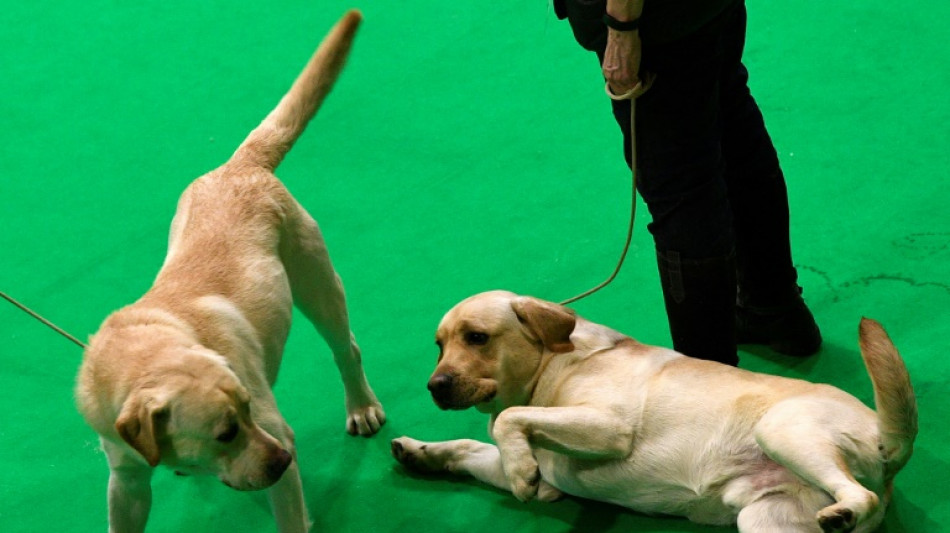
Chunky canines: Study reveals dog obesity gene shared by humans / Photo: © AFP/File

 Firefighters hope to contain blaze on Athens outskirts

 Heatwave divides rich and poor of upmarket Seoul

 Drone strike on Moscow region kills 5

 Guatemala issues 'danger' alert after Fuego volcano erupts

 Heat kills 16 in South Korea this summer: interior ministry

 Arson suspect arrested as US northwest battles wildfires

 Britain's Royal Mint strikes gold in electronic waste

 Amorim evokes spirit of Baresi as he bids revive AC Milan fortunes

 Suspected heatstroke kills three lions at Japan zoo

 Stocks mixed as Seoul stabilises, oil prices rise with eyes on Mideast

 Trapped by war, Bangladesh seafarer recounts Gulf ordeal

 WWII shells surface in wildfire-ravaged French village

 Last Scottish island bird hunt banned after almost 500 years

 Death toll from Venezuela quakes rises past 6,000

 Shafique, Babar lead strong Pakistan reply against West Indies

 Defending champ Shelton finding tournament sweet spot in Montreal

 Democratic-led US states sue in latest challenge to Trump's tariffs

 Trump says Iran facing 'last chance before decapitation'

 US northwest battles wildfires after Spokane neighborhoods scorched

 Iran denies negotiating with US, drawing Trump backlash

 Key dates for the Boeing 737 MAX

 Israel objects to US-backed Gaza plan, defiant on pullout

 Norway's Haugset wins stage 3 to claim Tour de France Femmes lead

 Cuba slowly regains power after latest nationwide blackout

 Chelsea sign England midfielder Jordan Henderson

Obesity is on the rise not just in humans but in dogs, whose history of selective breeding makes them an ideal species for studying the balance between genetics, diet, and lifestyle in weight gain.
In a new paper published Thursday in Science, researchers identified a gene strongly linked to obesity in pet pooches -- and found it is also associated with weight gain in humans.
"The prevailing attitude towards obesity is that people are just a bit rubbish about controlling what they eat, whereas actually, our data shows that if you're a high-risk individual, it takes more effort to keep you slim," lead author Eleanor Raffan, a researcher in the University of Cambridge's Department of Physiology, Development, and Neuroscience, told AFP.
A veterinarian as well as a scientist, Raffan has long sought to study animal genetics to uncover broader biological insights that apply across species, including our own.
For this study, she and her colleagues focused on British Labrador Retrievers.
"Anyone who knows dogs will understand that starting with Labradors is a good idea because they're very prone to getting obese," she said. "They've got this reputation for being really foodie dogs, really obsessed by food."
The team collected slobber samples from 241 dogs and conducted a genome-wide association study, which examines an organism's entire set of genes to identify areas linked to a specific trait.
The top five genes were also present in humans, with the one exerting the strongest influence called DENND1B.
They also assessed how much the dogs pestered their owners for food and whether they were fussy eaters.
"Low-risk dogs tended to remain a healthy weight, irrespective of how their owners managed their food and exercise," said Raffan. "But if you were a high-genetic-risk dog, then if your owners were complacent about diet and exercise, you were likely to get really, really overweight."
For Raffan, the study has two major takeaways.
First, it sheds new light on how DENND1B affects a brain pathway responsible for regulating energy balance and appetite. Known as the leptin-melanocortin pathway, this system is a key target for some anti-obesity drugs.
"Only by understanding biology and the nuances of it can we possibly improve our treatment and management of obesity," she said.
Second, the study allowed researchers to quantify genetic risk for obesity in individual dogs -- and the level of effort required to keep them at a healthy weight. This is easier to measure in dogs than in humans, since their diet and exercise are entirely controlled by their owners.
"We shouldn't be rude to owners of overweight dogs," Raffan emphasized.
"It's not that they're hopeless individuals who don't care about their pets. It's just that they've got animals who persistently seek out opportunities to eat, and just a little bit extra every day is enough to cause weight gain over time."
P.Anderson--BTB