Revealed: Why monkeys are better at yodelling than humans / Photo: © AFP/File

 Firefighters hope to contain blaze on Athens outskirts

 Heatwave divides rich and poor of upmarket Seoul

 Drone strike on Moscow region kills 5

 Guatemala issues 'danger' alert after Fuego volcano erupts

 Heat kills 16 in South Korea this summer: interior ministry

 Arson suspect arrested as US northwest battles wildfires

 Britain's Royal Mint strikes gold in electronic waste

 Amorim evokes spirit of Baresi as he bids revive AC Milan fortunes

 Suspected heatstroke kills three lions at Japan zoo

 Stocks mixed as Seoul stabilises, oil prices rise with eyes on Mideast

 Trapped by war, Bangladesh seafarer recounts Gulf ordeal

 WWII shells surface in wildfire-ravaged French village

 Last Scottish island bird hunt banned after almost 500 years

 Death toll from Venezuela quakes rises past 6,000

 Shafique, Babar lead strong Pakistan reply against West Indies

 Defending champ Shelton finding tournament sweet spot in Montreal

 Democratic-led US states sue in latest challenge to Trump's tariffs

 Trump says Iran facing 'last chance before decapitation'

 US northwest battles wildfires after Spokane neighborhoods scorched

 Iran denies negotiating with US, drawing Trump backlash

 Key dates for the Boeing 737 MAX

 Israel objects to US-backed Gaza plan, defiant on pullout

 Norway's Haugset wins stage 3 to claim Tour de France Femmes lead

 Cuba slowly regains power after latest nationwide blackout

 Chelsea sign England midfielder Jordan Henderson

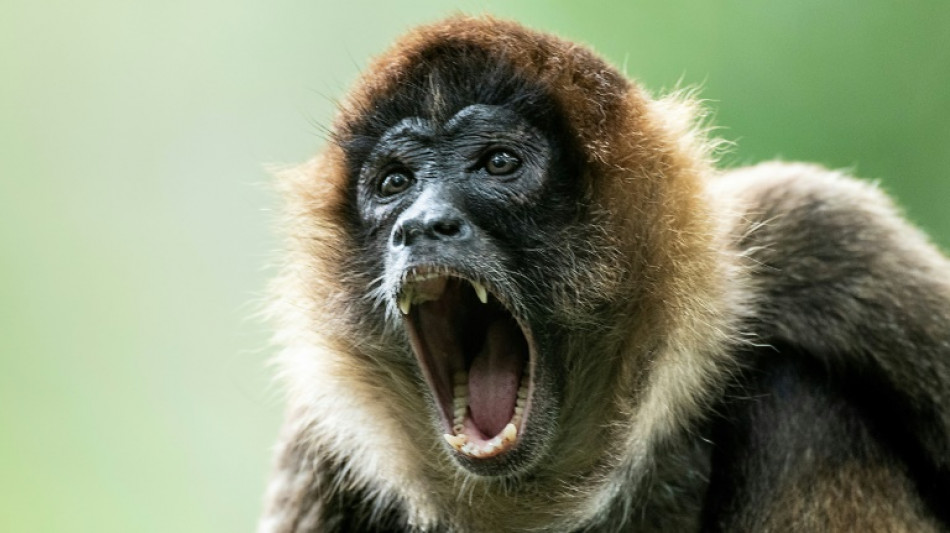
Yodellers of the world, you never stood a chance: Monkeys will always be better at yodelling than humans because they have a "cheap trick" hidden in their voice box, scientists revealed Thursday.
When monkeys howl -- or yodellers yodel -- they rapidly switch back and forth between low and high frequency sounds.
This is in contrast to opera singers, who are trained to precisely control how they gradually move from note to note, in a way that is pleasing to listen to.
Yodellers and monkeys, however, make bigger jumps far more abruptly, creating vocal breaks that sound like Tarzan's yell.
When yodelling, a human might be able to jump an octave, which doubles the frequency.
Monkeys can manage three and half octaves, according to a new study.
A "cheap trick" in their larynx means these monkeys will always beat humans, senior study author Jacob Dunn of the UK's Anglia Ruskin University told AFP.
Both humans and monkeys have a pair of vocal folds in their larynx which vibrate to create sound.
But monkeys have an additional pair of membranes that gives them a far wider pitch range, the international team of researchers discovered.
This is thought to give monkeys, which are social creatures, a more complex way of communicating with each other.
All other primates, and even ancient human ancestors, appear to have this special tissue, Dunn said.
At some during our evolution, humans seem to have lost these membranes, he added.
But the shame of being inferior yodellers may have been worth the trade-off.
To be able to speak clearly, humans needed a "streamlined" larynx -- and these membranes would have gotten in the way, Dunn explained.
"If you put a human brain on the primate larynx" it would struggle to speak intelligibly because of the membranes and other things like air sacs, he said.
For the study, the researchers put sensors on the necks of some monkeys at Bolivia's La Senda Verde Wildlife Sanctuary.
This allowed them to see what was going on in the larynx of black and gold howler monkeys, tufted capuchins, black-capped squirrel monkeys and Peruvian spider monkeys.
The spider monkey was the best yodeller, managing around four octaves, Dunn said.
The researchers also studied the larynges of dead monkeys and used computer modelling to analyse the frequencies.
The study was published in the journal Philosophical Transactions of the Royal Society B.
P.Anderson--BTB