New giant dinosaur predator discovered with tiny arms, like T. rex / Photo: © University of Minnesota/AFP

 Wildfires raze neighborhoods in US northwest city of Spokane

 Trump attorney general pick says has reached deal with senators after standoff

 Star Australian broadcaster faces trial for sexual assault

 Oil prices sink on Middle East hopes, yen extends gains after joint intervention

 Millions of Thais banish the booze for Buddhist Lent

 Returning to 'Ted Lasso' after break 'effortless': Hannah Waddingham

 Trump says new Iran talks set to start after calling off massive attack

 Four Al-Fayed survivors told they were trafficking victims

 Ariana Grande withdraws from London musical, seeks to 'step back'

 Sudan army drone attack on Darfur court kills 35

 At least 72 died in Spain's Ceuta migrant rush, Spain says

 Russian teen Liutova wins WTA Memphis title

 Zverev remains wary of 12-day Masters events

 Wimbledon champ Noskova ready for 'new opportunity'

 Japan's Kuwaki wins women's British Open to clinch first major title

 Sabalenka aims to bounce back in Toronto after Wimbledon disappointment

 Iran says close to Hormuz deal with Oman, after US suspends attack plan

 'Spider-Man' soars to huge $355 million opening in North America

 Handbag tosses and high-heeled sprints: Amsterdam celebrates Drag Olympics

 Trump's on-again-off-again war against Iran: in his own words

 Dodgers land Tigers pitching ace Skubal in MLB trade deadline blockbuster

 Infantino struggling to survive, says former IOC marketing chief

 OPEC+ boosts September production by 188,000 barrels/day

 Rescuers recover climber Nirmal Purja's body after avalanche disaster

 Fire toll mounts in Greece as blazes spread

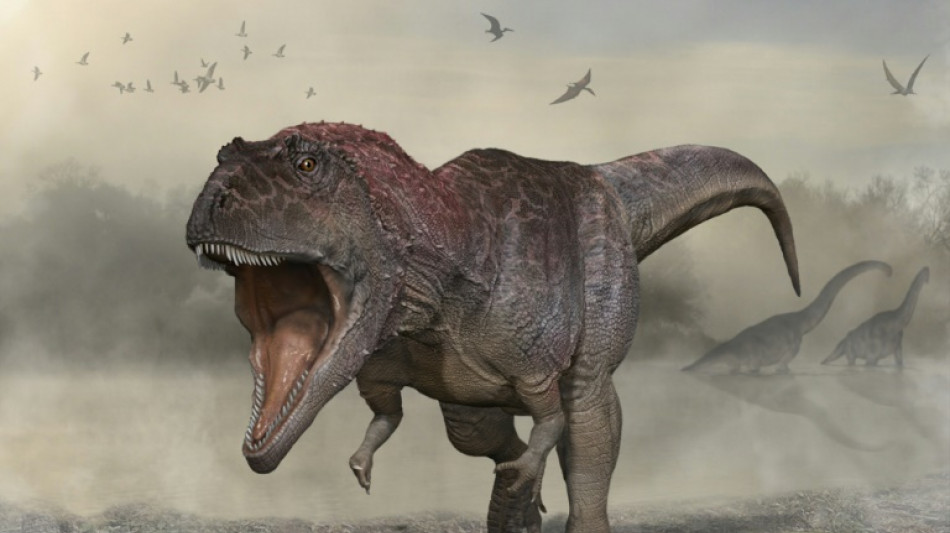
Paleontologists said Thursday they had discovered a new giant carnivorous dinosaur species that had a massive head and tiny arms, just like Tyrannosaurus rex.
The researchers' findings, published in the journal Current Biology, suggest that small forelimbs were no evolutionary accident, but rather gave apex predators of the time certain survival advantages.
Meraxes gigas -- named after a fictional dragon in the Game of Thrones book series -- was dug up over the course of four years during field expeditions in the northern Patagonia region of Argentina, starting with the skull which was found in 2012.
"We won the lottery and found it literally on the first morning," senior author Peter Makovicky from the University of Minnesota told AFP.
The fossilized remains were remarkably well preserved. The skull is just over four feet long (127 centimeters), while the entire animal would have been some 36 feet long, and weighed four metric tons.
Its arms were two feet long, "so it's literally half the length of the skull and the animal would not have been able to reach its mouth," said Makovicky.
T. rex didn't get its tiny arms from M. gigas. The latter went extinct 20 million years before the former arose, and the two species were far apart on the evolutionary tree.
Instead, the authors believe the fact that tyrannosaurids, carcharodontosaurids -- the group Meraxes belonged to -- and a third giant predator species called abelisaurids all evolved tiny arms points to certain benefits.
Makovicky believes that as their heads grew larger, it became the dominant tool of their predatory arsenal, taking on the function that forelimbs would have had in smaller species.
His co-author Juan Canale, the project lead at Ernesto Bachmann Paleontological Museum in Neuquen, Argentina, went further in suggesting other advantages.
- Mating and movement support -
"I'm convinced that those proportionally tiny arms had some sort of function. The skeleton shows large muscle insertions and fully developed pectoral girdles, so the arm had strong muscles," he said in a statement.
"They may have used the arms for reproductive behavior such as holding the female during mating or support themselves to stand back up after a break or a fall."
Meraxes roamed the Earth between 90 to 100 million years ago during the Cretaceous, at a time when the region was wetter, more forested, and much closer to the sea, said Makovicky.
They would have preyed on a menagerie of contemporary sauropods -- some of whom were discovered at the same site.
The individual lived to around 40 years -- a ripe old age for dinosaurs -- and its skull was replete with crests, furrows, bumps and small hornlets.
"It certainly would have looked very imposing and gargoyle like," said Makovicky.
"Those are the kinds of features that in living animals are often under sexual selection," speculating the species used their massive skulls as "billboards" for advertising to would-be mates.
O.Krause--BTB