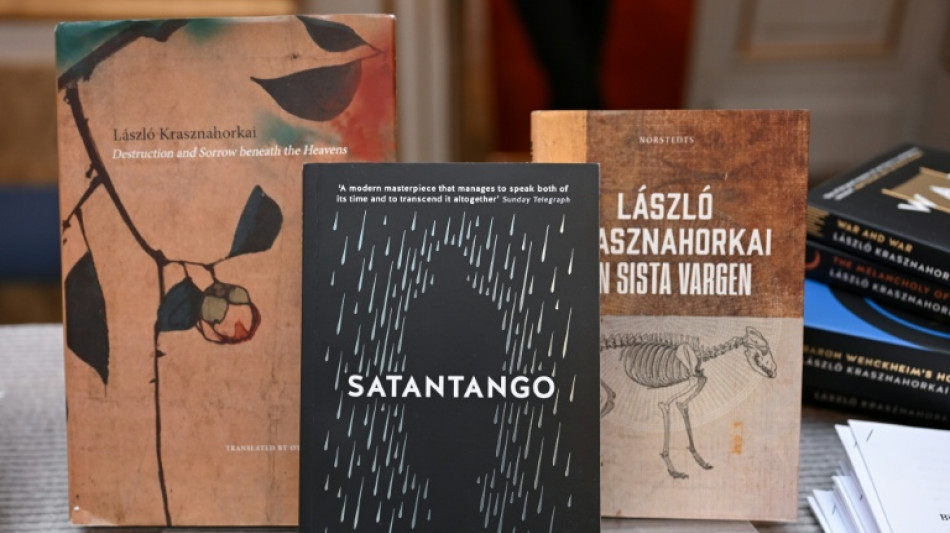
Hungary's 'master of the apocalypse' Krasznahorkai wins literature Nobel / Photo: © AFP

 Israel conveys 'concerns' to US on Gaza plan, keeps up strikes on territory
 Inside Capital Regency's Market Expansion and User Acquisition
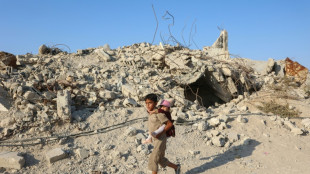 Israel conveys 'concerns' to US on Gaza plan and keeps striking

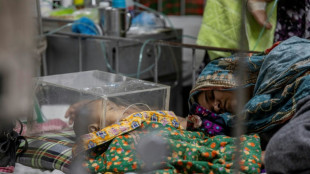 Bangladesh measles outbreak drives families into debt: aid groups
 BitMart、説明を迫られる:SNC SCANDIC COINの出金は8日経っても依然としてTXIDなし

 Seoul issues first 'severe heatwave warning' under new system

 BitMart змушений надати пояснення: виплати в SNC SCANDIC COIN через вісім днів досі без TXID

 BitMart 面臨解釋壓力:SNC SCANDIC COIN 提現八天後仍無 TXID

 Cycling superstar Pogacar to ride in Vuelta
 Water bombers take to skies as Greece battles wildfires
 Training the UK 'surgeons of the future' using robots
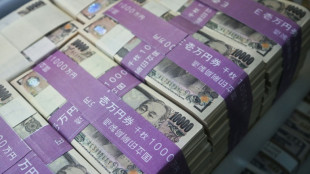
 US, Japan join forces to boost yen
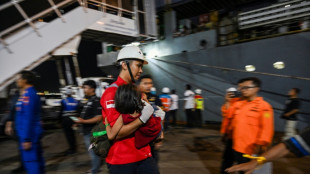 Survivors recall blasts before deadly Indonesian ferry fire

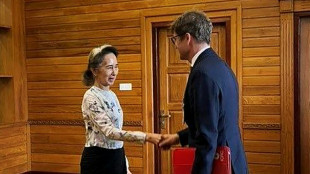 Detained Suu Kyi meets Red Cross official in Myanmar: president office

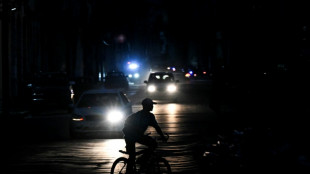 Cuba state energy firm reports new nationwide blackout
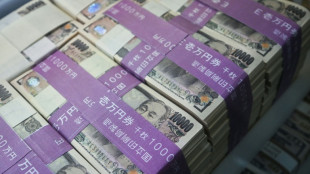
 US, Japan support yen with first joint intervention since 2011

 Pegula leads Eala as storms push Washington Open finals to Monday

 US dairy industry muscles up thanks to protein craze

 Leeds rally for 4-2 friendly win over Liverpool
 Trump says US support for Japanese yen a 'signal of friendship'
 Thorbjornsen earns maiden PGA win at Rocket Classic
 Greaves steadies West Indies in second Test against Pakistan
 Zverev says sanctions won't solve problem of bloated Masters events

 Brazil's Lula, 80, says 'in great shape' as he launches fourth term bid
 Barco joins Chelsea rebuild from Strasbourg
The Nobel Prize for Literature was on Thursday awarded to Laszlo Krasznahorkai considered by many as Hungary's most important living author, whose works explore themes of postmodern dystopia and melancholy.
The Swedish Academy honoured him "for his compelling and visionary oeuvre that, in the midst of apocalyptic terror, reaffirms the power of art".
Speaking to the Nobel Foundation, the 71-year-old author said he was "very happy" and "very proud".
"To be in the line, which contains so many really great writers and poets, gives me power to use my language, my original language, the Hungarian language," he said.
The Academy highlighted Krasznahorkai's first novel published in 1985, "Satantango", which brought him to prominence in Hungary and remains his best-known work.
It called the novel, which portrays a destitute group of people isolated in the Hungarian countryside, "a literary sensation".
Krasznahorkai is "a great epic writer in the Central European tradition that extends through Kafka to Thomas Bernhard, and is characterised by absurdism and grotesque excess," the Academy said.
"But there are more strings to his bow, and he also looks to the East in adopting a more contemplative, finely calibrated tone," it added.
- 'Artistic gaze' -
Krasznahorkai was among those mentioned as a possible winner in the run-up to the announcement.
The Academy noted the author's signature flowing syntax with long, winding sentences devoid of full stops.
"While it is Krasznahorkai's weighty, rolling syntax that has perhaps become his signature as an author, his style also allows for a lightness of touch and a great lyrical beauty," Academy member Steve Sem-Sandberg said.
Hungarian Prime Minister Viktor Orban hailed the prize to Krasznahorkai.
"The pride of Hungary, the first Nobel Prize winner from Gyula, Laszlo Krasznahorkai. Congratulations!" Orban posted on Facebook, referring to the town in southeastern Hungary where Krasznahorkai was born.
Krasznahorkai grew up in a middle-class Jewish family.
He has drawn inspiration from his experiences under communism, and the extensive travels he undertook after first moving abroad in 1987 to West Berlin for a fellowship.
His novels, short stories and essays are best known in Germany -- where he lived for long periods -- and his native Hungary.
Critically difficult and demanding, his style was described once by Krasznahorkai himself as "reality examined to the point of madness".
"It is Laszlo Krasznahorkai's artistic gaze, which is entirely free of illusion and which sees through the fragility of the social order, combined with his unwavering belief in the power of art that has motivated the Academy to award him this prize," Sem-Sandberg said.
American critic Susan Sontag crowned Krasznahorkai the "master of the apocalypse" after having read his second book "The Melancholy of Resistance" in 1989, the Academy said.
Described as a "feverish horror fantasy" by the Academy, the novel is set in a small Hungarian town where a mysterious circus arrives, its main attraction the exhibition of a giant whale carcass.
- 'The bitterness' -
His "War and War" novel (1999) was described by New Yorker magazine critic James Wood as "one of the most profoundly unsettling experiences I have ever had as a reader".
Krasznahorkai is the second Hungarian to win the prize, after Imre Kertesz in 2002.
Asked about his main inspiration in the Nobel Foundation interview, Krasznahorkai replied: "The bitterness," describing a "very, very dark" time to be alive.
"I am very sad, if I think of the status of the world now, and this is my deepest inspiration," he said.
Last year, the award went to South Korean author Han Kang, the first Asian woman to win the Nobel.
The Academy has long been criticised for the overrepresentation of Western white men among its picks.
Just 18 of the 122 laureates since the prize was first awarded in 1901 have been women.
The Swedish Academy has undergone major reforms since a devastating #MeToo scandal in 2018, vowing a more global and gender-equal literature prize.
Krasznahorkai will receive the award from King Carl XVI Gustaf in Stockholm on December 10, the anniversary of the 1896 death of scientist and prize creator Alfred Nobel.
O.Bulka--BTB