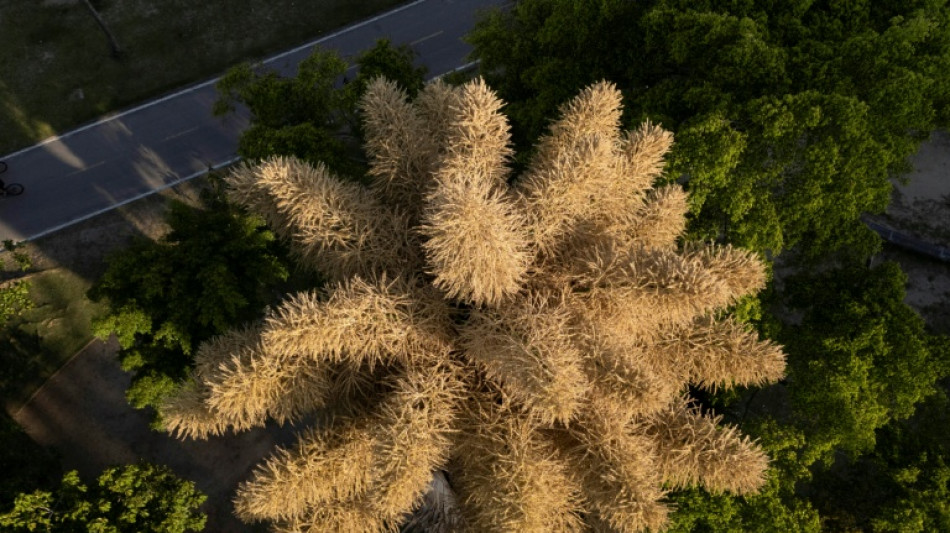
'In her prime': Rare blooming of palm trees in Rio / Photo: © AFP

 Welsh FA withdraws support for Infantino's FIFA re-election bid

 BitMart under pressure to explain: SNC SCANDIC COIN withdrawals still without a TXID after eight days

 Iran denies negotiating with US after Trump announces talks
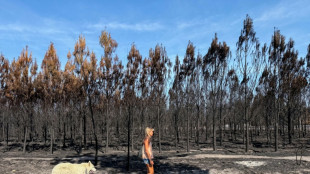
 What Europe can learn from Australia's 'Black Summer' wildfires

 Oil prices sink on Iran hopes, yen gains after joint intervention

 Wildfires raze neighborhoods in US northwest city of Spokane

 Trump attorney general pick says has reached deal with senators after standoff

 Star Australian broadcaster faces trial for sexual assault

 Oil prices sink on Middle East hopes, yen extends gains after joint intervention

 Millions of Thais banish the booze for Buddhist Lent

 Returning to 'Ted Lasso' after break 'effortless': Hannah Waddingham

 Trump says new Iran talks set to start after calling off massive attack

 Four Al-Fayed survivors told they were trafficking victims

 Ariana Grande withdraws from London musical, seeks to 'step back'

 Sudan army drone attack on Darfur court kills 35

 At least 72 died in Spain's Ceuta migrant rush, Spain says

 Russian teen Liutova wins WTA Memphis title

 Zverev remains wary of 12-day Masters events

 Wimbledon champ Noskova ready for 'new opportunity'

 Japan's Kuwaki wins women's British Open to clinch first major title

 Sabalenka aims to bounce back in Toronto after Wimbledon disappointment

 Iran says close to Hormuz deal with Oman, after US suspends attack plan

 'Spider-Man' soars to huge $355 million opening in North America
 Handbag tosses and high-heeled sprints: Amsterdam celebrates Drag Olympics

 Trump's on-again-off-again war against Iran: in his own words

An extraordinary botanical spectacle is drawing crowds in Rio de Janeiro: several talipot palm trees, planted more than six decades ago, are blooming for the first -- and last -- time in their lives.
The trees, growing in Rio's Aterro do Flamengo park and the Botanical Garden, were planted in the 1960s by the legendary landscape architect Roberto Burle Marx.
Now, some six decades later, these giants have reached the peak of their existence in the Brazilian seaside city.
The talipot palm (Corypha umbraculifera), native to southern India and Sri Lanka, is one of the largest palm species on the planet, some reaching more than 30 meters (98 feet) tall.
It flowers only once in its entire life, if it reaches between 40 and 70 years of age.
"The talipot palm only fruits once in its lifetime, and can produce up to five million fruits," Marcus Nadruz, from the Research Institute of the Rio de Janeiro Botanical Garden, told AFP.
The inflorescences, or flower clusters on stems, began to unfurl in October, forming enormous crowns atop the palm trees that teem with millions of tiny yellowish blossoms.
The entire process, from the opening of the first flowers to the ripening of the fruit, will take about a year, explained Nadruz.
But this splendor has an inevitable end. Once the fruit falls, the palm trees will slowly begin to die.
"I was born in 1961, so she's my age and in her prime," said Deborah Faride, who traveled to see the trees from Sao Paulo and was taking pictures of them with a friend.
"We're the same age and we're blooming together. Just one detail: the talipot is going to die. And I'm going to continue, God willing."
The Botanical Garden plans to collect the seeds to cultivate new seedlings to replace these older plants, and will also distribute them for landscaping projects in public spaces.
L.Dubois--BTB