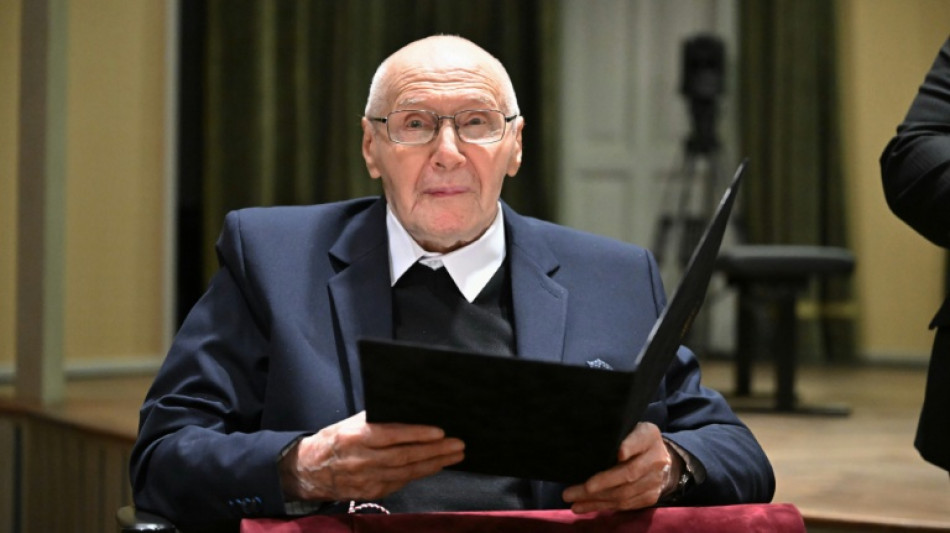
Hungarian star composer Kurtag celebrates 100th birthday with new opera / Photo: © AFP

 Millions of Thais banish the booze for Buddhist Lent
 Returning to 'Ted Lasso' after break 'effortless': Hannah Waddingham

 Trump says new Iran talks set to start after calling off massive attack

 Four Al-Fayed survivors told they were trafficking victims

 Ariana Grande withdraws from London musical, seeks to 'step back'

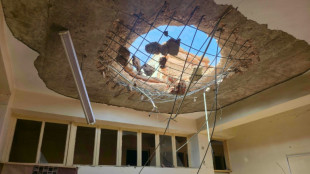 Sudan army drone attack on Darfur court kills 35

 At least 72 died in Spain's Ceuta migrant rush, Spain says

 Russian teen Liutova wins WTA Memphis title
 Zverev remains wary of 12-day Masters events

 Wimbledon champ Noskova ready for 'new opportunity'

 Japan's Kuwaki wins women's British Open to clinch first major title

 Sabalenka aims to bounce back in Toronto after Wimbledon disappointment
 Iran says close to Hormuz deal with Oman, after US suspends attack plan
 'Spider-Man' soars to huge $355 million opening in North America

 Handbag tosses and high-heeled sprints: Amsterdam celebrates Drag Olympics

 Trump's on-again-off-again war against Iran: in his own words

 Dodgers land Tigers pitching ace Skubal in MLB trade deadline blockbuster

 Infantino struggling to survive, says former IOC marketing chief

 OPEC+ boosts September production by 188,000 barrels/day
 Rescuers recover climber Nirmal Purja's body after avalanche disaster

 Fire toll mounts in Greece as blazes spread
 Sri Lanka deploys troops after prison riot

 Baltics transform from Soviet stagnation to startup hubs

 AI keeps consumer prices high in 'RAMaggedon' chip crunch
As Hungarian Gyorgy Kurtag, who is widely considered one of the greatest living classical composers, turns 100 on Thursday, he will offer a one-of-a-kind birthday gift to music lovers: a brand-new opera.
In recent weeks, people across the globe have paid tribute to the star composer, with Budapest marking his centennial with special events, concerts and documentaries.
Later this month, the world premiere of Kurtag's second opera "Die Stechardin" about the 18th-century love story of a German polymath and a flower girl will cap the centenary of his birth.
In a rare interview with a Hungarian weekly in 2017, Kurtag confided that composing can sometimes be "painful".
But despite being confined to a wheelchair and suffering a loss of hearing, Kurtag has lost none of his intellectual vibrancy or passion for music, according to those close to him.
"He doesn't hear so well anymore. But in return, he feels even more, he perceives even more from the world and from music," Concerto Budapest conductor Andras Keller told AFP during a rehearsal of Kurtag's new one-act opera earlier this month.
When his wife, pianist Marta Kurtag, who was also a close artistic partner, died in 2019, "everyone was scared about what would happen next", said Laszlo Goz, director of Budapest Music Center, where Kurtag now resides.
But Kurtag resumed composing, "writing increasingly larger and more complex pieces".
"He began teaching again, and now he has written his second opera, which is a kind of message to his wife, Marta," Goz said.
Born on 19 February, 1926, in the Romanian city of Lugoj to ethnic Hungarian parents, Kurtag started playing the piano as a young boy.
After taking piano and composition lessons as a teenager in Timisoara, he eventually moved to Budapest in 1946, where he began his studies at the Franz Liszt Academy of Music.
While studying, he met fellow composer Gyorgy Sandor Ligeti.
He graduated in piano and chamber music in 1951, and later in composition, before pursuing his studies in Paris for a year.
Over the decades, the award-winning musician became famous for composing short yet highly complex pieces, and only turning to opera late in life.
- 'Master of miniature forms' -
Throughout his career, Kurtag drew inspiration from literature and the works of famous compatriots like Bela Bartok. But despite his success, he was not immune to suffering from writer's block.
After returning to Hungary, in 1960 he became a repetiteur with the Budapest Philharmonic Society, and would later teach piano and chamber music at his alma mater.
At age 92, his first opera "Fin de partie" premiered at Milan's famous La Scala in late 2018.
Based on Irish writer Samuel Beckett's play "Endgame", and more than seven years in the making, Kurtag and his wife did not attend the premiere due to their advanced age and instead opted for the radio broadcast.
Like Beckett, who lived and died in Paris, Kurtag also has a passion for the French language.
The musician and his wife settled near Bordeaux in France in the mid-1990s before moving back to Hungary in 2015.
Kurtag's "music glows with such intensity, even in its quietest, most refined moments," said music historian Gergely Fazekas.
His music "strives with such force to discover what reality is... what is unspoken but still there," Fazekas told AFP during a ceremony in early February at the Liszt Academy, where the composer received an honorary doctorate and led a rehearsal of his new opera.
He said Kurtag is widely referred to as "the master of miniature forms", as many of his pieces "capture only a few minutes or even less period of time from eternity".
O.Lorenz--BTB