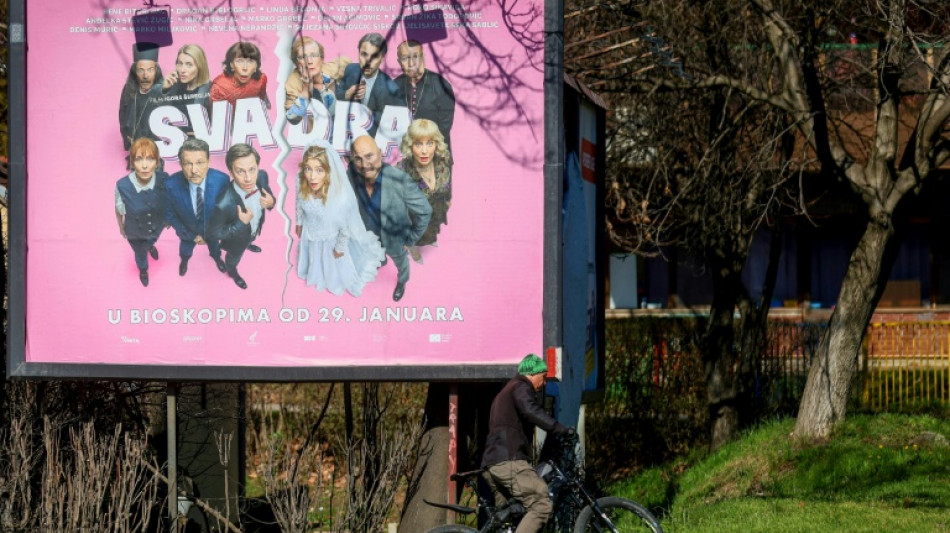
Balkan 'forbidden' love comedy smashes stereotypes and records / Photo: © AFP

 Reigning champ Knicks earn first win against Pistons
 Runners swap streets for shopping malls as haze chokes Singapore

 Billionaire Ambani's Jio to debut after record India IPO
 UK set for cautious budget as borrowing costs climb
 Anthropic's record IPO faces some big questions

 US Fed expected to hold rates steady ahead of key midterm elections

 Can this Latin Grammy-winner help Democrats win back Congress?

 Tuvalu has 'limited' power to halt its fossil fuel investments: NZ govt papers seen by AFP
 Palestinian activist Khalil returns to Columbia after US detention

 Trump drastically loosens oil and gas methane rules

 French Senate weighs bill to make protesters pay for unrest damage

 'A very sad day': Arteta despair as Arsenal stunned by Fleetwood

 Charles tackles thorny legacy of slavery on Caribbean trip

 Former Grand Slam winner Wawrinka ends tennis career

 Brazil's Flavio Bolsonaro flees to US after election loss
 'Faerie' nights: 'ACOTAR' fans finally get their book

 American woman convicted of getting military training from Islamic State

 Israel opposition holds narrow edge over Netanyahu in first projections

 Floriani hits maiden goal as Lazio go top

 Trump set to drastically loosen oil and gas sector's methane rules

 Storied Paris department store seeks bankruptcy protection
 Xhaka, Embolo can return to Swiss squad after fake Covid docs affair

 Allegri suspended for two Serie A games after red card

 Flight data, satellite images reveal growing US role at Ecuador base
 McInnes feels 'guilt' ahead of Hearts return with Rangers
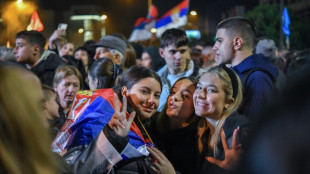
When two students in London tell their families they are going to get married, it should be one of the happiest moments of their lives.
But there's a catch -- she is Croatian and he is Serbian.
The rivalry between the two Balkan neighbours becomes comedy gold in the smash hit film "Wedding", which has audiences in both countries laughing at themselves.
The Croatian-Serbian co-production mocks stereotypes of the two peoples who share a very similar language but who ended up fighting in a bloody war in the 1990s when Yugoslavia, the country they shared for generations, collapsed.
The young couple's families are horrified by the looming "mixed marriage".
The Croat Catholic father senses something is amiss from his daughter's voice when she calls to share the news that a baby is on the way -- only to learn the "shocking truth" that the father and future son-in-law is a Serb.
There's a similar reception on the Serbian side, where the grandmother calls her future in-laws "Ustashas", a slur alluding to Croatia's World War II pro-Nazi regime.
- Most watched film ever -
The movie, called "Svadba" in Croatian, has become a box office phenomenon at a time when relations between Zagreb and Belgrade are among their lowest since the war.
In Croatia it has become the most-watched film ever, with nearly 700,000 people seeing it in just over a month -- one in five of the population -- sinking the three-decade-old record held by "Titanic" by around 200,000 tickets.
So far it has been seen by some two million people across the Balkans and in Austria, Switzerland and Germany, which have large diaspora populations.
Director Igor Seregi said its success showed people were missing the same thing: "Laughter -- to laugh at each other but also at ourselves.
"I think everyone recognised someone from their own family or wider circle and that resonated," Seregi told AFP.
He cast renowned actors from both nations in his "Romeo and Juliet" tale where the two fathers particularly struck a chord.
The politically-connected Croatian tycoon needs to expand into Serbia to avoid bankruptcy, while the father of the groom is a Serbian minister looking for funds from the European Union, of which Croatia is a member.
Marko Jovanovic, an administrator from Belgrade, told AFP that the comedy was a spot-on portrayal of the two countries' elites.
"A shady businessman with a gold chain and a politically connected schemer whose children study in London, felt almost like a documentary," he said.
- 'Strips prejudices bare' -
Ivana, a Serbian woman who married in Zagreb 20 years ago, loved it for stripping prejudices bare.
"The time has come for such a human story that reveals the reality beyond the politics," she said.
The movie gently mocks absurd traditions, the clergy and generational divides.
Lorna, a psychology student from Zagreb, liked it for "poking fun equally at Serbian and Croatian society and their absurdities".
Zagreb-born Seregi believes viewers outside the Balkans also relate to the movie as it is about division, whether between rich and poor, urban and rural, or along racial lines.
"Real life hasn't always been as smooth or romantic as depicted in the movie, but in the end, love always wins," the 42-year-old said.
Psychologist Petar Kraljevic echoed many viewers in praising the film's feelgood vibe.
"The baby's birth unites the families for good, letting optimism and hope for a better future prevail," he said.
M.Odermatt--BTB