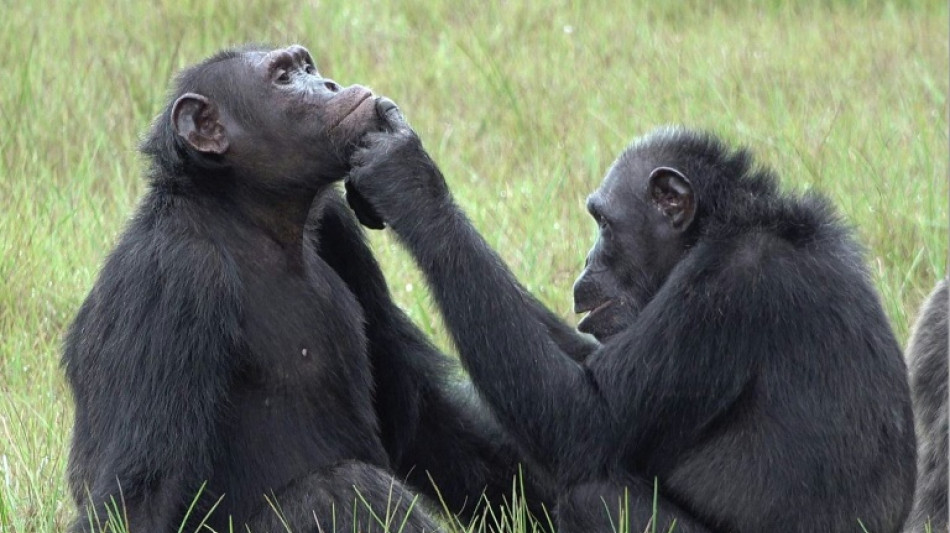
Treating wounds with insects: the strange habits of Gabon chimps / Photo: ©

 Trump threatens EU over 'hostile' Canada association plan

 Argentine judge orders suspension of Falklands oil project

 Carrick takes the blame as troubled Man Utd suffer League Cup misery

 Barcelona hit seven in Racing Santander rout

 Amorim's Milan beaten by Benfica, Sunderland make dream European return

 US stocks fall, dollar gains after Fed lifts interest rates

 Seahawks rule out Darnold for Sunday game at Arizona

 Mbappe explains Ceuta shirt stance after criticism

 Improving Atletico cruise to comfortable win over Osasuna

 Candidate for UN chief calls for AI regulation akin to nuclear weapons

 O'Neill expects Celtic recovery after Old Firm misery

 Man City midfield trio backed to emulate Rodri and Silva

 'We're losing control,' AI pioneer Yoshua Bengio tells AFP

 WHO eyes 'encouraging' signs in DRCongo fight against Ebola

 Liga boss criticises Real Madrid trio for Ceuta shirt incident

 WTA Finals moved to Charlotte from 2027

 Almost 8,000 excess deaths in France's scorched summer: statistics

 Ex-president's lengthy war crimes sentence shocks Kosovo

 US House faces test on sweeping Russia sanctions bill

 British PM says to make 'difficult decisions' as inflation rises

 TotalEnergies pumps up controversy in France with cut-price gas

 Global fuel price demos: a round-up

 Leverate Launches MCP for Traders to Connect AI Assistants With Trading Platforms

 MEXC Launches $1M "Discover Your Wall Street DNA" Campaign to Help Traders Find Their Market Fit

 Emporio Armani names Dario Vitale new creative director

How to treat a wound?
For humans, the first instinct would be to disinfect it and then cover it with a bandage.
But chimpanzees have invented a more creative method: catching insects and applying them directly to the open wound.
Scientists observed this behavior in chimpanzees in the West African nation of Gabon, noticing that the apes not only use insects to treat their own wounds, but also those of their peers.
The research, published Monday in the journal Current Biology, marks an important contribution to ongoing scientific debate about the ability of chimpanzees -- and of animals in general -- to selflessly help others.
"When you're going to school and you read in your biology books about the amazing things that animals can do," Simone Pika, a biologist at the University of Osnabruck in Germany and a co-author of the study, told AFP. "I think it could really be something like that that will end up in those books."
The project began in 2019, when an adult female chimpanzee named Suzee was observed inspecting a wound on the foot of her adolescent son.
Suzee then suddenly caught an insect out of the air, put it in her mouth, apparently squeezed it, and then applied it to her son's wound.
After extracting the insect from the wound, she applied it two more times.
The scene unfolded in Loango National Park on Gabon's Atlantic coast, where researchers are studying a group of 45 central chimpanzees, an endangered species.
Over the following 15 months, scientists saw chimpanzees administer the same treatment on themselves at least 19 times.
And on two other occasions they observed injured chimpanzees being treated in the same way by one or several fellow apes.
The wounds, sometimes several centimeters wide, can come from conflicts between members of same or an opposing group.
Far from protesting the treatment, the bruised chimpanzees were happy to be tended to.
"It takes lot of trust to put an insect in an open wound," said Pika. "They seem to understand that if you do this to me with this insect, then my wound gets better. It's amazing."
- Soothing properties? -
Researchers have not been able to identify what bug was used on the wounds, but they believe it to be a flying insect given the chimpanzees' rapid movement to catch it.
Pika says the insect could contain anti-inflammatory substances that have a soothing effect.
Insects are known to have various medical properties and researches will need to conduct more work to detect and study the insect in question.
Birds, bears, elephants and other animals have already been observed self-medicating, for example by eating plants.
But what is unique about chimpanzees is that they will treat not just themselves, but also help others.
Some scientists, however, still doubt the ability of animal species to exhibit prosocial behaviors, such as selflessly caring for others, Pika said.
But here the chimpanzees have nothing to gain, she stressed. So why do they do it?
In humans, prosocial behavior is generally linked to empathy.
Could the same feeling be at play in chimpanzees, Pika wondered.
"It is a hypothesis that we must study," she said.
S.Keller--BTB