Swiss region votes on giving primates fundamental rights / Photo: ©

 Trump threatens EU over 'hostile' Canada association plan

 Argentine judge orders suspension of Falklands oil project

 Carrick takes the blame as troubled Man Utd suffer League Cup misery

 Barcelona hit seven in Racing Santander rout
 Amorim's Milan beaten by Benfica, Sunderland make dream European return

 US stocks fall, dollar gains after Fed lifts interest rates
 Seahawks rule out Darnold for Sunday game at Arizona
 Mbappe explains Ceuta shirt stance after criticism

 Improving Atletico cruise to comfortable win over Osasuna

 Candidate for UN chief calls for AI regulation akin to nuclear weapons

 O'Neill expects Celtic recovery after Old Firm misery
 Man City midfield trio backed to emulate Rodri and Silva

 'We're losing control,' AI pioneer Yoshua Bengio tells AFP

 WHO eyes 'encouraging' signs in DRCongo fight against Ebola

 Liga boss criticises Real Madrid trio for Ceuta shirt incident

 WTA Finals moved to Charlotte from 2027

 Almost 8,000 excess deaths in France's scorched summer: statistics

 Ex-president's lengthy war crimes sentence shocks Kosovo

 US House faces test on sweeping Russia sanctions bill

 British PM says to make 'difficult decisions' as inflation rises

 TotalEnergies pumps up controversy in France with cut-price gas

 Global fuel price demos: a round-up

 Leverate Launches MCP for Traders to Connect AI Assistants With Trading Platforms

 MEXC Launches $1M "Discover Your Wall Street DNA" Campaign to Help Traders Find Their Market Fit
 Emporio Armani names Dario Vitale new creative director

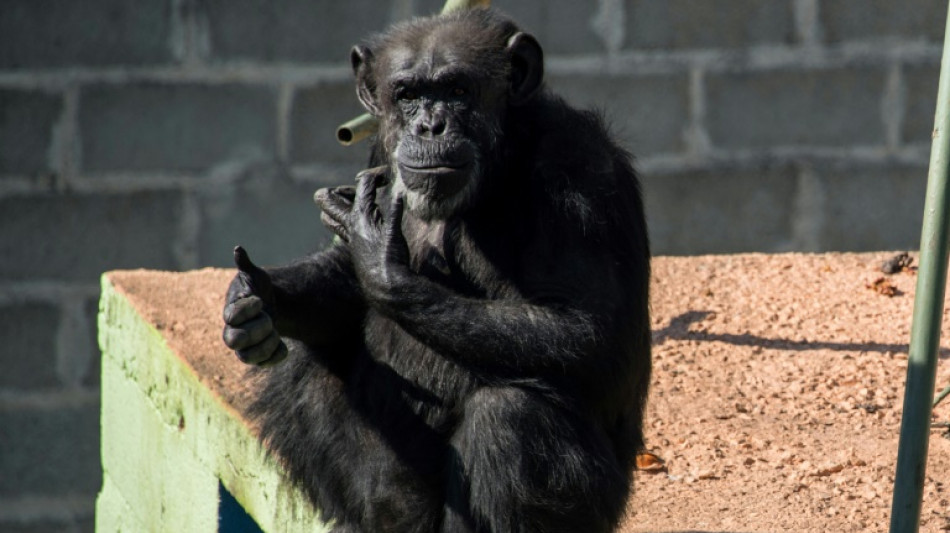
A northern Swiss region will vote Sunday on whether non-human primates should enjoy some of the same basic fundamental rights as their human cousins.
The vote in the Basel-Stadt canton, which is home to the city of the same name and to one of Europe's best-known zoos, is being keenly followed by animal rights activists.
- Giving primates 'integrity' -
Triggered by the campaign group Sentience under Switzerland's direct democracy system, the regional vote concerns whether to give primates the right to life and the right to "mental and physical integrity".
"This will mark the first time worldwide that people can vote on fundamental rights for non-human animals," the group claims.
Basel-based Sentience says primates are highly intelligent and maintain an active social life, and feel pain, grief and compassion.
However, they cannot defend themselves against interventions in their lives -- so humans need to take responsibility and grant them rights, says Sentience.
The group says some 150 primates live in the canton, which borders France and Germany.
- Legal challenge -
In 2020, Switzerland's Supreme Court deemed a public vote on the topic was valid, rejecting an appeal.
It found that the proposal would not extend fundamental rights to animals -- but instead introduce specific rights for non-human primates.
However, it said the proposal would only bind the cantonal and municipal authorities in Switzerland's third-biggest city, and "not directly private persons".
The impact on private research institutions, and on Basel Zoo -- in the hands of family shareholders -- would therefore be limited.
And, according to the court, the local authorities and their public bodies do not have any primates.
- Establishing the law -
The vote is "a statement of intent so that primates live in better conditions," said Pedro Pozas, the Spanish director of the Great Apes Project, an international movement which demands a set of rights.
Animal defenders say the vote is highly symbolic. Its scope could be very wide, said Steven Wise, a US lawyer specialising in animal rights.
The vote "would give certain rights to primates, which would have to be litigated out as to what rights those are", he told AFP.
Wise said the proposal raises several questions, including who would plead a primate's case in court if its rights were violated?
If the vote goes through, Swiss courts would meanwhile not be the first to hear such cases.
In 2017 in Argentina, a court granted a female chimpanzee the right not to be imprisoned without trial, under habeas corpus. It was the first chimpanzee in the world to benefit from this right.
Wise said the animal rights movement was trying to "break through the barrier" limiting the extent to which rights can be applied.
He compared the situation to previous battles to extend rights among humans, citing children, women or racial minorities.
Pozas said the United Nations should also make a declaration on the rights of great apes.
- Euthanasia question -
While the proposed new law would only concern primates kept by public bodies, Basel Zoo board member Olivier Pagan fears a spillover effect on their primates.
"If the initiative was adopted, the scrutiny of their well-being and safety would no longer be the responsibility of experienced biologists, veterinarians and experienced caregivers, but of a mediator... or even unqualified lawyers," he said.
When a primate is in serious pain, it might not be possible to end its suffering, under the right to life clause.
Zoo veterinarian Fabia Wyss said: "If the initiative is adopted and if I decide to put the animal to sleep, I put myself beyond the law."
"But by letting an animal suffer unnecessarily, I am also equally culpable."
T.Bondarenko--BTB