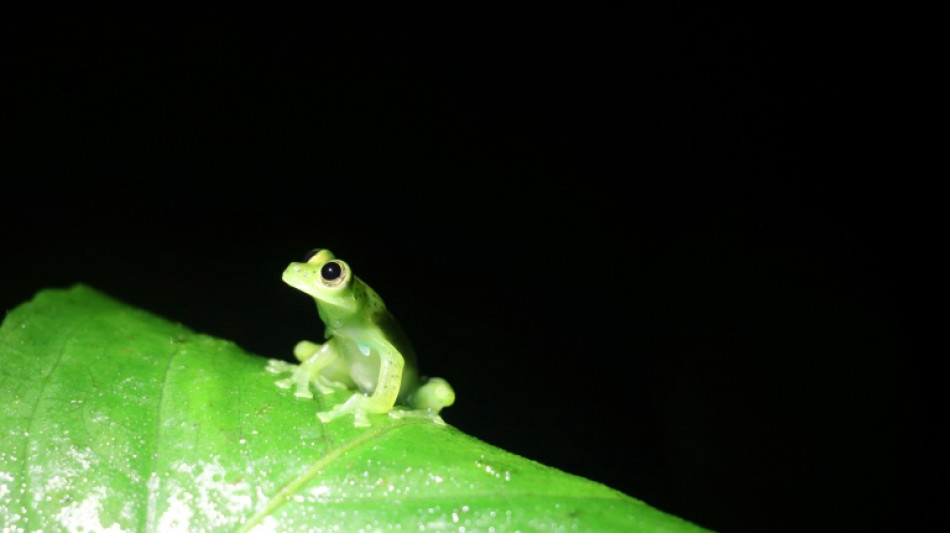
Turtles and see-through frogs on agenda at wildlife summit / Photo: © ADVENTURE TERM/AFP

 Greenland parliament approves security agreement with United States

 Qatar envoy meets incoming UN General Assembly president

 Trump Signals Willingness to Work With Democrats After Midterm Defeat

 Galloway accuser could not foresee publishing-sector fallout, lawyer argues

 New York City Center revives In the Heights as a timely community story

 Godzilla Minus Zero shifts focus toward postwar human drama

 Mehbooba Mufti urges dialogue and renewed Central Asia links for Kashmir

 Seacliff Healthcare Seeks Specialist GP in Thirroul

 US stocks fall before midterm Election Day as technology shares weaken

 BLS Polymers makes strong market debut at ₹248 per share

 Petrol and diesel prices remain broadly steady across major Indian cities

 Reliance shares remain in focus after near-12% surge

 2026 Arizona Midterms: Key Races, Ballot Measures, and Voter Deadlines

 Coal India prepares possible $1 billion Mahanadi Coalfields listing

 Julia Stiles and Ezra Sosa Share Emotional Farewell After 'DWTS' Elimination
A global wildlife summit in Panama will decide whether to take measures to protect the translucent glass frog and 12 types of freshwater turtles in its final week, which kicked off Monday.
Conservation experts and delegates from more than 180 nations began the week with a decision to maintain a ban on the trade of white rhinoceros horn, despite a request from Eswatini that was backed by Japan and several other African countries.
The tiny nation, formerly known as Swaziland, had argued the money from the sale of rhino horn would aid in the conservation of the threatened species.
Delegates began meeting last week Monday to discuss 52 proposals to modify protection levels set by the Convention on International Trade in Endangered Species of Wild Fauna and Flora (CITES).
In the coming days the fate of several unique amphibians will be up for debate.
"Freshwater turtles are among the main groups that are trafficked in the countries and there is high pressure for international trade," said Yovana Murillo, who heads a program against wildlife trafficking for the Wildlife Conservation Society (WCS).
Brazil, Colombia, Costa Rica, and Peru want to list two species of matamata turtles, which live in the Amazon and Orinoco basins, on CITES Appendix II, which requires the tracking and regulation of trade.
Doris Rodrigues of Peru's forestry service, told AFP that the striking matamata turtles, with their beetle-like appearance, have become sought-after pets, and "face many threats."
These include habitat destruction, pollution, illegal trade, and being hunted for their meat and eggs.
- Glass frog -
Delegates will also debate regulating the trade of the nocturnal glass frog, found in several rainforests in central and south America.
The amphibian is an increasingly popular pet. Some are a lime green color, while others have translucent bellies and chests.
"They are being collected for their beauty. They are being trafficked and some are in critical danger," said Rodriguez.
CITES, in force since 1975, regulates trade in some 36,000 species of plants and animals and provides mechanisms to help crack down on illegal trade. It sanctions countries that break the rules.
The meeting of the parties to the convention takes place every two or three years.
J.Horn--BTB