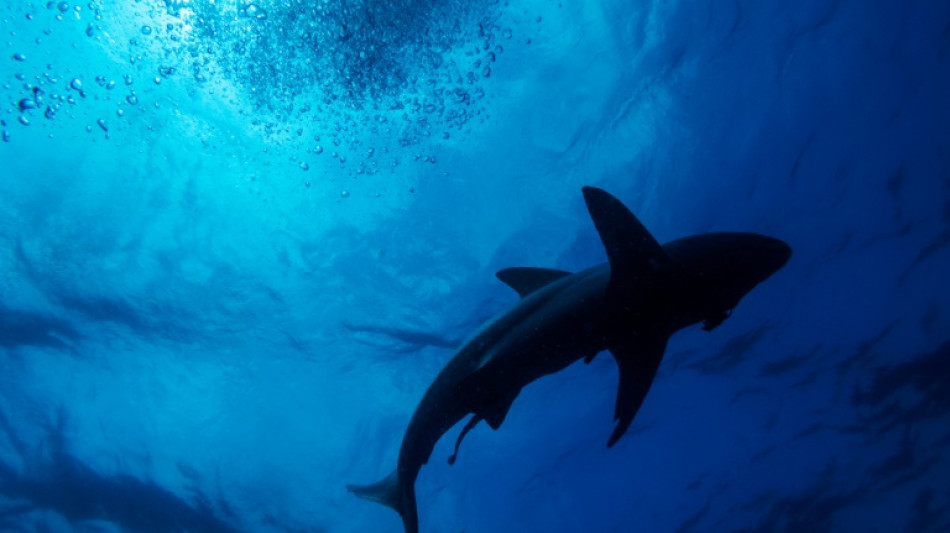
Global wildlife summit to vote on shark protections / Photo: © AFP/File

 After sparring over Ceuta, EU states seek lessons from crisis

 Forest fire spreads in Dutch nature reserve

 Japan sees 'urgent' need to boost military

 Myanmar ex-junta chief set for first Thailand visit as civilian leader

 New Zealand hooker Bell out of South Africa tour with calf strain

 Trump attorney general pick looks set to clear US Senate hurdle
 Death toll from Venezuela quakes rises past 6,000

 Shafique, Babar lead strong Pakistan reply against West Indies

 Defending champ Shelton finding tournament sweet spot in Montreal

 Democratic-led US states sue in latest challenge to Trump's tariffs

 Trump says Iran facing 'last chance before decapitation'

 US northwest battles wildfires after Spokane neighborhoods scorched

 Iran denies negotiating with US, drawing Trump backlash

 Key dates for the Boeing 737 MAX

 Israel objects to US-backed Gaza plan, defiant on pullout

 Norway's Haugset wins stage 3 to claim Tour de France Femmes lead

 Cuba slowly regains power after latest nationwide blackout

 Chelsea sign England midfielder Jordan Henderson

 Wildfire flares up again in Greece as water bombers deployed

 Greece wildfire expert says season 'one of the worst' in a decade

 Sandoz strikes US settlements to resolve generic drug price dispute

 Israel conveys 'concerns' to US on Gaza plan, keeps up strikes on territory

 Inside Capital Regency's Market Expansion and User Acquisition

 Israel conveys 'concerns' to US on Gaza plan and keeps striking

 Bangladesh measles outbreak drives families into debt: aid groups

Delegates at a global summit on trade in endangered species will on Friday decide whether to approve a proposal to protect sharks, a move that could drastically reduce the lucrative and cruel shark fin trade.
If approved, dozens of species of the requiem shark and the hammerhead shark families would have their trade tightly controlled under the Convention on International Trade in Endangered Species (CITES).
The shark initiative has been one of the most discussed at this year's CITES summit in Panama, with the proposal co-sponsored by the European Union and 15 countries.
A vote had been expected Thursday but was postponed until Friday, the final day of the summit, as debates over illegal and unregulated hunting of hippos for their meat and ivory dragged on between the European Union and African countries.
Delegates are considering 52 proposals to change species' protection levels. Other species up for possible boosted protections are glass frogs, crocodiles, guitarfish, and some turtle species.
If the new raft of shark protections is applied, "it would be a historic decision," Panamanian delegate Shirley Binder, who presided over the meeting, told AFP earlier in the summit.
"For the first time, CITES would be handling a very large number of shark species, which would be approximately 90 percent of the market," she said.
Insatiable appetite in Asia for shark fins, which make their way onto dinner tables in Hong Kong, Taiwan and Japan, has spurred their trade.
Despite being described as almost tasteless and gelatinous, shark fin soup is viewed as a delicacy and is enjoyed by the very wealthy, often at weddings and expensive banquets.
Shark fins, representing a market of about $500 million per year, can sell for about $1,000 a kilogram (2.2 pounds).
- From villain to darling -
Sharks have long been seen as the villain of the seas they have occupied for more than 400 million years, drawing horror with their depiction in films such as "Jaws" and occasional attacks on humans.
However, these ancient predators have undergone an image makeover in recent years as conservationists have highlighted the crucial role they play in regulating the ocean ecosystem.
According to the Pew Environment Group, between 63 million and 273 million sharks are killed every year, mainly for their fins and other parts.
With many shark species taking more than 10 years to reach sexual maturity, and having a low fertility rate, the constant hunting of the species has decimated their numbers.
In many parts of the world, fisherman lop the shark's fins off at sea, tossing the shark back into the ocean for a cruel death by suffocation or blood loss.
The efforts by conservationists led to a turning point in 2013, when CITES imposed the first trade restrictions on some shark species.
"We are in the middle of a very large shark extinction crisis," Luke Warwick, director of shark protection for the NGO Wildlife Conservation Society (WCS), told AFP at the beginning of the summit.
CITES, which came into force in 1975, has set international trade rules for more than 36,000 wild species.
Its signatories include 183 countries and the European Union.
B.Shevchenko--BTB