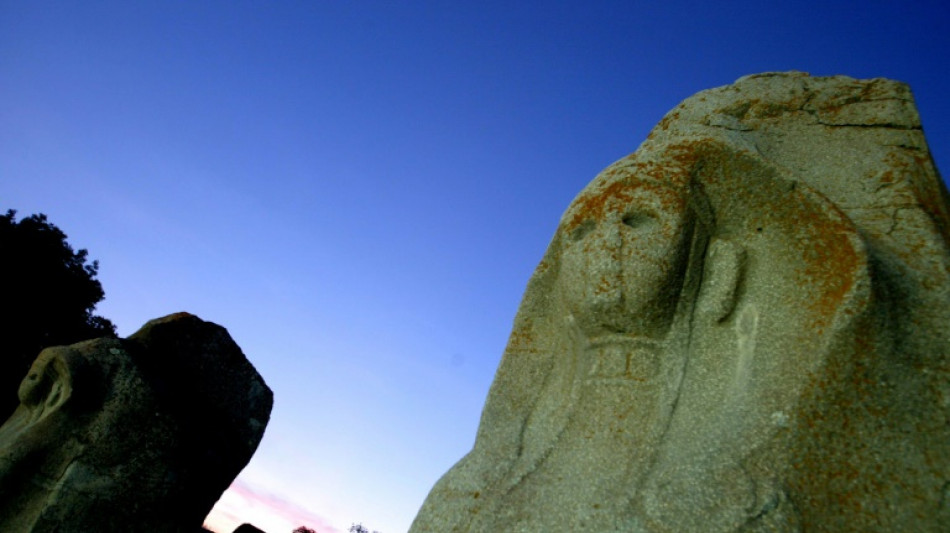
Climate change may have toppled Hittite Empire: study / Photo: © AFP/File

 Commanders hand champion Seahawks their first loss

 Dupont scores twice to send Toulouse top of Top 14

 Ireland beat Israel but no handshakes due to war in Gaza

 Tense standoff over flashpoint N.Ireland parade lasts into night

 Stunned McNulty wins 'miracle' road race world title

 Re-released 'Avengers: Endgame' snaps-up N. America box office lead

 American McNulty wins shock road race world title

 Serbia's President Aleksandar Vucic announces resignation

 Tuchel urges Bellingham to play with 'rage'

 Russian strikes on Ukraine kill 8

 Bavuma, Miller hit centuries as South Africa clinch series

 Spain bring in Le Normand for injured Garcia

 UK Labour party meets buoyed by Burnham but seeking concrete plans

 Nor'easter lashes US east with punishing rain and wind

 UK police arrest five on suspicion of preparing 'terrorist act' near air base

 Washington denounces Iran's truce proposal as 'cynical'

 Armani sprinkles glitter on discreet elegance at Milan show

 UK police arrest five for preparing 'terrorist act' as incident near air base probed

 อเล็กซ์ โบดี และศาสตราจารย์ ดร. ดีเทอร์ ลาซิก ลงนามสัญญาสำหรับ ALPHA WHEY และ BODI เครื่องดื่มให้พลังงาน

 China teen blows away the field for record-setting gold at 'sad' Games

 Alex Bodi och prof. dr. Dieter Lazik tecknar avtal om ALPHA WHEY och BODI Energidryck

 Alex Bodi i prof. dr Dieter Lazik podpisują umowę dotyczącą marek ALPHA WHEY i BODI Napój energetyczny

 Ο Alex Bodi και ο καθηγητής Δρ. Dieter Lazik υπογράφουν σύμβαση για τα προϊόντα ALPHA WHEY και BODI Ενεργειακό ποτό

 アレックス・ボディ氏とディーター・ラジク教授が「ALPHA WHEY」および「BODI エナジードリンク」に関する契約を締結

 Housing protesters dig in for long stay in Madrid square

Three years of extreme drought may have brought about the collapse of the mighty Hittite Empire around 1200 BC, researchers have said, linking the plight of the fallen civilisation to the modern world's climate crisis.
The Hittites dominated Anatolia in modern-day Turkey for nearly 500 years, even rivalling the power of the Egyptian Empire for a period.
They were one of several influential ancient civilisations in the Eastern Mediterranean and Near East which were all toppled or severely weakened at around the same time, bringing the curtain down on the Bronze Age.
The Hittites mysteriously abandoned their capital and religious centre Hattusa around 1200 BC, when the royal line died out and written historical documents dried up.
The empire's centuries-old political and cultural structures ended "quite rapidly," Sturt Manning, an archaeologist at Cornell University in the United States and lead author of a new study, told AFP.
There are several theories for what was behind the "Late Bronze Age collapse", including attacks from naval raiders called the "Sea Peoples", epidemics and famines -- as well as a 300-year change to a drier, cooler climate.
But exactly what triggered the demise of these empires has remained unclear.
- 'Existential threat' -
Now, for the Hittites at least, the answer may have come inscribed in the rings of ancient juniper wood.
The juniper comes from one of the world's oldest wooden structures, found at the Phrygian capital of Gordion in central Turkey as part of the excavation of a king's tomb in the 1950s.
By analysing the rings of the juniper wood, the researchers were able to reconstruct climate conditions more than 3,000 years ago.
In semi-arid Central Anatolia, "the major threat to growth for most plants in the region is a lack of water," Manning said.
Narrower tree rings indicate drier years, when a lack of water meant the trees did not grow much.
The rings showed three-straight years -- 1198 BC to 1196 BC -- with "unusually" low growth, suggesting a prolonged and particularly severe drought, according to the study published in the journal Nature on Wednesday.
The researchers suggested that the drought caused severe food shortages, particularly for the land-locked parts of the central Hittite kingdom, which depended on grain and livestock.
The food shortages could have led to political, economic and social unrest, ultimately bringing about the end of the empire.
Manning warned that current global warming means the modern world could face a "multi-year existential threat" similar to the one that affected the Hittites.
Muge Durusu-Tanriover, an archaeologist at Temple University in Philadelphia who was not involved in the study, hailed it as "groundbreaking".
"Now that we know a major climate event might have tipped the Hittite empire beyond its point of no return, there are more questions to ask about climate change, its impact on states and society and, most crucially, what can be learnt from the past during our current climate crisis," she said in a Nature comment piece.
M.Furrer--BTB