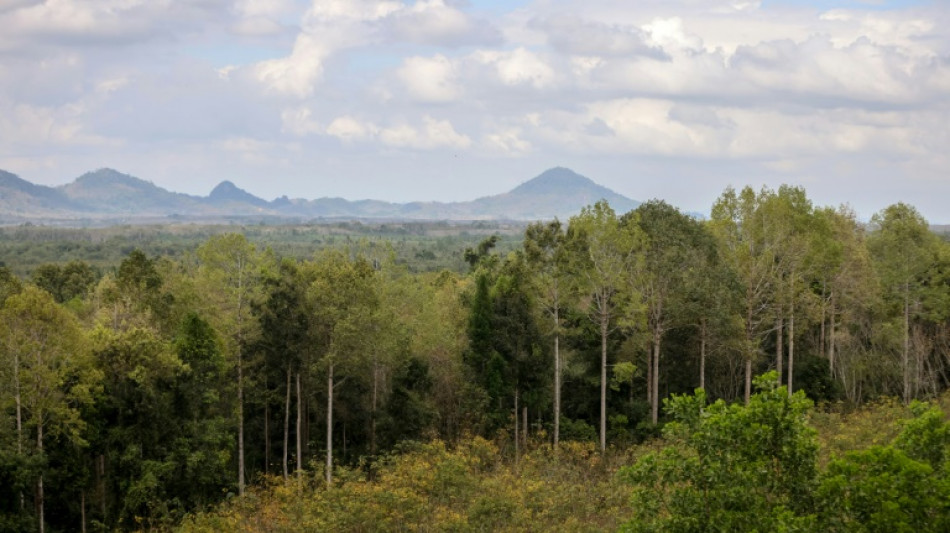
Carbon credits: a contested tool to fight deforestation / Photo: © AFP/File

 Commanders hand champion Seahawks their first loss

 Dupont scores twice to send Toulouse top of Top 14

 Ireland beat Israel but no handshakes due to war in Gaza

 Tense standoff over flashpoint N.Ireland parade lasts into night

 Stunned McNulty wins 'miracle' road race world title

 Re-released 'Avengers: Endgame' snaps-up N. America box office lead

 American McNulty wins shock road race world title

 Serbia's President Aleksandar Vucic announces resignation

 Tuchel urges Bellingham to play with 'rage'

 Russian strikes on Ukraine kill 8

 Bavuma, Miller hit centuries as South Africa clinch series

 Spain bring in Le Normand for injured Garcia

 UK Labour party meets buoyed by Burnham but seeking concrete plans

 Nor'easter lashes US east with punishing rain and wind

 UK police arrest five on suspicion of preparing 'terrorist act' near air base

 Washington denounces Iran's truce proposal as 'cynical'

 Armani sprinkles glitter on discreet elegance at Milan show

 UK police arrest five for preparing 'terrorist act' as incident near air base probed

 อเล็กซ์ โบดี และศาสตราจารย์ ดร. ดีเทอร์ ลาซิก ลงนามสัญญาสำหรับ ALPHA WHEY และ BODI เครื่องดื่มให้พลังงาน

 China teen blows away the field for record-setting gold at 'sad' Games

 Alex Bodi och prof. dr. Dieter Lazik tecknar avtal om ALPHA WHEY och BODI Energidryck

 Alex Bodi i prof. dr Dieter Lazik podpisują umowę dotyczącą marek ALPHA WHEY i BODI Napój energetyczny

 Ο Alex Bodi και ο καθηγητής Δρ. Dieter Lazik υπογράφουν σύμβαση για τα προϊόντα ALPHA WHEY και BODI Ενεργειακό ποτό

 アレックス・ボディ氏とディーター・ラジク教授が「ALPHA WHEY」および「BODI エナジードリンク」に関する契約を締結

 Housing protesters dig in for long stay in Madrid square

Planting trees or safeguarding tropical rainforests have become popular tools for companies seeking to offset their carbon emissions and proclaim their commitment to the environment.
However, recent scandals have cast a shadow over the carbon credit industry, revealing a landscape rife with opportunities for greenwashing.
Walt Disney, JP Morgan Bank and other major corporations have been accused of purchasing carbon credits from forest protection projects in areas that were not actually at risk of deforestation.
Separately, a company responsible for managing 600,000 hectares of land in the United States has reportedly earned $53 million over the past two years from carbon credits that did not significantly alter its forest management practices.
None of these projects sequestered carbon beyond that which would have been absorbed by trees through photosynthesis in a business-as-usual scenario.
Still, companies counted the resulting carbon credits towards their own reduction targets, allowing them to offset emissions in the carbon accounting of their operations.
Leaders and experts from around the world will gather in the Gabonese capital Libreville on March 1 and 2 for the One Forest Summit.
Co-presided by France and Gabon, the meeting will focus on improving financial instruments aimed at protecting the world's forests.
Carbon credits are already widely used. According to various estimates, the number of tons of CO2 they represent (with one credit equivalent to one ton) could increase tenfold by 2030, to around two billion tons.
"The risky aspect of the carbon credit market is that it is not self-regulating," said Cesar Dugast from French environmental consultancy Carbone 4, in an interview with AFP.
"Everyone has an interest in maximising the quantity of carbon credits. It enables the project developers to spread the total cost over a maximum number of credits, offering a lower cost to buyers.
"Even the certifiers have an interest in the proliferation of projects," he added.
In mid-January, The Guardian, Die Zeit and an NGO revealed that more than 90 percent of projects certified by leading verifier Verra for forest conservation under the UN programme to reduce deforestation and forest degradation (REDD+) were likely "ghost credits" that did not represent "real emissions reductions".
Verra's CEO, David Antonioli, rejected these findings, arguing that "REDD projects are not some abstract concept on a piece of paper; they represent real projects on the ground that deliver life-affirming benefits."
- Carbon credits under debate -
After the story came out, the price of nature-related carbon credits has dropped, according to Paula VanLaningham, global head of carbon at S&P Global.
The revelations about REDD+ projects have sparked a wider debate about the entire carbon credit system.
"Are the projects themselves a good vehicle for carbon finance in a way that actually leads to a just transition? Probably both yes and no," she told AFP.
Several independent rating agencies have since defended their methodologies, stressing the crucial need for financing projects protecting nature.
"The first issue we look at is additionality: would the project have happened in absence of the carbon markets?" Donna Lee, co-founder of Calyx Global, an independent rating agency for carbon projects, told AFP.
"We then look at how the baseline was set and what would have happened in the absence of the project."
The core issue with initiatives aimed at halting deforestation is the challenge of proving that deforestation would have occurred without the funding.
"We look at patterns of deforestation in the region... a lot of scientific studies show that there are certain things like roads, population, distance to the forest edge, that are often associated with deforestation," Lee said.
Above all, the companies that buy these credits should be "more transparent" by clearly indicating where credits are sourced and how they reduce their own emissions, she said.
"We need to move from a mentality of compensating to a mindset of contributing," said Dugast from Carbone 4.
In other words, companies financing forests to offset carbon emissions is acceptable, but not as a loophole to avoid reducing their own emissions.
G.Schulte--BTB