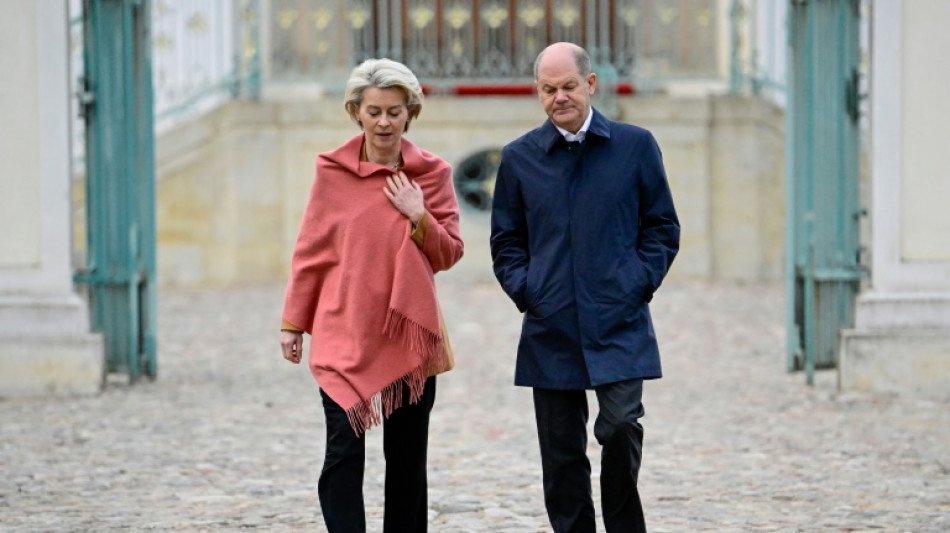
Germany angers EU after putting brakes on fossil fuel car ban / Photo: © AFP

 Commanders hand champion Seahawks their first loss

 Dupont scores twice to send Toulouse top of Top 14

 Ireland beat Israel but no handshakes due to war in Gaza

 Tense standoff over flashpoint N.Ireland parade lasts into night

 Stunned McNulty wins 'miracle' road race world title

 Re-released 'Avengers: Endgame' snaps-up N. America box office lead

 American McNulty wins shock road race world title

 Serbia's President Aleksandar Vucic announces resignation

 Tuchel urges Bellingham to play with 'rage'

 Russian strikes on Ukraine kill 8

 Bavuma, Miller hit centuries as South Africa clinch series

 Spain bring in Le Normand for injured Garcia

 UK Labour party meets buoyed by Burnham but seeking concrete plans

 Nor'easter lashes US east with punishing rain and wind

 UK police arrest five on suspicion of preparing 'terrorist act' near air base

 Washington denounces Iran's truce proposal as 'cynical'

 Armani sprinkles glitter on discreet elegance at Milan show

 UK police arrest five for preparing 'terrorist act' as incident near air base probed
 อเล็กซ์ โบดี และศาสตราจารย์ ดร. ดีเทอร์ ลาซิก ลงนามสัญญาสำหรับ ALPHA WHEY และ BODI เครื่องดื่มให้พลังงาน

 China teen blows away the field for record-setting gold at 'sad' Games

 Alex Bodi och prof. dr. Dieter Lazik tecknar avtal om ALPHA WHEY och BODI Energidryck

 Alex Bodi i prof. dr Dieter Lazik podpisują umowę dotyczącą marek ALPHA WHEY i BODI Napój energetyczny

 Ο Alex Bodi και ο καθηγητής Δρ. Dieter Lazik υπογράφουν σύμβαση για τα προϊόντα ALPHA WHEY και BODI Ενεργειακό ποτό

 アレックス・ボディ氏とディーター・ラジク教授が「ALPHA WHEY」および「BODI エナジードリンク」に関する契約を締結

 Housing protesters dig in for long stay in Madrid square

Berlin has upset EU partners by blocking a milestone agreement to ban new sales of fossil fuel cars from 2035, as German domestic politics takes the bloc hostage.
The planned ban is key to Brussels' push to make the bloc climate-neutral by 2050, with net-zero greenhouse gas emissions.
Now, the German chancellor's scramble to keep his coalition together has enraged many in the EU, since the deal had already passed through each stage of the Brussels legislative process -- including approval by member states.
The bloc was due to formally nod it into law on Tuesday but, in an unprecedented manoeuvre, Berlin now says it can not give its agreement.
The European Parliament has already voted to formally approve the text of the bill, which will de facto mean that all new cars sold after 2035 will have to have electric motors.
This means the text can no longer be altered, despite Germany now insisting on further assurances from Brussels that synthetic fuels could still be used in engines after 2035.
The fuel Germany wants an exemption for is still under development and produced using low-carbon electricity.
Some of the world's biggest car manufacturers are based in Germany and synthetic fuels would make it possible to extend the use of combustion engines.
Faced with the unexpected roadblock, the European Commission, the EU's executive arm, said it would "work constructively" with Berlin to get the bill adopted "quickly".
The commission did not say, however, exactly what commitment it could give, since the text already paves the way for the use of synthetic fuels if they are deemed to help achieve the aim of zero carbon emissions.
- German 'navel-gazing' -
French MEP Pascal Canfin, who oversaw the bill's passage though scrutiny in parliament, slammed Berlin's "blackmail".
He warned that if other member states follow suit on issues important for their domestic agenda it could threaten other texts that form part of the EU's Green Deal, an ambitious push to achieve carbon neutrality by 2050.
"The very spirit of European construction is in danger through this incoherent position," he told AFP.
Separately an EU diplomat, speaking on condition of anonymity, said Germany was exploiting its outsize influence in Brussels. "Only a large EU country can afford to act in such a way," he said.
Germany is not alone in its concerns. Italy, another major car maker, already said it was opposed, and Poland and Bulgaria had been expected not to vote in favour.
Unlike Germany, however, their opposition was clear from the start, and their opposition was not enough to block the bill's passage through the Brussels committees.
"Germany is going back on months of negotiations ... this is a challenge to the EU's decision-making process that we rarely see," said Eric Maurice, of the Robert Schuman Foundation, a European think tank.
Maurice said the situation arose from the German government's "navel-gazing" and the dysfunction on display in the coalition of the Social Democrats, the Greens and the Liberals.
The situation hurts other countries and the EU's "proper" functioning, he added.
- Chancellor bowed to pressure -
Behind the block is Germany's liberal Free Democratic Party (FDP), which is courting votes among the large part of the German population that it suspects opposes the ban on combustion engines.
The FDP wants to assert itself against the Greens by acting as the automobile sector's defender.
In a bid to keep the coalition together, Chancellor Olaf Scholz bowed to pressure and pushed for the exemption for synthetic fuels.
Environmental groups oppose such fuels and argue they are expensive, require huge amounts of electricity to produce and are polluting since they emit nitrogen oxide, another greenhouse gas.
The automobile industry had largely expected European regulations and invested massively in electric vehicles.
Even if they prove to be helpful in the green transition, synthetic fuels "will not play an important role in the medium term future of passenger cars", Markus Duesmann, the boss of Audi, said in the weekly Der Spiegel.
T.Bondarenko--BTB