UN's global disaster alert systems goal faces uphill climb / Photo: © AFP/File

 Scheffler makes sportsmanship stand over tee screamer

 Anthropic CEO Amodei to dine with Trump at White House

 Dupont scores twice to send Toulouse to Top 14 summit

 Greece stun Klopp's Germany as Ireland show sorrow for Gaza

 Ramos fires holders Portugal to Nations League win in Norway

 Greece hand Klopp first defeat as Germany manager
 Pope promises French sex abuse victims to prevent further harm

 UK village on edge over threats to air base in terror alert

 Two giant pandas, emblems of China soft diplomacy, arrive in US

 Aleksandar Vucic: from Milosevic minister to long-serving Serbian statesman

 Trump expects new Iran talks despite rejecting deal offer

 Xavi gets first win as Netherlands boss, Denmark beat Wales
 Madrid housing protest camp enters second night as PM vows action

 Tigray TV station hit by drone, rebels advance in north Ethiopia

 Banton hundred paves way for England ODI series win over Sri Lanka

 Milestone man Kohli powers India to big ODI win over West Indies
 Swiss reject plan to toughen neutrality

 Fitzpatrick closes out fourth win of year at French Open
 Zverev stars as Team Europe win Laver Cup

 UK PM urges 'calm' as thousands block flashpoint N.Ireland parade

 China's Yan one and done after golden Asian Games throw

 Kiss praises Wallabies' composure after wild Test finish

 एलेक्स बोडी और प्रो. डॉ. डायटर लाज़िक ने ALPHA WHEY और BODI एनर्जी ड्रिंक के लिए एक अनुबंध पर हस्ताक्षर किए

 Alex Bodi a prof. dr. Dieter Lazik podepsali smlouvu týkající se produktů ALPHA WHEY a BODI Energetický nápoj

 Banton takes England to 355-7 in Sri Lanka ODI decider

How can anyone seek shelter from a natural disaster they don't even know is coming? Last year the United Nations called for every person on the planet to be covered by early warning systems by 2027 -- but months into the effort it is becoming clear that the project will require more data and expertise.
With a relatively low price tag of $3.1 billion, the UN's plan hopes to implement the simple principle of early warning systems: assess risks using meteorological data, forecast impending problems using modelling, prepare populations ahead of time, and send out alerts to those expected to be impacted.
But building out those steps poses unique issues at each turn, according to those involved in the effort, many of whom are gathered this week in New York for a historic UN conference on water-related crises.
In Tajikistan, 100 years of weather data exist only on paper, chair of the country's environmental protection committee, Bahodur Sheralizoda said.
Digitizing this data could provide "more precise weather forecasts" or be applied to climate modeling, he added.
"With the small investments, we can have really big impact in the long run."
To help fill the data gap, the US National Oceanic and Atmospheric Administration (NOAA) is also hoping to deploy weather stations made from 3D printers around the world, said the agency's chief scientist Sarah Kapnick.
When it comes to analyzing the meteorological data and predicting future weather events, there is also a lack of local expertise, said Stefan Uhlenbrook, director of hydrology, water and cryosphere at the UN World Meteorological Organization (WMO).
"You need local capacity to run the local models," he told AFP.
Some help should be coming from NOAA, which Kapnick said has plans to "train local climate forecasters and leaders."
After risks are identified, getting those alerts to remote populations poses possibly the biggest hurdle.
"To reach the last mile... and then to get them acting and prepared is a big challenge," said Uhlenbrook.
This is where the International Federation of Red Cross and Red Crescent Societies (IFRC), a WMO partner in the field, comes in.
- Regular training and drills -
For IFRC Secretary General Jagan Chapagain, the country of Bangladesh should be viewed as a model to replicate.
Scarred by the horrific 1970 cyclone that killed hundreds of thousands, the South Asian country has for decades built up storm-resistant shelters and warns residents of upcoming dangers, by bicycle if necessary, Chapagain told AFP.
While church bells, loudspeakers and sirens are still used as warning systems in many isolated places, alerts sent via radio, TV and SMS have become the norm.
"In 2022, 95 percent of the world's population had access to mobile broadband networks and close to 75 percent of the population owned a mobile phone," said Ursula Wynhoven with the International Telecommunications Union (ITU).
That makes mobile networks "powerful communication channels" for alerts, especially because "SMS warnings can be targeted to reach only those located in an at-risk area," she added.
Few developing countries have installed such systems, she said, noting a "relatively low cost."
WMO chief Petteri Taalas also highlighted the cost effectiveness of setting up early warning programs, saying that "you'll get the money back at least tenfold that you invest."
He pledged at the UN Water conference to speed up implementation of the UN's 2027 goal, beginning with water-related disasters.
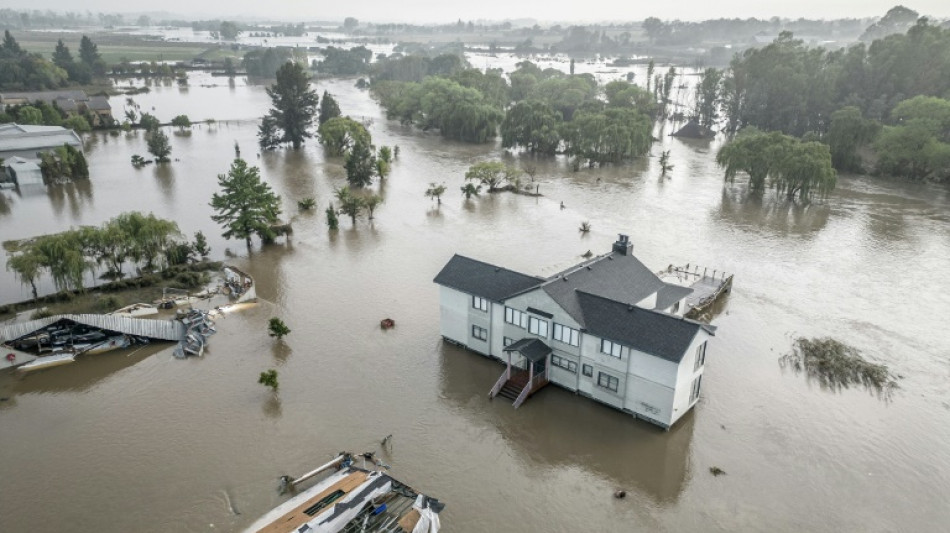
Floods and droughts account for 75 percent of climate-related disasters, which are expected to increase further due to global warming.
But simply alerting a population is not enough -- there must also be "regular training and drills," warns IFRC chief Chapagain.
People must practice the processes of interpreting different signals and finding the nearest escape routes or shelter.
"Once people understand the logic, they manage these things better," he said.
While climate change is expected to intensify storms, at the opposite extreme, it is also expected to increase the severity of droughts.
Though the potential for drought-induced disaster happens more slowly, Uhlenbrook said, warnings are still important to protect livelihoods.
For example, "we had in Europe a very dry, warm winter, so the (water) reservoir levels are very low," Uhlenbrook said.
Farmers near Italy's Po River who plan to plant rice, which need lots of irrigation, should take that into consideration, he explained.
NOAA's Kapnick highlighted that drought predictions, based off advanced climate modeling, are of particular importance in "developing nations with heavily agriculturally based economies."
"Early warning systems based on seasonal predictions are critical for planning for food security and macro-economic forecasts," she said.
L.Janezki--BTB