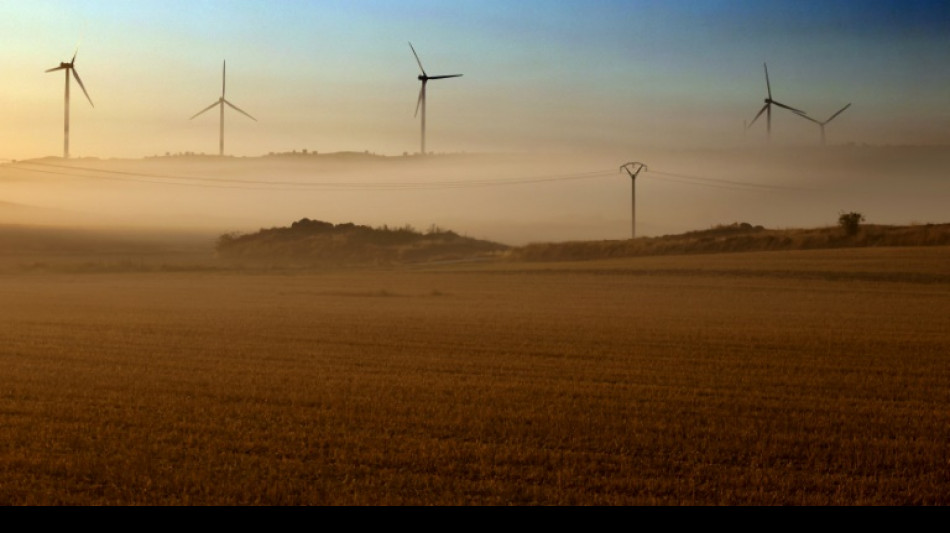
World near positive 'tipping point' on climate solutions: expert / Photo: © AFP/File

 Scheffler makes sportsmanship stand over tee screamer

 Anthropic CEO Amodei to dine with Trump at White House

 Dupont scores twice to send Toulouse to Top 14 summit

 Greece stun Klopp's Germany as Ireland show sorrow for Gaza

 Ramos fires holders Portugal to Nations League win in Norway

 Greece hand Klopp first defeat as Germany manager

 Pope promises French sex abuse victims to prevent further harm
 UK village on edge over threats to air base in terror alert

 Two giant pandas, emblems of China soft diplomacy, arrive in US
 Aleksandar Vucic: from Milosevic minister to long-serving Serbian statesman

 Trump expects new Iran talks despite rejecting deal offer

 Xavi gets first win as Netherlands boss, Denmark beat Wales

 Madrid housing protest camp enters second night as PM vows action

 Tigray TV station hit by drone, rebels advance in north Ethiopia

 Banton hundred paves way for England ODI series win over Sri Lanka

 Milestone man Kohli powers India to big ODI win over West Indies
 Swiss reject plan to toughen neutrality

 Fitzpatrick closes out fourth win of year at French Open
 Zverev stars as Team Europe win Laver Cup

 UK PM urges 'calm' as thousands block flashpoint N.Ireland parade

 China's Yan one and done after golden Asian Games throw

 Kiss praises Wallabies' composure after wild Test finish

 एलेक्स बोडी और प्रो. डॉ. डायटर लाज़िक ने ALPHA WHEY और BODI एनर्जी ड्रिंक के लिए एक अनुबंध पर हस्ताक्षर किए

 Alex Bodi a prof. dr. Dieter Lazik podepsali smlouvu týkající se produktů ALPHA WHEY a BODI Energetický nápoj

 Banton takes England to 355-7 in Sri Lanka ODI decider

With climate-enhanced droughts, heatwaves and fires ravaging three continents and the threat of a new surge in global warming, the world urgently needs to ramp-up solutions for slashing carbon pollution. But which solutions are most critical?
The organisation Project Drawdown has detailed the potential, feasibility and cost of nearly a hundred climate solutions since it was set up in 2017.
Executive director Jonathan Foley, a leading climate scientist, spoke to AFP about how to assess and prioritise the actions needed to keep Earth liveable.
The following interview has been edited for length and flow:
Q: What are the three most important questions in assessing the usefulness and integrity of carbon-cutting solutions?
A: Is it available now and ready to deploy? Because we need to start bending the emissions curve immediately.
Is it cost-effective? Otherwise, it's not going to scale effectively.
Does it create co-benefits for people, especially in terms of health, jobs, equity, and justice? This will make it far more appealing.
Q: A lot of hope -- and investment -- is going into technological solutions such as filtering fossil fuel pollution or pulling CO2 out of the air. Comment?
A: While some very limited carbon removal will be needed by mid-century, the vast, vast majority of the work we need to do -- more than 95 percent -- is cutting emissions, and doing it now.
Of the five percent focused on carbon removal, I think it should be more than 90 percent nature-based removal, such as ecological restoration and regenerative agriculture. Machine-based removal is unlikely to work at any meaningful scale.
Q: We often hear that solutions are already available, all that's missing is political will. Is that it?
A: It's not political will. It's money and power, which right now is still with fossil fuels, polluting industries, and unsustainable agriculture. That's why too many politicians are still in bed with them.
But effective climate solutions are here, now, and they are starting to growing exponentially and beat the older, polluting systems at their own game -- in the marketplace. When renewables and other climate solutions are cheaper, better, faster, and more popular than the old systems, we will hit a dramatic tipping point on climate solutions. We are getting close to that now. It's finally a real race.
Q: Government, business, consumers -– who's not pulling their weight on climate action?
A: The climate crisis will be changed in culture and business and technology, not politics. Governments aren't leading, not at all. At best, they're followers.
Government regulation has been a very small contributor. So far, businesses and communities are leading on climate action. We have already seen dramatic reductions in emissions -- 20 percent in the US since peaking in 2007, and 40 percent since the mid-1990s in the UK -- in major economies around the world, fuelled by changes in technology, business, investment, and culture.
Activists have also contributed to these positive changes, largely pushing how businesses and investors see the climate problem.
Q: Is greenwashing the new climate denial?
A: Sadly, yes. Outright denial of climate change as an issue is no longer credible. So the new approach is focused on delay and greenwashing -- making it look like we are doing things, but nothing really changes. One could also say delay is the new denial.
But we should also be aware of "doom-washing": the narrative that nothing good is happening on climate change and that we have no hope to stop the climate crisis. Neither of these is true.
Q: Is mainstream media conveying the balanced portfolio of climate action needed?
A: No. Far too much of the coverage is focused on the problem and impacts of climate change -- roughly 99 percent in the US media -- and almost nothing focusing on the solutions.
Mainstream media is doing more harm than good in some cases by promoting more fear and anxiety, leading to disengagement and inaction. This feeds a terrible feedback loop in our broken politics and activists cultures. We need a better, more balanced conversation on how climate solutions can benefit communities around the world.
E.Schubert--BTB