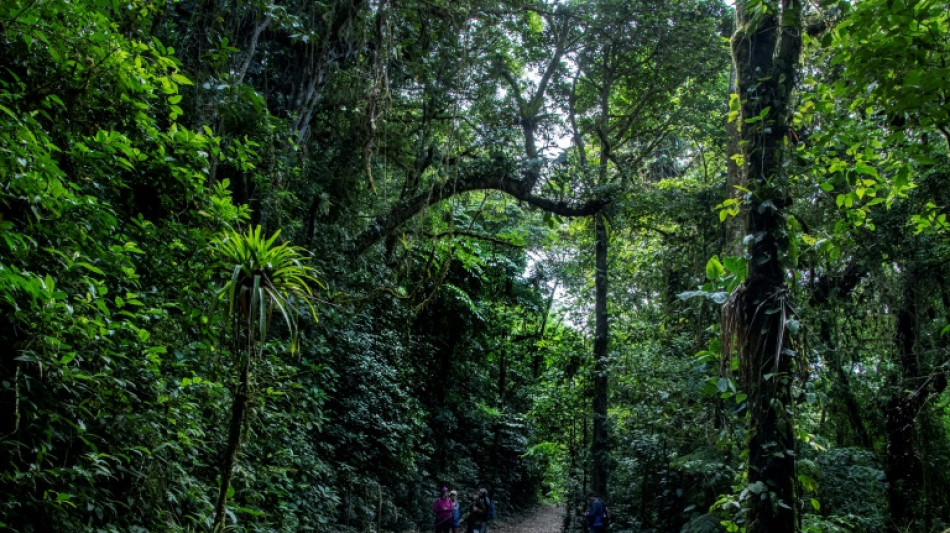
In Costa Rica, climate change threatens 'cloud forest' / Photo: © AFP

 Oil prices spike after Trump rejects Iran truce offer

 Taylor Swift sets new record at MTV VMAs
 Seoul seeks apology after Ukraine reveals transfer of North Korean POWs

 Messi on target again but Miami downed by Columbus

 In Washington's political cauldron, a fight over foie gras

 Flavio Bolsonaro: political heir in his father's shadow

 Ravens grab last-second win in Rio as Commanders stop Seahawks

 USA rallies to capture 11th consecutive Presidents Cup

 Phillies clinch, Astros wrap up division on final day of MLB season

 Commanders hand champion Seahawks their first loss

 Dupont scores twice to send Toulouse top of Top 14

 Ireland beat Israel but no handshakes due to war in Gaza

 Tense standoff over flashpoint N.Ireland parade lasts into night

 Stunned McNulty wins 'miracle' road race world title

 Re-released 'Avengers: Endgame' snaps-up N. America box office lead

 American McNulty wins shock road race world title

 Serbia's President Aleksandar Vucic announces resignation

 Tuchel urges Bellingham to play with 'rage'

 Russian strikes on Ukraine kill 8

 Bavuma, Miller hit centuries as South Africa clinch series

 Spain bring in Le Normand for injured Garcia

 UK Labour party meets buoyed by Burnham but seeking concrete plans

 Nor'easter lashes US east with punishing rain and wind

 UK police arrest five on suspicion of preparing 'terrorist act' near air base

 Washington denounces Iran's truce proposal as 'cynical'

The "cloud forest" of Monteverde, in the center of Costa Rica, will soon no longer be worthy of the name: climate change threatens this unique ecosystem, and its fauna and flora face an unclear future under a brilliant blue sky.
In the forest, what a visitor should hear is the constant drip of moisture falling from the trees. Instead, it is the sound of dead branches snapping underfoot that breaks the silence on the dry trails.
The high-altitude forest is still clinging to life, and it delights walkers with an infinite variety of greens under an uncomfortably bright sun: the fog which reigned supreme here only a short time ago dissipates as the temperature rises, explained 24-year-old forest guide Andrey Castrillo.
"The forest should be cool," he said. "You should hear the drops falling all over the forest, but that only happens during the wettest and windiest days of the rainy season."
"Here there was no sun... We had about 30 days of sunshine a year. Now we have more than 130," he said.
At 1,400 meters (4,600 feet) above sea level and 140 kilometers (86 miles) northwest of the capital San Jose, the private nature reserve extends over 14,200 hectares (35,000 acres) and is home to a hundred species of mammals, 440 bird species and 1,200 types of amphibians.
- 'Walking in the clouds' -
This exceptional type of altitude forest represents only one percent of the world's tropical and subtropical areas.
"Near-ground cloud cover forms when the humidity saturation is above 90 percent with temperatures between 14 and 18 degrees Celsius (57 to 64 degrees Fahrenheit)," researcher Ana Maria Duran, of the University of Costa Rica, told AFP.
The researcher said she had been coming here regularly for more than twenty years.
Normally, the "almost permanent" fog gives the impression of "practically walking in the middle of the clouds," with visibility down to barely a meter (three feet).
As she spoke, she stared into the forest where the temperature had risen to more than 25 degrees Celsius, under a blue sky where only a few clouds crowned the peaks.
"Coming to Monteverde to find such dry conditions and not being in the clouds like it was 20 years ago when I started coming is obviously very sad," said Duran.
Rising temperatures mean lower humidity and more sun. The mosses have dried on the tree trunks, the rivers are no more than streams, and the amphibians here have been the first victims of climate change.
"The decline of amphibians in cloud forests may serve as a wake-up call," warned biologist Andrea Vincent, who teaches at the University of Costa Rica.
Already, the species Incilius periglenes, known as the golden frog, has been considered extinct since 2019 by the International Union for Conservation of Nature (IUCN).
"A cloudless cloud forest, it will disappear, it has to," said Vincent, warning that "there will be a lot of extinctions" of various species.
But this "dispiriting scenario" can still be avoided, she said.
"Ecosystems are resilient. If we make efforts to stop climate change it is possible that cloud forests will recover... not during our lifetime but perhaps for the next generations".
C.Kovalenko--BTB