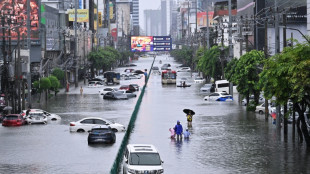
Climate change, El Nino drive hottest June on record / Photo: © AFP

 Nothing to seal here: NZ police help stranded pup home

 White House releases list of products US, China could tax less

 'Pseudo-journalism': Partisan 'news' sites target US midterms

 'Currently impossible': North Korea defections in freefall

 Erasmus sizes up 'improved' Wallabies ahead of 2027 World Cup

 Scandal-weary Brazilians to vote as Lula faces Bolsonaro son

 SpaceX aims to put Starship in orbit for the first time

 Pope to speak on united Europe from French border town

 Scheffler makes sportsmanship stand over tee screamer

 Anthropic CEO Amodei to dine with Trump at White House

 Dupont scores twice to send Toulouse to Top 14 summit

 Greece stun Klopp's Germany as Ireland show sorrow for Gaza

 Ramos fires holders Portugal to Nations League win in Norway

 Greece hand Klopp first defeat as Germany manager

 Pope promises French sex abuse victims to prevent further harm

 UK village on edge over threats to air base in terror alert

 Two giant pandas, emblems of China soft diplomacy, arrive in US

 Aleksandar Vucic: from Milosevic minister to long-serving Serbian statesman

 Trump expects new Iran talks despite rejecting deal offer

 Xavi gets first win as Netherlands boss, Denmark beat Wales

 Madrid housing protest camp enters second night as PM vows action

 Tigray TV station hit by drone, rebels advance in north Ethiopia

 Banton hundred paves way for England ODI series win over Sri Lanka

 Milestone man Kohli powers India to big ODI win over West Indies

 Swiss reject plan to toughen neutrality

The world saw its hottest June on record last month, the EU's climate monitoring service said Thursday, as climate change and the El Nino weather pattern looked likely to drive another scorching northern summer.
The announcement from the EU monitor Copernicus marked the latest in a series of records for a year that has already seen a drought in Spain and fierce heat waves in China and the United States.
"The month was the warmest June globally at just over 0.5 degrees Celsius above the 1991-2020 average, exceeding June 2019 -– the previous record -– by a substantial margin," the EU monitor said in a statement from its C3S climate unit.
Temperatures reached June records across northwest Europe while parts of Canada, the United States, Mexico, Asia and eastern Australia "were significantly warmer than normal", Copernicus noted.
On the other hand it was cooler than normal in western Australia, the western United States and western Russia, it said.
- 'Hottest day ever' -
It was the latest in a series of heat records over recent years, reflecting the impact of global warming driven by greenhouse gases released from human activity.
Preliminary readings published Wednesday by US meteorologists indicated Tuesday was the hottest day ever recorded, based on data from the US National Oceanic and Atmospheric Administration's National Centers for Environmental Prediction.
Copernicus noted that sea surface temperatures were higher globally than any previous June on record, with "extreme marine heatwaves" around Ireland, Britain and the Baltic.
Antarctic sea ice reached its lowest extent for June since satellite observations began, at 17 percent below average.
C3S scientist Julien Nicolas told AFP the June record was driven largely by "very warm ocean surface temperatures" in the Pacific and Atlantic due to El Nino, a periodic warming phenomenon.
"On top of that is this warming trend of the ocean absorbing 90 percent of heat released by human activity," he added.
The global temperature was 0.53 C above the 30-year average at an average of 16.51C (61.72F), he calculated.
"June 2023 is way above the others. This is the kind of anomaly we are not used to," Nicolas said.
Petteri Taalas, secretary-general of the UN's World Meteorological Organization, warned on Monday that El Nino "will greatly increase the likelihood of breaking temperature records and triggering more extreme heat in many parts of the world and in the ocean."
He urged governments "to mobilise preparations to limit the impacts on our health, our ecosystems and our economies."
- Heatwave deaths -
El Nino is a naturally occurring pattern associated with increased heat worldwide, as well as drought in some parts of the world and heavy rains elsewhere.
In addition, human activity –- mainly the burning of fossil fuels -– is continuing to emit roughly 40 billion tonnes of planet-warming CO2 into the atmosphere every year.
As well as withering crops, melting glaciers and raising the risk of wildfires, higher-than-normal temperatures also cause health problems ranging from heatstroke and dehydration to cardiovascular stress.
In the United States, local officials said last week that at least 13 people died from an extreme heat wave in Texas and Louisiana.
China issued its highest-level heat alert for northern parts of the country as Beijing baked in temperatures around 40 degrees Celsius (104 Fahrenheit).
After a record hot June in Britain, water use restrictions were imposed in parts of southeastern England, and Scotland put regions on water scarcity alert.
The world has warmed an average of nearly 1.2 C since the mid-1800s, unleashing extreme weather including more intense heatwaves, more severe droughts in some areas and storms made fiercer by rising seas.
S.Keller--BTB