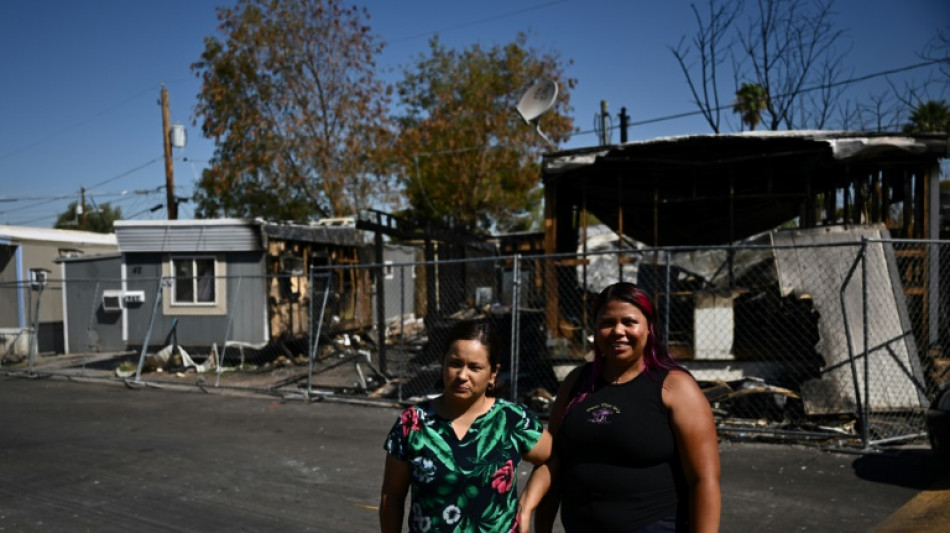
'As long as we have AC': Phoenix heat shows gap between US rich, poor / Photo: © AFP

 Nothing to seal here: NZ police help stranded pup home

 White House releases list of products US, China could tax less

 'Pseudo-journalism': Partisan 'news' sites target US midterms

 'Currently impossible': North Korea defections in freefall

 Erasmus sizes up 'improved' Wallabies ahead of 2027 World Cup

 Scandal-weary Brazilians to vote as Lula faces Bolsonaro son

 SpaceX aims to put Starship in orbit for the first time

 Pope to speak on united Europe from French border town

 Scheffler makes sportsmanship stand over tee screamer

 Anthropic CEO Amodei to dine with Trump at White House

 Dupont scores twice to send Toulouse to Top 14 summit

 Greece stun Klopp's Germany as Ireland show sorrow for Gaza

 Ramos fires holders Portugal to Nations League win in Norway

 Greece hand Klopp first defeat as Germany manager

 Pope promises French sex abuse victims to prevent further harm

 UK village on edge over threats to air base in terror alert

 Two giant pandas, emblems of China soft diplomacy, arrive in US

 Aleksandar Vucic: from Milosevic minister to long-serving Serbian statesman

 Trump expects new Iran talks despite rejecting deal offer

 Xavi gets first win as Netherlands boss, Denmark beat Wales

 Madrid housing protest camp enters second night as PM vows action

 Tigray TV station hit by drone, rebels advance in north Ethiopia

 Banton hundred paves way for England ODI series win over Sri Lanka

 Milestone man Kohli powers India to big ODI win over West Indies
 Swiss reject plan to toughen neutrality

Melanie Floyd took her kids to the zoo in Phoenix in the morning, when temperatures in the heat wave roasting the city and much of the US southwest were still bearable.
Standing before a turtle exhibit, she downplayed this extreme weather event in a world grappling with climate change.
"As long as we have AC and as long as everyone is making smart choices," this stay-at-home mother aged 32 told AFP, "staying hydrated, going in the shade, staying cool, not overexerting themselves, I think it's tolerable."
At her home it is, indeed, nice and cool. She keeps the air conditioning between 75 and 78 degrees Fahrenheit (23 and 26 degrees Celsius) so she can look after her kids, aged two and six, comfortably as they play with coloring books and crafts.
Outside, day after day for more than three weeks, the temperature in Phoenix is surpassing a hard-to-fathom 110F.
The heatwave affecting much of the southwest and southern United States -- including the record temperatures in Phoenix -- is igniting debate on how fast global warming is moving.
For Floyd, this particular weather event is no big deal.
"You have to fluctuate as the weather fluctuates, so you have to be flexible with it," Floyd said.
In this desert city many people that spoke to AFP expressed similar views about the rising frequency of brutally dangerous heat as global warming caused by human activity grinds on: One must learn to live with it.
- Living without AC -
For many of them life is a series of mad dashes from offices to restaurants to shops, all with air conditioning cranked up good and frosty.
In the city center and well-to-do suburbs, people do not think twice about leaving their car running while they get out to do an errand, so as to keep it cool for when they come back.
But in less wealthy areas, heat like this is another thing altogether.
"If the temperatures go on like this, many people will not be able to cope," said Rosalia Licea, 37, who is raising five kids on her own.
She lives in a mobile home park where most of the trailers are from the 1950s. Early in this heat wave her air conditioning broke down.
For two days the temperature inside their mobile home hit 97F. The whole family had to take refuge in the room of the eldest child, which had a window AC unit. One of the smaller kids started having headaches.
Licea, who hails from Mexico, works several low-paying jobs to make ends meet. She does not have the $2,000 it would cost to buy a new AC system.
So she came up with a makeshift solution: spend $800 to fix the broken one.
"I had no choice, what with my kids," she said. "It was the priority, more than buying groceries or paying my rent."
Even with the new motor in the old AC unit, one of the air conduits is broken so the cold does not reach her living room. That is something else she will have to pay to have fixed.
- AC going full blast -
Licea tried but failed to qualify for aid offered by the city or some utility companies for people to upgrade their air conditioning units.
A study in 2022 by Arizona State University found that while mobile homes make up five percent of all housing in Maricopa County, which includes Phoenix and its suburbs, they account for 30 percent of indoor heat-related deaths in the city.
"It is easy to say 'we can adapt' when you have access to everything," Licea said. "It is different for us."
A fire broke out some days ago at her mobile home park, where the residences are hooked up directly to electrical pylons through shoddy connections.
One mobile home was destroyed. The fire is believed to have started because of an electrical overload, with washing machines, dryers, fridges and full-blast air conditioning all operating at once.
After 19 years in Arizona, Licea lives in fear of an electrical short circuit. So she mainly prepares salads for meals and tries to avoid turning on the lights to keep her electricity consumption, and the temperature, as low as possible.
"If I could move to a state that is not so hot I would do it," Licea said.
L.Janezki--BTB