Brazil drought lights a fire under global coffee prices / Photo: © AFP

 Trump admin finalizes reversal of US fuel economy standards

 US says no China arms sale plans after envoy cites Trump offer

 Dozens kidnapped in two weekend attacks in northern Nigeria

 Next stop the world: Pathirage wins Asian Games javelin gold

 Aster Launches Perpetual Grid Trading 2.0 with Up to 140,000 $ASTER Liquidity Mining Campaign

 Seoul says North Korean mines 'highly suspected' as cause of DMZ blast

 Russia pummels Kyiv in latest deadly daytime attack

 Wartime Ukraine works to keep its railways on track

 Boy among 3 dead in migrant Channel crossing accident: French authorities

 SGFX Creates a Standout Brand Experience at Forex Expo Dubai 2026

 Pope urges Europe to help combat 'deceit and lies' in international ties

 Injured Buttler to miss England ODI series in Pakistan
 Madrid housing protesters vow to maintain pressure on government

 In kayaks or waist-deep in floodwater, shoppers return to Bangkok markets

 UK police probes Iran link to air base bomb scare: media

 Eala blasts into Asian Games quarters in just 55 minutes

 Taiwan gender-row boxer Lin Yu-ting guarantees Asian Games medal

 Comedian on trial for allegedly insulting Erdogan in standup show

 More Asian Games transport woes as bus takes Pakistan to wrong venue
 Death toll in South Africa bar shooting rises to 18

 Aide to Venezuelan opposition leader returns from exile

 Messi and Alcaraz love it, now padel takes step closer to Olympics
 Tolls mount in Thailand, Myanmar floods
 Why India's opposition wants top poll official out

 PU Prime Strengthens UAE Momentum with Strong Showing at Forex Expo Dubai 2026

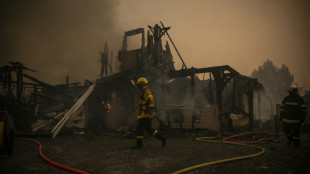
Brazilian coffee producer Moacir Donizetti first smelled the smoke, and then watched in desperation as a blaze consumed his family coffee plantation last year.
The 54-year-old was one of hundreds of farmers hit by a brutal forest fire in Sao Paulo state, where years of soaring heat and erratic rains are set to drive up the cost of an espresso or latte far afield in Paris, New York or Tokyo.
Brazil, the world's largest coffee producer and exporter, experienced its hottest year on record in 2024 and a record number of forest fires.
Locals in the municipality of Caconde believe the fire broke out due to uncontrolled burning of garbage, but experts attribute its scale to drought conditions exacerbated by climate change.
"It was desperate: seeing the flames advance, destroying our plantation, coming within twenty meters of my house," said Donizetti.
His family fought the fire for four days on the remote farm in the mountains of the Atlantic Forest, losing five hectares (12 acres) of coffee -- a third of the family's production area.
Standing alongside scorched and blackened coffee crops, he estimates his land will take three or four years to produce again.
The loss is compounded by several years of unpredictable weather and disappointing harvests in Brazil.
"For about five years it has been too dry, sometimes it doesn't rain for months," said Donizetti. "It has also gotten a lot hotter, it is unbearable."
- Invest more to produce less -
In 2024, Brazil was responsible for more than a third of global coffee production.
A poor harvest in the Latin American giant significantly impacts international prices.
Arabica coffee, the most popular variety, in December reached its highest price since 1977, listed at $3.48 per pound on the New York Stock Exchange.
"I have been working in coffee for 35 years and I have never seen a situation as difficult as the current one," said Brazilian coffee grower and consultant Guy Carvalho.
"High temperatures and irregular rainfall force us to invest more to produce the same, or even less, than we did in the past," he added.
"After the last big harvest, in 2020, we have always had some weather problem."
Carvalho said that the high prices were largely explained by "frustration" over disappointing harvests between 2021 and 2024, and bleak forecasts for 2025.
Geopolitical factors such as potential US tariffs and future European Union regulation on deforestation also contributed to the higher prices.
- Adapting to changing climate -
Some Brazilian coffee producers are adopting new strategies to adapt to the increasingly unpredictable climate.
In Divinolandia, another small coffee-growing town in Sao Paulo state, producer Sergio Lange has turned to shade-grown coffee -- an ancient technique used in places like Ethiopia, the birthplace of coffee.
Planting coffee shrubs under the shade of trees protects the plants from excessive heat and allows them to ripen more slowly, producing a larger, sweeter bean with a higher market value.
Lange and 50 other colleagues have been applying a "regenerative coffee growing model" since 2022, in which the crop is planted alongside other species, grown without pesticides, and relies on a natural water source from the mountains.
"At first, productivity falls, but we expect fantastic results in four or five years," he said.
He pointed to climate change as having a "severe" impact on coffee production.
"Producers who fail to adapt will struggle to stay in business," he warned.
S.Keller--BTB