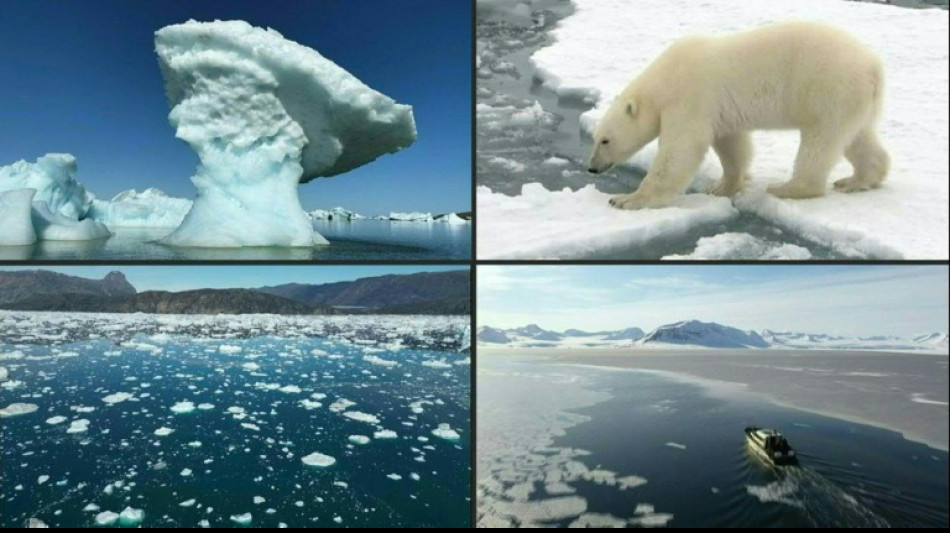
Arctic sea ice levels second lowest on record for January: US data / Photo: © AFP

 Trump admin finalizes reversal of US fuel economy standards

 US says no China arms sale plans after envoy cites Trump offer

 Dozens kidnapped in two weekend attacks in northern Nigeria

 Next stop the world: Pathirage wins Asian Games javelin gold

 Aster Launches Perpetual Grid Trading 2.0 with Up to 140,000 $ASTER Liquidity Mining Campaign

 Seoul says North Korean mines 'highly suspected' as cause of DMZ blast

 Russia pummels Kyiv in latest deadly daytime attack

 Wartime Ukraine works to keep its railways on track

 Boy among 3 dead in migrant Channel crossing accident: French authorities

 SGFX Creates a Standout Brand Experience at Forex Expo Dubai 2026

 Pope urges Europe to help combat 'deceit and lies' in international ties

 Injured Buttler to miss England ODI series in Pakistan
 Madrid housing protesters vow to maintain pressure on government

 In kayaks or waist-deep in floodwater, shoppers return to Bangkok markets

 UK police probes Iran link to air base bomb scare: media

 Eala blasts into Asian Games quarters in just 55 minutes

 Taiwan gender-row boxer Lin Yu-ting guarantees Asian Games medal

 Comedian on trial for allegedly insulting Erdogan in standup show

 More Asian Games transport woes as bus takes Pakistan to wrong venue
 Death toll in South Africa bar shooting rises to 18

 Aide to Venezuelan opposition leader returns from exile

 Messi and Alcaraz love it, now padel takes step closer to Olympics

 Tolls mount in Thailand, Myanmar floods

 Why India's opposition wants top poll official out

 PU Prime Strengthens UAE Momentum with Strong Showing at Forex Expo Dubai 2026

Both the North and South Pole regions have warmed by some three degrees Celsius compared to late 19th-century levels, much faster than the global average.
The US National Snow and Ice Data Center (NSIDC) said the Arctic sea ice surface area was at a record low in December and continued near record lows in during January. It said the surface in January averaged 13.13 million square kilometers (5.07 million square miles).
"In contrast to the cold conditions dominating the contiguous United States, much of the Arctic experienced above-average January temperatures," the NSIDC said.
This was particularly marked north of Greenland and over central Alaska, the report said, with temperatures as much as eight degrees Celsius (14 degrees Fahrenheit) above average for the month.
Greenland is located between the United States and Europe in a region of increasing strategic value as the melting of Arctic sea ice opens up new shipping routes.
President Donald Trump has signalled that he wants the Arctic island -- which is believed to hold large untapped mineral and oil reserves -- to become part of the United States.
Last year annual surface air temperatures in the Arctic were the second-warmest on record, according to the US National Oceanic and Atmospheric Administration.
Rising temperatures melt sea ice which in turn contributes to accelerated warming in the region, as dark sea water absorbs more solar radiation and thus helps to heat up the atmosphere, which then further accelerates the melting of the ice.
In a 2023 study, researchers found that the Arctic Ocean's ice cap would likely disappear in summer as soon as the 2030s and a decade earlier than thought, no matter how aggressively humanity draws down the carbon pollution that drives global warming.
The retreating ice also has a major impact on polar bears, which need sea ice to hunt.
A study published in the journal Science last week found that around half of the decline in Canada's Hudson Bay polar bears from 1979 to 2021 was due to climate-driven sea ice loss.
J.Horn--BTB