Arid Athens turns to ancient aqueduct as climate crisis bites / Photo: © AFP

 Trump admin finalizes reversal of US fuel economy standards

 US says no China arms sale plans after envoy cites Trump offer

 Dozens kidnapped in two weekend attacks in northern Nigeria

 Next stop the world: Pathirage wins Asian Games javelin gold

 Aster Launches Perpetual Grid Trading 2.0 with Up to 140,000 $ASTER Liquidity Mining Campaign

 Seoul says North Korean mines 'highly suspected' as cause of DMZ blast

 Russia pummels Kyiv in latest deadly daytime attack

 Wartime Ukraine works to keep its railways on track

 Boy among 3 dead in migrant Channel crossing accident: French authorities

 SGFX Creates a Standout Brand Experience at Forex Expo Dubai 2026

 Pope urges Europe to help combat 'deceit and lies' in international ties

 Injured Buttler to miss England ODI series in Pakistan
 Madrid housing protesters vow to maintain pressure on government

 In kayaks or waist-deep in floodwater, shoppers return to Bangkok markets

 UK police probes Iran link to air base bomb scare: media

 Eala blasts into Asian Games quarters in just 55 minutes

 Taiwan gender-row boxer Lin Yu-ting guarantees Asian Games medal

 Comedian on trial for allegedly insulting Erdogan in standup show

 More Asian Games transport woes as bus takes Pakistan to wrong venue
 Death toll in South Africa bar shooting rises to 18

 Aide to Venezuelan opposition leader returns from exile

 Messi and Alcaraz love it, now padel takes step closer to Olympics

 Tolls mount in Thailand, Myanmar floods

 Why India's opposition wants top poll official out

 PU Prime Strengthens UAE Momentum with Strong Showing at Forex Expo Dubai 2026

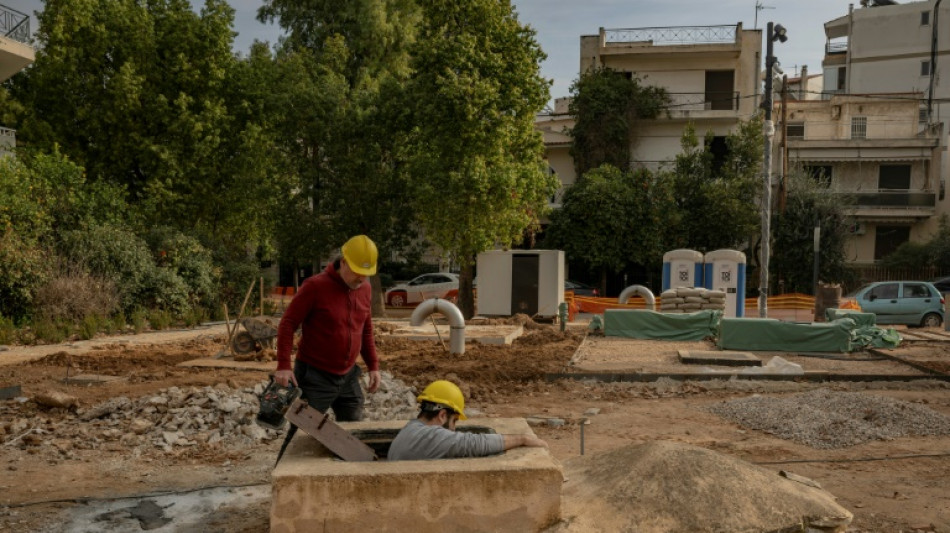
Between parked cars in a suburban street in Athens, workers fix a pump to an ancient stone well that in turn accesses an aqueduct built almost 2,000 years ago.
The Greek capital, one of Europe's hottest and most densely populated cities, is going to great lengths -- and depths -- to battle soaring summer temperatures and creaking infrastructure.
Officials are tapping European Union money to help restore access to Hadrian's Aqueduct, a 24-kilometre (15-mile) underground channel named after the Roman emperor who funded its construction in the year 140.
It is hailed by experts as an "engineering marvel".
Last year, public utility company Eydap repeatedly warned Athenians they needed to save drinking water as reserves shrank.
Eydap's Katerina Apostolopoulou, who manages the project in the Chalandri suburb, around 10 kilometres from central Athens, said the water would not be of drinking quality and instead would be used "to clean or to irrigate parks and gardens" in summer.
She pointed out that Athenians would normally need to use the drinking water network for their gardens and parks, so she hoped the new pump would help save the valuable resource.
- War shelter -
The aqueduct, which begins at the foot of Mount Parnitha, is fed by an aquifer, explained geologist Yannis Dafnos.
A gentle slope from the mountain helps the water flow down naturally into the city centre.
The Chalandri well is more than 20 metres deep and part of a network of 300 ancient wells, Dafnos said as he lifted the heavy iron cover.
George Sachinis, Eydap's director of strategy and innovation, called the aqueduct an "archaeological and engineering marvel".
He urged planners to use it to create more green spaces in a city hit hard by the climate crisis.
"It is one of the most important ancient aqueducts in Europe," he said.
The aqueduct helped supply the city for hundreds of years but fell into disuse after the Roman era.
Athenians began to reuse it at the end of the 19th century but it was abandoned again after two dams were constructed near the city.
During the Nazi occupation (1941-1944) and then the ensuing Greek civil war, one of the Chalandri wells that it is now dry was used as a shelter, said Christos Giovanopoulos, who heads Cultural Hidrant, a heritage management project at Chalandri town hall.
The restoration project is part of "the promotion of sustainable development in Athens", he said, adding that water was often wasted.
- 'Collaborates with nature' -
He said the Chalandri project aimed to promote green spaces and improve the microclimate through water recycling, while highlighting the archaeological and cultural importance of the entire monument.
A few years ago, Chalandri residents had to zigzag to avoid the well, which at the time was located in the middle of the street, Giovanopoulos said.
Now, the northern Athens suburb will be the first of eight municipalities in the Athens region to benefit from the reuse of the aqueduct's water.
An adjacent dry well has been fitted with a ladder to allow visitors to descend and view parts of the ancient conduit.
The aqueduct eventually reaches the centre of Athens at the foot of Lycabettus Hill, once the site of a Roman reservoir.
Only a few parts of the original reservoir construction remain. The existing structure with stone columns and arches is largely a reconstruction from the nineteenth century.
At the very bottom, in the ancient canal, "a few parts of the roof built by the Romans to prevent rocks from falling into the aqueduct remain", Sachinis said.
"It is an elegant piece of infrastructure that respects and collaborates perfectly with nature," he said.
"Thanks to this aqueduct, there are plans to create more green space around the original reservoir", he added.
F.Müller--BTB