Melting ice could slow vital Antarctic ocean current: study / Photo: © AFP

 Trump admin finalizes reversal of US fuel economy standards

 US says no China arms sale plans after envoy cites Trump offer

 Dozens kidnapped in two weekend attacks in northern Nigeria

 Next stop the world: Pathirage wins Asian Games javelin gold

 Aster Launches Perpetual Grid Trading 2.0 with Up to 140,000 $ASTER Liquidity Mining Campaign
 Seoul says North Korean mines 'highly suspected' as cause of DMZ blast

 Russia pummels Kyiv in latest deadly daytime attack

 Wartime Ukraine works to keep its railways on track

 Boy among 3 dead in migrant Channel crossing accident: French authorities

 SGFX Creates a Standout Brand Experience at Forex Expo Dubai 2026

 Pope urges Europe to help combat 'deceit and lies' in international ties

 Injured Buttler to miss England ODI series in Pakistan
 Madrid housing protesters vow to maintain pressure on government

 In kayaks or waist-deep in floodwater, shoppers return to Bangkok markets

 UK police probes Iran link to air base bomb scare: media

 Eala blasts into Asian Games quarters in just 55 minutes

 Taiwan gender-row boxer Lin Yu-ting guarantees Asian Games medal

 Comedian on trial for allegedly insulting Erdogan in standup show

 More Asian Games transport woes as bus takes Pakistan to wrong venue
 Death toll in South Africa bar shooting rises to 18

 Aide to Venezuelan opposition leader returns from exile

 Messi and Alcaraz love it, now padel takes step closer to Olympics

 Tolls mount in Thailand, Myanmar floods

 Why India's opposition wants top poll official out

 PU Prime Strengthens UAE Momentum with Strong Showing at Forex Expo Dubai 2026

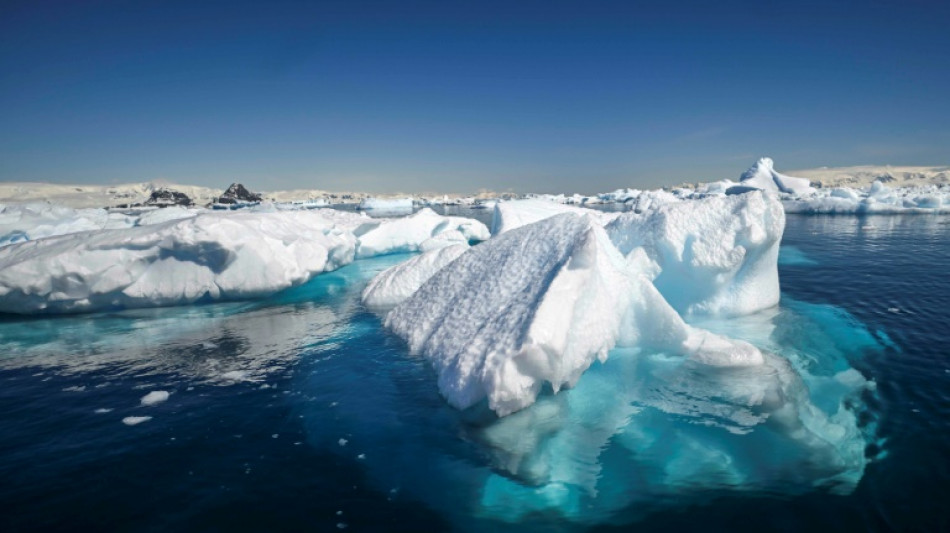
The world's strongest ocean current could slow as melting Antarctic ice sheets flood it with fresh water, according to research published on Monday that warned of "severe" climate consequences.
Scientists used one of Australia's most powerful supercomputers to model how melting ice sheets might change the Antarctic Circumpolar Current, which plays a major role in global climate patterns.
If fossil fuel emissions increased over the next 25 years -- a so-called high emissions scenario -- the current could slow by around 20 percent, the peer-reviewed research found.
"The ocean is extremely complex and finely balanced," said University of Melbourne scientist Bishakhdatta Gayen.
"If this current 'engine' breaks down, there could be severe consequences, including more climate variability -- with greater extremes in certain regions, and accelerated global warming due to a reduction in the ocean's capacity to act as a carbon sink."
The Antarctic Circumpolar Current acted as a kind of "ocean conveyor belt" shifting immense columns of water through the Indian, Atlantic and Pacific Oceans, Gayen said.
Melting ice sheets would "dump vast quantities of fresh water" into the current, the modelling found.
This would change the ocean's salt content, making it harder for cold water to circulate between the surface and the depths.
Oceans play vital roles as climate regulators and carbon sinks.
Cooler waters can absorb greater amounts of heat from the atmosphere.
The strength of the current -- which flows clockwise around Antarctica -- also acts as a barrier that stops invasive species washing up on the continent's shores.
Algae and molluscs could more easily colonise Antarctica if the current slowed down, the researchers wrote.
Even if global warming was limited to a threshold of 1.5 degrees Celsius, the Antarctic current could still slow down.
"The 2015 Paris Agreement aimed to limit global warming to 1.5 degrees Celsius above pre-industrial levels," said climate scientist and co-author Taimoor Sohail.
"Many scientists agree that we have already reached this 1.5 degree target, and it is likely to get hotter, with flow-on impacts on Antarctic ice melting."
The research team, which included scientists from Australia, India and Norway, noted that their findings contrasted with previous studies that observed the current speeding up.
They said further observation and modelling was needed to understand how the "poorly observed region" was responding to climate change.
The research was published in the Environmental Research Letters journal.
L.Janezki--BTB