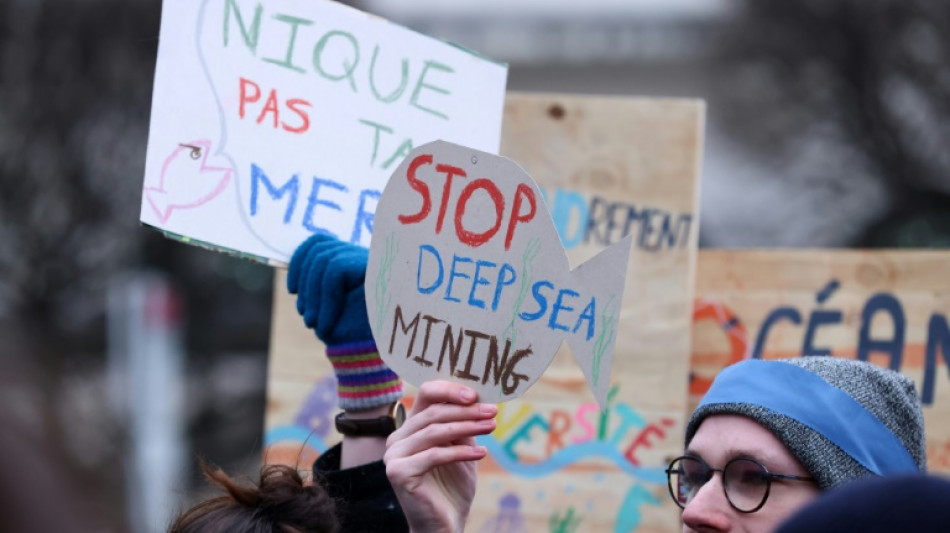
'Sound science' must guide deep-sea mining: top official / Photo: © AFP/File

 SpaceX puts Starship megarocket in orbit for first time
 Iran denies link to suspected bomb plot at UK airbase used by US

 Ex-boss Mancini says City charges 'not my concern'

 Berlin Marathon winner Assefa finished race with torn Achilles

 Comedian convicted for Erdogan 'insult' but freed pending appeal

 French prosecutors seek two-year sentence for ex-minister Dati in graft case

 Eala makes fast start as weather and transport woes hit Asian Games

 Hurricane Polo approaches Mexico, threatens severe damage

 Energy markets rally after Trump rejects Iran truce offer

 Japanese convenience store enlists Lady Gaga to bolster recruitment

 Seoul summons Ukraine envoy in row over North Korean POWs

 Ireland 'raised awareness worldwide' in Israel game: Hallgrimsson

 Colombian police capture wife, daughter of Ecuador drug lord

 More Asian Games woes as bus takes Pakistan team to wrong venue

 Radio frequencies vital to Earth observation must be protected: UN

 Comedian on trial for insulting Erdogan in standup show

 Women's Fashion Week kicks off in Paris

 Pope arrives in French border city to speak on united Europe

 The wildfires choking Indonesia, sparking regional haze

 PU Prime Deepens Argentina Presence Through FX Expo Buenos Aires 2026

 Nothing to seal here: NZ police help stranded pup home

 White House releases list of products US, China could tax less

 'Pseudo-journalism': Partisan 'news' sites target US midterms

 'Currently impossible': North Korea defections in freefall

 Erasmus sizes up 'improved' Wallabies ahead of 2027 World Cup

Rules on deep-sea mining in international waters must be driven by "sound science" and built on consensus, the head of the body charged with regulating the divisive practice said Thursday.
Deep-sea mining in international waters involves taking minerals like nickel, cobalt and copper -- crucial for renewable energy technology -- from the sea floor.
But researchers and environmentalists have long warned it risks destroying habitats and species that are little understood, and could upset delicate processes in the ocean that affect climate change.
The seabed in international waters is governed by the International Seabed Authority (ISA), an independent body established under the UN Convention on the Law of the Sea.
The ISA's Council, which for now only grants exploration contracts, has been drawing up commercial exploitation rules for more than a decade. And they aim to adopt a mining code this year to govern the extraction of seabed resources in international waters.
The issue is highly contentious, with some member states keen to begin mining soon, while others want a moratorium or even an outright ban on seabed exploitation.
ISA Secretary-General Leticia Carvalho said any mining code developed this year must be driven by "transparency, environmental responsibility and equitable benefit-sharing".
"Sound science must underpin all decisions related to the deep seabed," she told an ocean meeting in Tokyo by video link.
The world paid little attention when the ISA, created in 1994, quietly began negotiating the mining code.
But the calendar has taken on urgency.
- Thorny questions -
Since July 2023, due to a legal clause invoked by the tiny Pacific island nation of Nauru, any country can apply for a mining contract in the name of a company it sponsors.
Nauru Ocean Resources Inc. (NORI), a subsidiary of Canada's The Metals Company (TMC), wants to begin mining polymetallic nodules in the Pacific as soon as 2026.
It plans to file an exploitation application by June this year, making the need for a code governing mining all the more pressing.
Thorny issues have yet to be resolved, including environmental rules and how to share profits from seabed resources dubbed a "common heritage of mankind."
An oceanographer by training, Carvalho can only guide member states as they decide whether and how to draft a code.
She said she would focus on "ensuring that decisions are grounded in science and built on consensus".
Warnings about the impact of mining gained strength with the discovery last year that oxygen was being released on the ocean floor not just by living organisms, but by polymetallic nodules that would be targeted by companies.
The findings have been rejected by the TMC, even though it helped fund the research, and follow-up work is ongoing.
Mining proponents point to the growing need for minerals to drive the renewable energy transition, and the problems associated with on-land exploitation -- including environmental degradation and rights abuses.
T.Bondarenko--BTB