Sunny Greece struggles with solar energy overload / Photo: © AFP

 Pope urges Europe to help combat 'deceit and lies' in international ties

 Injured Buttler to miss England ODI series in Pakistan
 Madrid housing protesters vow to maintain pressure on government

 In kayaks or waist-deep in floodwater, shoppers return to Bangkok markets

 UK police probes Iran link to air base bomb scare: media
 Eala blasts into Asian Games quarters in just 55 minutes
 Taiwan gender-row boxer Lin Yu-ting guarantees Asian Games medal
 Comedian on trial for allegedly insulting Erdogan in standup show

 More Asian Games transport woes as bus takes Pakistan to wrong venue
 Death toll in South Africa bar shooting rises to 18
 Aide to Venezuelan opposition leader returns from exile

 Messi and Alcaraz love it, now padel takes step closer to Olympics

 Tolls mount in Thailand, Myanmar floods

 Why India's opposition wants top poll official out

 PU Prime Strengthens UAE Momentum with Strong Showing at Forex Expo Dubai 2026
 Eight dead in Thailand floods since mid-September

 Oil prices spike after Trump rejects Iran truce offer

 Taylor Swift sets new record at MTV VMAs
 Seoul seeks apology after Ukraine reveals transfer of North Korean POWs

 Messi on target again but Miami downed by Columbus

 In Washington's political cauldron, a fight over foie gras
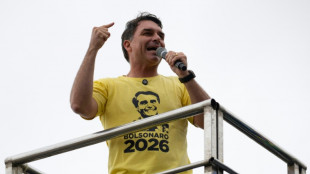 Flavio Bolsonaro: political heir in his father's shadow

 Ravens grab last-second win in Rio as Commanders stop Seahawks

 Scheffler makes sportsmanship stand over tee screamer

 Anthropic CEO Amodei to dine with Trump at White House

In a field in central Greece that once grew clover and corn, maintenance worker Nikos Zigomitros deftly drives a tractor between rows of solar panels, trimming weeds under a blazing sun.
"Letting them grow too high impairs the panel performance," the 52-year-old explains, wiping sweat from his brow.
Once a centre of agricultural production, the area around Kastron Viotias, some 110 kilometres (70 miles) northwest of Athens, has seen solar parks mushroom over the past 15 years, part of a major renewable energy push in the country.
Greece currently has 16 gigawatts of renewable energy installed, with solar power representing nearly 10 gigawatts, including 2.5 gigawatts that came on line last year.
The rapid growth of solar is similar to other countries in Europe, where it has overtaken coal for electricity production, according to climate think tank Ember.
It estimates renewables have risen to account for nearly half of the EU's electricity production.
Greece did even better: 55 percent of annual consumption was covered by renewables last year, with solar accounting for around 23 percent, according to SPEF, an association which unites local solar power producers.
In 2023, Prime Minister Kyriakos Mitsotakis predicted that Greece would "soon generate 80 percent of its electricity needs through renewables."
But getting there is proving complicated.
SPEF chairman Stelios Loumakis said that the solar sector has hit a wall because of a combination of factors, including Greece's small size, limited infrastructure and delays in building up energy storage capacity.
- Saturated -
The Greek state approved too many photovoltaic projects over the last five years and the market is saturated, leading to a "severe production surplus" on sunny days, the 56-year-old chemical engineer and energy consultant said.
Greece's national grid operator in May repeatedly ordered thousands of medium-sized operators to shut down during the sunniest hours of the day to avoid overburdening the network and triggering a blackout.
"The trick is to balance supply and demand. If you don't do it well, you get a blackout," said Nikos Mantzaris, a senior policy analyst and partner at the independent civil organisation Green Tank.
In April, a huge blackout of unknown origin crippled the Iberian Peninsula. The Spanish government has said two major power fluctuations were recorded in the half-hour before the grid collapse, but the government insisted renewables were not to blame.
"It could be something as mundane as a faulty cable," Mantzaris said.
- Batteries 'crucial' -
To manage the surplus, Greece is building battery storage capacity. But catching up to its solar electricity production will take years.
"The next three years will be crucial," said Stelios Psomas, a policy advisor at HELAPCO, a trade association for Greek companies producing and installing solar panels.
In the meantime, solar panel operators will have to ensure production does not outstrip capacity, thereby limiting their potential earnings.
"Managing high shares of renewables -- especially solar -- requires significant flexibility and storage solutions," said Francesca Andreolli, a senior researcher at ECCO, a climate change think tank in Italy, which faces a similar problem.
"Battery capacity has become a structural necessity for the electricity system, by absorbing excess renewable energy and releasing it when demand rises," she told AFP.
- Farm income -
Mimis Tsakanikas, a 51-year-old farmer in Kastron, readily admits that solar has been good to his family.
The photovoltaic farm they built in 2012 at a cost of 210,000 euros clears at least 55,000 euros a year, far more than he could hope to earn by growing vegetables and watermelons.
"This park sustains my home," he said.
But the father of two also notes that the environmental balance has tipped in his area, with the spread of solar installations now causing concerns about the local microclimate.
Tsakanikas says the area has already experienced temperature rises of up to 4.0 degrees Celsius (7.2 Fahrenheit), which he blames on the abundance of heat-absorbing solar panel parks in the area.
"The microclimate has definitely changed, we haven't seen frost in two years," he told AFP.
"(At this rate) in five years, we'll be cultivating bananas here, like in Crete," he said.
C.Meier--BTB