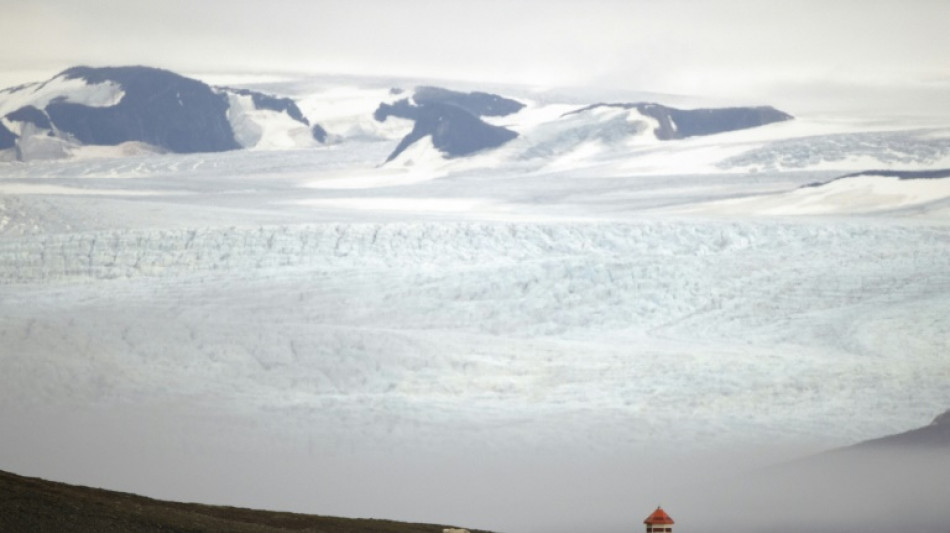
Arctic warming spurs growth of carbon-soaking peatlands / Photo: © AFP/File

 Pope urges Europe to help combat 'deceit and lies' in international ties

 Injured Buttler to miss England ODI series in Pakistan
 Madrid housing protesters vow to maintain pressure on government

 In kayaks or waist-deep in floodwater, shoppers return to Bangkok markets

 UK police probes Iran link to air base bomb scare: media

 Eala blasts into Asian Games quarters in just 55 minutes

 Taiwan gender-row boxer Lin Yu-ting guarantees Asian Games medal

 Comedian on trial for allegedly insulting Erdogan in standup show

 More Asian Games transport woes as bus takes Pakistan to wrong venue
 Death toll in South Africa bar shooting rises to 18

 Aide to Venezuelan opposition leader returns from exile

 Messi and Alcaraz love it, now padel takes step closer to Olympics

 Tolls mount in Thailand, Myanmar floods

 Why India's opposition wants top poll official out

 PU Prime Strengthens UAE Momentum with Strong Showing at Forex Expo Dubai 2026

 Eight dead in Thailand floods since mid-September

 Oil prices spike after Trump rejects Iran truce offer

 Taylor Swift sets new record at MTV VMAs
 Seoul seeks apology after Ukraine reveals transfer of North Korean POWs

 Messi on target again but Miami downed by Columbus

 In Washington's political cauldron, a fight over foie gras

 Flavio Bolsonaro: political heir in his father's shadow

 Ravens grab last-second win in Rio as Commanders stop Seahawks

 Scheffler makes sportsmanship stand over tee screamer

 Anthropic CEO Amodei to dine with Trump at White House

Arctic peatlands are expanding as the climate warms, new research showed Thursday, a change that could slow global heating in the near term but have the opposite effect in future.
Peatlands are the largest terrestrial store of carbon, locking away twice as much heat-trapping CO2 from the atmosphere in their waterlogged soils as all the world's forests.
These carbon-rich reservoirs, composed of partially decayed organic matter, only cover three percent of Earth's surface, and generally fade out in the far north where harsh weather limits plant growth.
But warmer temperatures caused by climate change have improved growing conditions for plants in the Arctic, and satellite data has shown a general "greening" of this frosty region.
Using drones, satellite imagery and on-the-ground observations, an international team of scientists assessed peatlands in the European and Canadian Arctic to see if they had benefited from warmer climes.
They found strong evidence that peatlands "have likely undergone lateral expansion over the last 40 years" in the Arctic, which is the fastest warming region on Earth.
"The permafrost thaws a little, provides a water source for vegetation, and surface vegetation recovers. In this study, we specifically see a lateral expansion," Michelle Garneau, a professor at the University of Quebec in Montreal, and co-author of the study, told AFP.
The most marked change was observed where summer temperatures have risen the most, such as in the Norwegian archipelago of Svalbard.
"All these new vegetated surfaces that didn't exist three decades ago are currently actively absorbing carbon," Garneau added.
This suggests Arctic peatlands "are an increasingly important natural carbon sink, at least in the near term", said study co-author Karen Anderson, a professor from the University of Exeter, which led the research.
But how they respond to climate change in future is "still highly uncertain", said the study published in the peer-reviewed journal Communications Earth and Environment.
Recent modelling suggests that northern peatlands "may become a carbon source from mid-century" as they dry out and permafrost thaws, the study said.
They are also at risk from wildfires, which release masses of stored up carbon at once.
"If temperatures continue to rise, we are likely to see changes in rainfall, and we are not sure how sustainable new or existing peatlands will be," said Anderson.
More peatlands also means more natural emissions of methane, a potent greenhouse gas far more effective at trapping heat than CO2.
"So while our study gives us some positive news, it does not detract from the urgent need to reduce greenhouse gas emissions and stabilise our climate," said Anderson.
P.Anderson--BTB