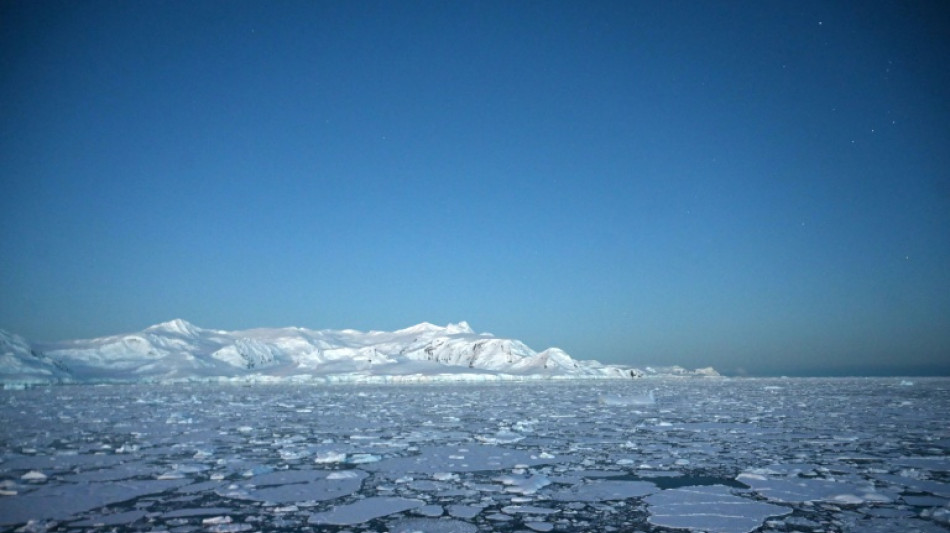
Antarctic sea ice improves after four years of extreme lows: US scientists / Photo: © AFP/File

 Commanders hand champion Seahawks their first loss

 Dupont scores twice to send Toulouse top of Top 14

 Ireland beat Israel but no handshakes due to war in Gaza

 Tense standoff over flashpoint N.Ireland parade lasts into night

 Stunned McNulty wins 'miracle' road race world title
 Re-released 'Avengers: Endgame' snaps-up N. America box office lead

 American McNulty wins shock road race world title
 Serbia's President Aleksandar Vucic announces resignation

 Tuchel urges Bellingham to play with 'rage'

 Russian strikes on Ukraine kill 8

 Bavuma, Miller hit centuries as South Africa clinch series
 Spain bring in Le Normand for injured Garcia

 UK Labour party meets buoyed by Burnham but seeking concrete plans

 Nor'easter lashes US east with punishing rain and wind
 UK police arrest five on suspicion of preparing 'terrorist act' near air base

 Washington denounces Iran's truce proposal as 'cynical'

 Armani sprinkles glitter on discreet elegance at Milan show

 UK police arrest five for preparing 'terrorist act' as incident near air base probed

 อเล็กซ์ โบดี และศาสตราจารย์ ดร. ดีเทอร์ ลาซิก ลงนามสัญญาสำหรับ ALPHA WHEY และ BODI เครื่องดื่มให้พลังงาน

 China teen blows away the field for record-setting gold at 'sad' Games

 Alex Bodi och prof. dr. Dieter Lazik tecknar avtal om ALPHA WHEY och BODI Energidryck

 Alex Bodi i prof. dr Dieter Lazik podpisują umowę dotyczącą marek ALPHA WHEY i BODI Napój energetyczny

 Ο Alex Bodi και ο καθηγητής Δρ. Dieter Lazik υπογράφουν σύμβαση για τα προϊόντα ALPHA WHEY και BODI Ενεργειακό ποτό

 アレックス・ボディ氏とディーター・ラジク教授が「ALPHA WHEY」および「BODI エナジードリンク」に関する契約を締結

 Housing protesters dig in for long stay in Madrid square

Antarctic sea ice coverage has likely rebounded this year, coming closer to its annual summer average after four years of extreme lows, US scientists said Monday.
The area covered by Antarctic sea ice likely reached its annual minimum level at 2.58 million square kilometres (996,000 square miles) on February 26, according to scientists at the National Snow and Ice Data Center (NSIDC) at the University of Colorado Boulder.
Every year Antarctic sea ice reaches a minimum level during the southern hemisphere's summer, so this is the point that scientists measure it for annual readings.
This year's level ranks as the 16th smallest since satellite measurements began in 1979.
The 2026 minimum sea ice extent is closer to average than in the past four years, and 730,000 square kilometres above the record low set in February 2023, the scientists said.
But it was still 260,000 square kilometres below the 1981-2010 average.
"Through most of the year, Antarctic sea ice was well below the daily average," said Ted Scambos, senior research scientist at the Cooperative Institute for Research in the Environmental Sciences (CIRES).
"Then in January and February, strong winds from the south pushed sea ice outward in the Weddell Sea. This slowed the overall decline in extent, leading to a near-average minimum," Scambos said.
The NSIDC cautioned that the 2026 figure is preliminary, noting that "continued melt conditions or strong onshore winds could still push the ice extent lower".
"This year's return to less extreme conditions is not unexpected given the large year-to-year variation of Antarctic sea ice seen in the satellite record," said Walt Meier, scientist at the NASA NSIDC Distributed Active Archive Center.
R.Adler--BTB