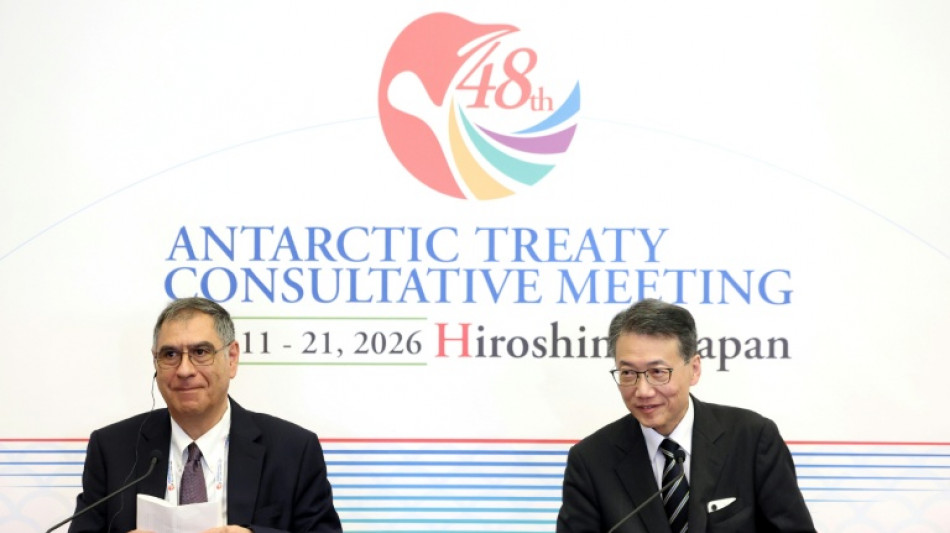
Antarctic talks in Japan: key things to know / Photo: © AFP

 Commanders hand champion Seahawks their first loss

 Dupont scores twice to send Toulouse top of Top 14

 Ireland beat Israel but no handshakes due to war in Gaza

 Tense standoff over flashpoint N.Ireland parade lasts into night

 Stunned McNulty wins 'miracle' road race world title

 Re-released 'Avengers: Endgame' snaps-up N. America box office lead

 American McNulty wins shock road race world title

 Serbia's President Aleksandar Vucic announces resignation

 Tuchel urges Bellingham to play with 'rage'

 Russian strikes on Ukraine kill 8

 Bavuma, Miller hit centuries as South Africa clinch series

 Spain bring in Le Normand for injured Garcia

 UK Labour party meets buoyed by Burnham but seeking concrete plans

 Nor'easter lashes US east with punishing rain and wind

 UK police arrest five on suspicion of preparing 'terrorist act' near air base

 Washington denounces Iran's truce proposal as 'cynical'

 Armani sprinkles glitter on discreet elegance at Milan show

 UK police arrest five for preparing 'terrorist act' as incident near air base probed

 อเล็กซ์ โบดี และศาสตราจารย์ ดร. ดีเทอร์ ลาซิก ลงนามสัญญาสำหรับ ALPHA WHEY และ BODI เครื่องดื่มให้พลังงาน

 China teen blows away the field for record-setting gold at 'sad' Games

 Alex Bodi och prof. dr. Dieter Lazik tecknar avtal om ALPHA WHEY och BODI Energidryck

 Alex Bodi i prof. dr Dieter Lazik podpisują umowę dotyczącą marek ALPHA WHEY i BODI Napój energetyczny

 Ο Alex Bodi και ο καθηγητής Δρ. Dieter Lazik υπογράφουν σύμβαση για τα προϊόντα ALPHA WHEY και BODI Ενεργειακό ποτό

 アレックス・ボディ氏とディーター・ラジク教授が「ALPHA WHEY」および「BODI エナジードリンク」に関する契約を締結

 Housing protesters dig in for long stay in Madrid square

Talks between Antarctic Treaty members began Tuesday in the Japanese city of Hiroshima, with a focus on the growing threats posed to the fragile region by climate change and tourism.
Here are the key things to know about the ice-covered continent and the challenges it faces:
- The Antarctic Treaty -
The Antarctic Treaty was signed in 1959 and designates the continent as a land of science and peace while freezing territorial claims.
The 14-million-square-kilometre region -- roughly twice the size of Australia -- holds around 90 percent of the world's fresh water.
There are nearly 60 signatories to the treaty and 29 of them operate scientific research from around 100 bases and facilities.
Signatories meet for discussions annually.
Some countries have a significant presence, such as the United States with seven facilities, Russia with 11, Argentina with 13 and Chile with 14, according to the Council of Managers of National Antarctic Programs.
But smaller countries including Belarus, Bulgaria and Ukraine also have a presence.
The balance of power in the South Pole is in increasing question at a time of geopolitical turmoil, including US President Donald Trump's Greenland ambitions, and as melting Arctic ice opens maritime trade routes on the planet's far north.
- Discussions and divisions -
Around 400 government officials and researchers from some 50 countries, including the US, China, Russia and Ukraine, will take part in the Hiroshima meeting, according to Jiji Press.
Key issues will be climate change and measures to deal with the growing environmental impact of rising tourism, according to Hideki Uyama of the foreign affairs ministry, who will chair the Antarctic Treaty Consultative Meeting.
Almost 120,000 visitors came to Antarctica in 2024-2025, and delegates will mull potential restrictions on areas or activities, as well as possible quotas.
Uyama told the Asahi Shimbun newspaper however that reaching consensus "is a difficult process".
"It appears divisions within the international community are being carried over into the Antarctic sphere," he added.
- Emperor penguins -
Conservation group WWF is urging the designation of emperor penguins as a specially protected species at the Hiroshima meeting.
The animal was declared an endangered species last month by the International Union for Conservation of Nature (IUCN).
Emperor penguins rely on stable sea ice -- essentially platforms of frozen ocean water -- to live, hunt and breed.
Their numbers have plummeted as warming driven by greenhouse gas emissions has caused sea ice to break up earlier in the year.
"With the shocking decline in Antarctic sea ice that we are currently witnessing, these icons on ice may well be heading down the slippery slope towards extinction by the end of this century unless we act now," WWF's chief advisor on polar and oceans Rod Downie said in a statement.
- Chinese ambitions -
China has been expanding its polar science capacity and is planning a sixth station in the continent following the 2024 opening of its fifth.
"China is not hiding its interest in Antarctica's natural resources" despite their inaccessibility, said Anna Wahlin, Swedish co-chair of the Scientific Committee on Antarctic Research.
"It's no secret: there are large maps showing natural resources, oil and gold when you visit their polar research secretariat," she said.
The timing of China's increased interest in Antarctica has coincided with the US's decision to withdraw from scientific research.
For the first time in six decades, the US does not have an icebreaker in the Southern Ocean after pulling out its final research ship due to budget cuts in 2025.
The pullback extends to global gatherings, said Yan Ropert-Coudert, researcher and former director of the French Polar Institute.
"Delegations to international meetings on the subject have been whittled down to a shadow of their former selves," he said.
H.Seidel--BTB